




- Trending
- Comments
- Latest

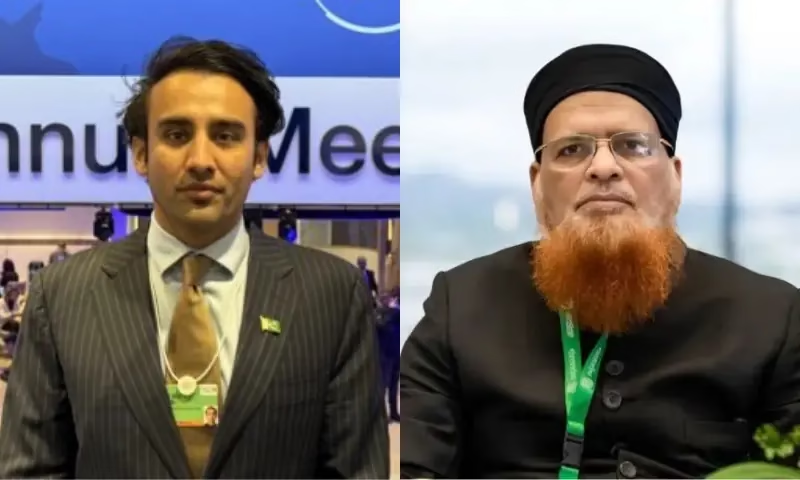
Bilal bin Saqib, chairman of Pakistan’s Virtual Assets Regulatory Authority (PVARA), met Islamic scholar Mufti Taqi Usmani on July 11 to discuss the Sharia status of cryptocurrencies, a week after Usmani’s fatwa declared crypto purchases impermissible under Islamic law.
The meeting comes as Pakistan crypto regulation advances under the country’s newly established legal framework, which requires licensed virtual assets to comply with Sharia principles. The discussion is particularly significant because an estimated 30 to 40 million Pakistanis already own cryptocurrencies, while the government is building a regulatory system that could shape the future of digital assets in the country.
Bilal bin Saqib described his July 11 meeting with Mufti Taqi Usmani as a “constructive discussion” focused on safeguarding citizens from financial risks while exploring how emerging blockchain technologies should be assessed.
“Constructive discussion,” — Bilal bin Saqib, Chairman, Pakistan Virtual Assets Regulatory Authority (PVARA).
Saqib said both parties shared the objective of protecting Pakistanis from “fraud, exploitation, and financial harm.”
“Fraud, exploitation, and financial harm.” — Bilal bin Saqib, Chairman, Pakistan Virtual Assets Regulatory Authority (PVARA).
While acknowledging the importance of Sharia compliance under Pakistan crypto regulation, Saqib argued that not all blockchain-based assets should be viewed through the same lens.
According to his statement on X, a blockchain network, a fiat-backed stablecoin, and a tokenized real-world asset each serve different functions and therefore require independent evaluation.
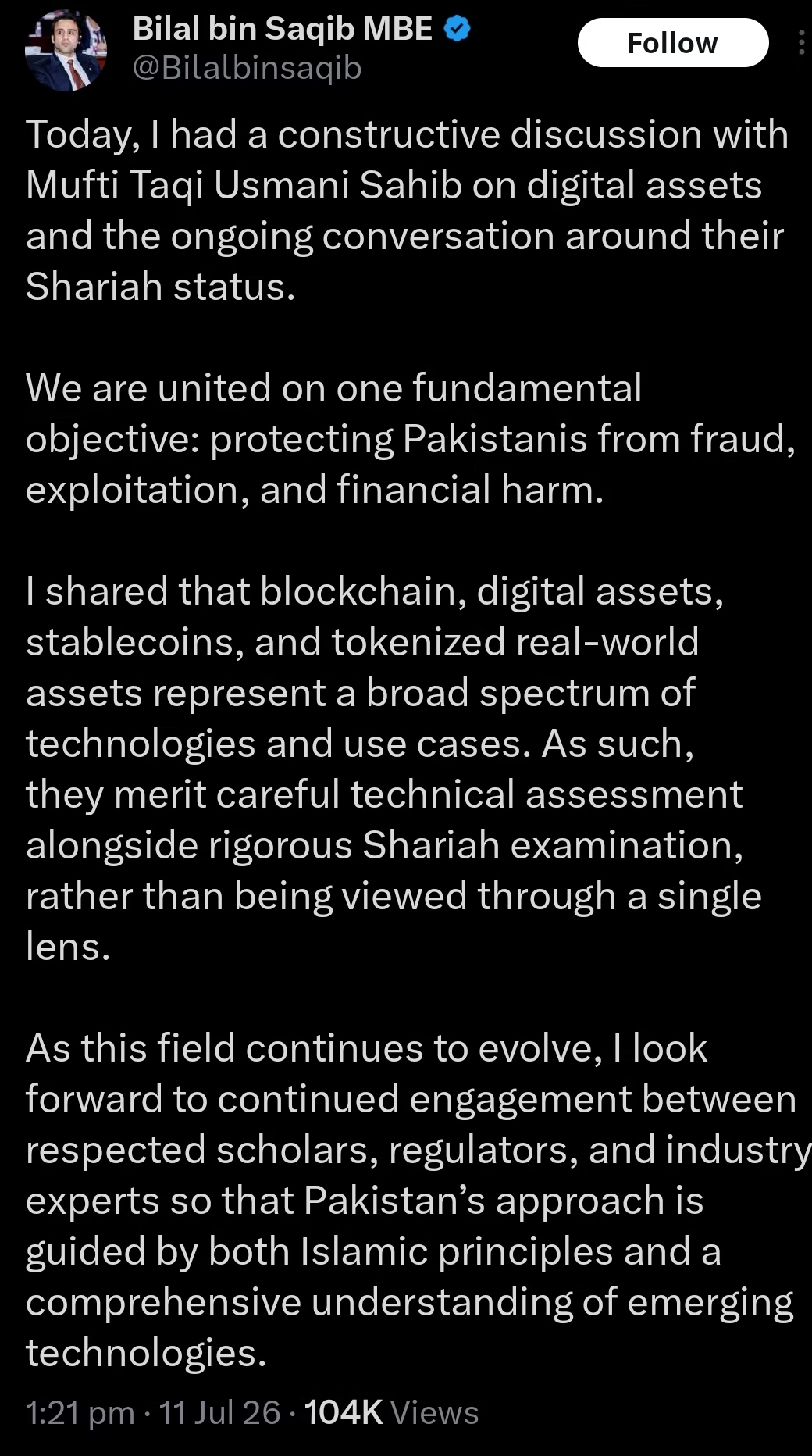
The regulator did not indicate that Usmani had changed or softened his views following the meeting. Instead, Saqib emphasized the need for continued dialogue between scholars, researchers, and regulators as Pakistan crypto regulation continues to evolve.
The discussion follows a fatwa issued on June 10 by Mufti Taqi Usmani and scholars affiliated with Darul Ifta at Jamia Darul Uloom Karachi. The ruling gained widespread attention after circulating publicly on Friday.
According to the fatwa, cryptocurrencies do not qualify as maal—the Islamic legal concept of wealth and are instead described as fictitious numerical entries in an account. The ruling specifically names USDT alongside other digital tokens, concluding that labeling an asset as a “virtual currency,” “token,” or “stablecoin” does not alter its religious status.
The scholars also addressed practical use cases beyond investment or speculation. They were asked about books and online courses purchased using cryptocurrency and concluded that such purchases were invalid because the buyer had not legally taken possession under Islamic law.
As a result, the ruling instructed buyers to return physical books and delete digital course materials rather than continue using or transferring them to others.
Although a fatwa does not carry the force of state law, Mufti Taqi Usmani is widely recognized as one of the world’s leading authorities on Islamic finance. His opinions are expected to carry significant weight among Pakistani Muslims and could influence public perception as Pakistan crypto regulation develops.
The debate comes only months after Pakistan’s parliament approved the Virtual Assets Act in March 2026, formally establishing PVARA as the country’s federal regulator for digital assets.
Under the legislation, PVARA is responsible for licensing cryptocurrency exchanges, custodians, wallet providers, and token issuers. Companies operating without regulatory approval face penalties of up to 50 million Pakistani rupees (approximately $179,000) and possible prison sentences, according to Cryptopolitan.
A defining feature of the framework is its requirement that licensed products undergo review by a committee of Islamic finance scholars before receiving Sharia approval.
This review process reflects the government’s effort to balance technological innovation with religious compliance, making Pakistan crypto regulation one of the few frameworks designed around both financial oversight and Islamic jurisprudence.
The central disagreement between regulators and religious scholars lies in whether blockchain-based assets should be evaluated individually or collectively.
Saqib has argued that a fiat-backed stablecoin or tokenized real-world asset differs fundamentally from speculative cryptocurrencies and therefore deserves its own technical and Sharia assessment. Under this approach, Pakistan crypto regulation could potentially approve certain blockchain products while rejecting others based on their structure, backing, and intended use.
However, the fatwa rejects that distinction by grouping stablecoins such as USDT with all other cryptocurrencies under the same prohibited category.
The outcome of this debate could significantly influence how Pakistan crypto regulation is implemented in practice. If regulators continue with case-by-case evaluations, some blockchain applications may still qualify for approval under the country’s licensing regime. If the broader interpretation reflected in the fatwa gains greater influence, the scope for Sharia-compliant digital assets could become considerably narrower.
For now, neither side has indicated a shift in position. Instead, the July 11 meeting highlights the ongoing dialogue between policymakers and religious scholars as Pakistan crypto regulation moves from legislation toward implementation.



Copyright © 2025 - The Bit Gazette.