



- Trending
- Comments
- Latest

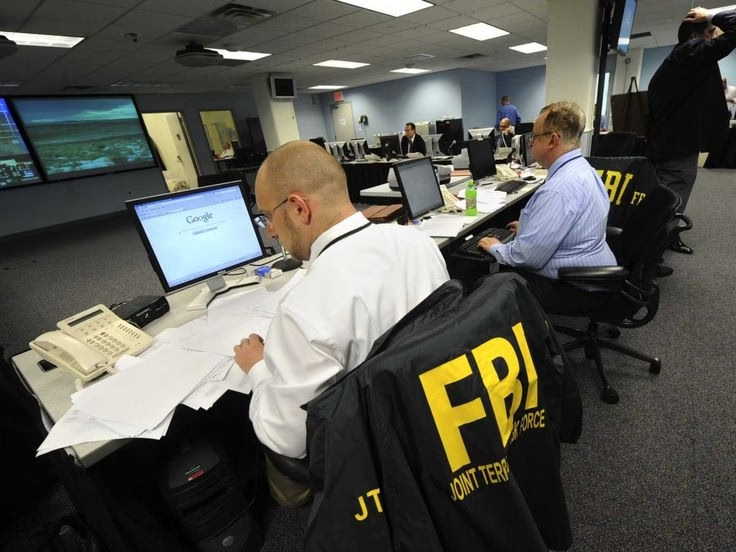
Americans reported more than $11.366 billion in cryptocurrency-related losses in 2025, according to the FBI’s Internet Crime Complaint Center, which logged 181,565 crypto-related complaints and said the figure made up over half of the $20.877 billion in total internet-crime losses the agency tracked last year.
A smaller but fast-growing slice of that damage ran through crypto kiosks: 13,460 complaints tied to the machines and $389 million lost, up 58% from 2024, with victims 60 and older accounting for $257.4 million of that total.
The report has pushed local governments to act. Spokane, Washington, banned all crypto ATMs within city limits after a unanimous council vote, with the ban taking effect in June 2025. Washington, DC’s attorney general has separately sued Athena Bitcoin over allegations that the vast majority of its early transactions were tied to fraud.
The IC3’s 2025 Annual Report was released on April 6, 2026. It logged 181,565 cryptocurrency-related complaints and said crypto losses made up more than half of the $20.877 billion in total internet-crime losses the agency tracked in 2025, the first time reported losses have cleared $20 billion.
The largest line item was crypto investment fraud, at $7.2 to $7.228 billion across roughly 61,559 complaints, up 25% from 2024. That is where the bulk of the money disappears, often after weeks of grooming and persuasion before a victim ever touches a machine.
Kiosk-related losses jumped 58% year over year to $389 million across 13,460 complaints, per the FBI’s kiosk complaint data. Victims 60 and older accounted for $257.4 million of that total across 6,188 complaints, roughly two-thirds of the category.
“By the time a victim is at a kiosk, they are already deep in the scammer’s trance,” Stefan Muehlbauer, CertiK’s head of U.S. government affairs, told Decrypt.
Spokane, Washington, became the first city in the state to ban all crypto ATMs after a unanimous council vote, with the ban taking effect in June 2025. Spokane Police Detective Tim Schwering, who began flagging the pattern to the department in 2023, told CNBC: “Cases started flowing my way where people were getting ripped off by cryptocurrency machines.”
Spokane Valley followed in May 2026 with its own unanimous ban, citing at least 10 documented cases of significant financial loss and one confirmed suicide linked to kiosk-related scams.
In Washington, DC, Attorney General Brian Schwalb sued Athena Bitcoin Inc. on September 8, 2025, alleging that 93% of deposits at the company’s seven local Bitcoin ATMs over its first five months of DC operation were scam-driven, on top of undisclosed fees of up to 26% and a refusal to refund victims.
The FBI’s Operation Level Up notified 3,780 potential victims in 2025 and is credited with preventing an estimated $225.9 million in losses that year, part of more than $500 million prevented since the program launched in 2024.
That effort has to scale against a large footprint: the U.S. hosted roughly 30,433 Bitcoin ATMs as of mid-2025, and a CNBC report from January 2026 put about 80% of the world’s bitcoin teller machines on U.S. soil.



Copyright © 2025 - The Bit Gazette.