







- Trending
- Comments
- Latest

Chainalysis Government Solutions sued the US government on July 27, 2026, over Immigration and Customs Enforcement’s decision to award a $94.66 million cryptocurrency-investigation contract to rival TRM Labs without competitive bidding.
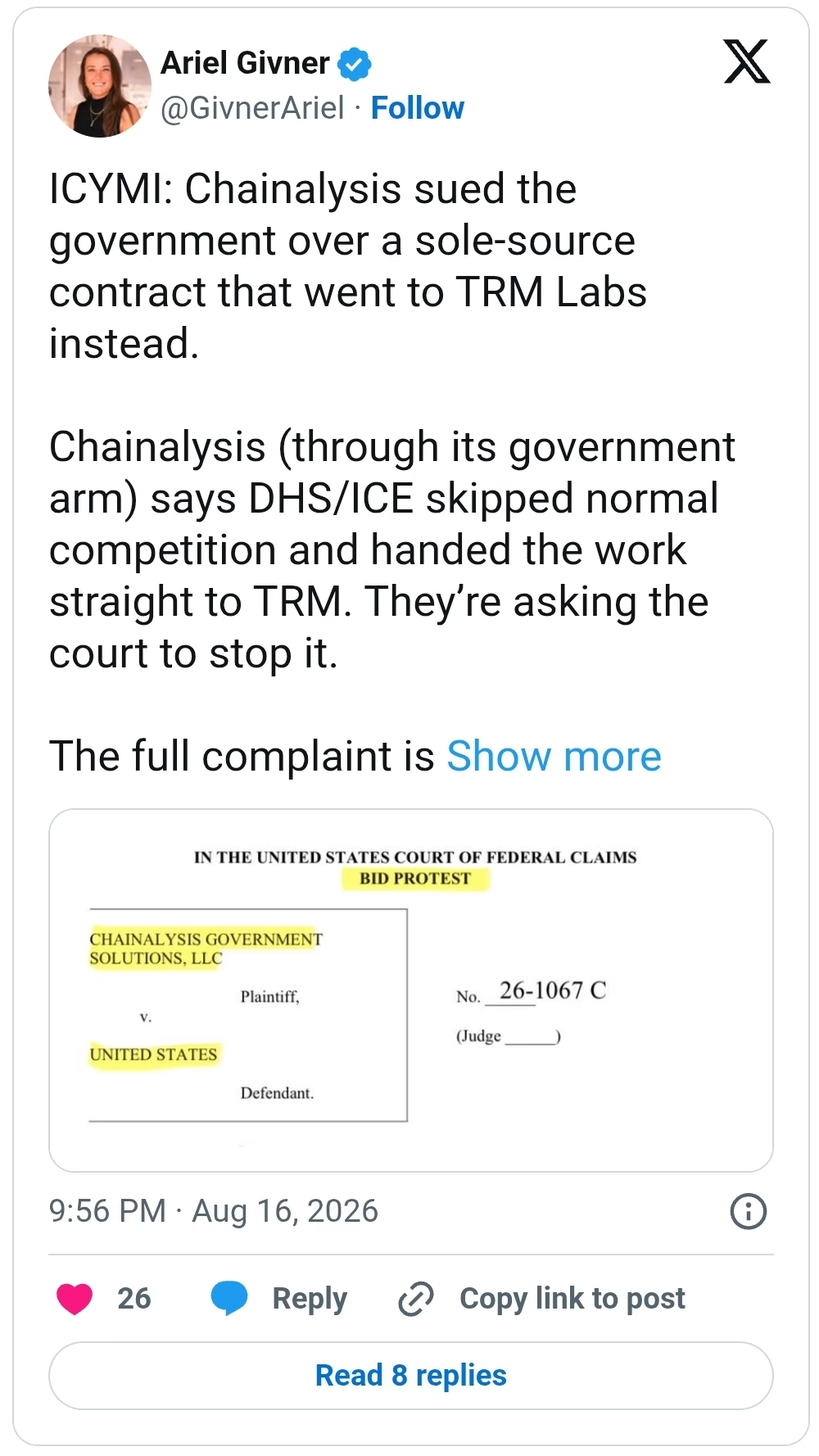
The case, numbered 26-1067C, centers on how ICE selected TRM Labs for the work. According to government records cited in the case, the agency did not conduct an open competitive bidding process. Instead, it used a sole-source procurement procedure under which only one bid was ultimately received.
The contract runs through June 30, 2027, and covers services for the Homeland Security Task Force National Coordination Center Cyber Disruption Center.
The scope of the ICE Crypto Contract includes cryptocurrency tracing, blockchain analysis, open-source intelligence and the mapping of criminal networks. The technology is intended to assist investigations involving scams, cybercrime and sextortion, placing the procurement at the intersection of cryptocurrency enforcement and federal law enforcement operations.
Chainalysis has challenged ICE’s procurement decision, arguing that the agency’s approach failed to provide the company with a fair opportunity to compete for the work.
In its legal challenge, Chainalysis characterized the agency’s decision as “arbitrary, capricious, and unreasonable” — Chainalysis Government Solutions, in its complaint before the US Court of Federal Claims.
The dispute is partly focused on ICE’s decision to use a sole-source process rather than open competition.
Government records indicate that ICE announced in June that it intended to obtain the required services from a single source. Companies were given until June 11 to submit statements demonstrating their capabilities.
The agency said only one source could reasonably provide the services required under the procurement.
Chainalysis, through its government solutions division, says it submitted its own capability statement before ICE awarded the contract to TRM Labs. The company is now asking the court to intervene and prevent the award from proceeding.
The ICE Crypto Contract is particularly significant because the services involved are designed to support sophisticated financial and cybercrime investigations. Blockchain intelligence platforms allow investigators to examine cryptocurrency transactions, trace the movement of digital assets and identify connections between wallets and suspected criminal activity.
The government uses such capabilities in investigations where traditional financial records may not provide a complete picture of how funds move.
The contract’s focus on cryptocurrency tracing also reflects the growing role of blockchain analysis in federal law enforcement. As digital assets have become increasingly intertwined with fraud, cybercrime and other illicit activity, agencies have expanded their reliance on specialist private-sector tools.
The legal proceedings are moving on an expedited schedule.
Chainalysis filed its principal court motion on August 11, although that filing, like the company’s original complaint, remains sealed. The company has argued that confidential business information and trade secrets are contained in the documents.
The court approved the continued sealing of the complaint on July 31.
TRM Labs entered the case on July 28, intervening on the government’s side. The company’s involvement gives the winning contractor a direct interest in defending the procurement decision and protecting the contract it received from ICE.
The court has established several deadlines ahead of oral arguments. The government and TRM Labs are required to respond to Chainalysis by August 21, while Chainalysis has until August 26 to respond.
Final replies from the parties are due August 31, followed by a joint appendix of relevant court documents on September 1.
Oral arguments are scheduled for September 2 at 10 a.m. in Washington, D.C. The government has asked the court to issue a decision by September 10.
The court has not yet determined whether ICE violated federal procurement rules when it awarded the contract to TRM Labs.
That means the central issues in the ICE Crypto Contract case remain unresolved. The court will have to consider Chainalysis’s arguments against the procurement process, as well as the government’s defense of its decision to use a sole-source procedure.
The sealed nature of the filings means much of Chainalysis’s detailed argument is not currently available to the public. The company has cited the need to protect confidential commercial information and trade secrets.
TRM Labs declined to comment on the lawsuit. Chainalysis and ICE also did not respond to requests for comment before publication.
The case therefore remains at an early but potentially consequential stage. No ruling has established that ICE acted unlawfully, and the allegations contained in Chainalysis’s complaint have yet to be tested through a final court decision.
The ICE Crypto Contract dispute nevertheless highlights the growing importance of blockchain intelligence technology to US law enforcement. Both Chainalysis and TRM Labs operate in a market where government agencies increasingly depend on private companies to trace cryptocurrency transactions and investigate digital financial networks.
For Chainalysis, the lawsuit represents an effort to challenge a procurement decision that handed a potentially lucrative government engagement to its competitor. For TRM Labs, the case places its newly awarded contract under judicial scrutiny.
The ICE Crypto Contract is currently scheduled to face its next major test in court on September 2, when the parties are expected to present oral arguments. A decision could follow by September 10 if the government’s requested timetable is adopted.
Until then, the $94.66 million agreement remains the subject of an unresolved federal procurement dispute, with neither the government nor the court having determined that the award violated federal law.
See Docket Here; Courtlisterner



Copyright © 2025 - The Bit Gazette.

