







- Trending
- Comments
- Latest

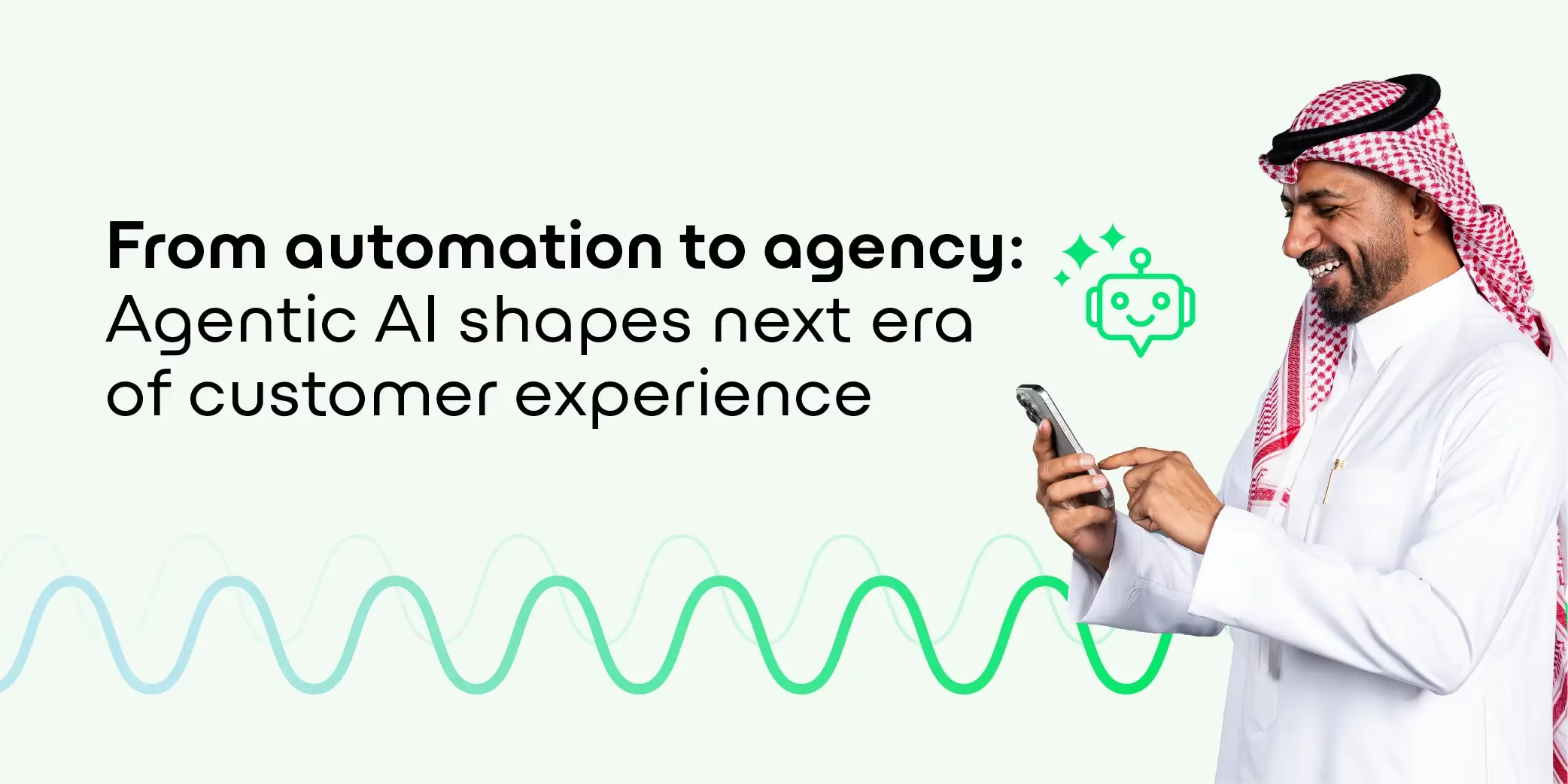
Riyadh, KSA, 22 July 2026, As generative AI, real-time orchestration, and system integration continue to mature, customer experience is entering a new era, defined not by isolated interaction but by autonomous AI agents that can reason, decide, and act across systems, channels, and workflows to achieve real outcomes across diverse industries.
This evolution requires more than basic automation. It demands robust agentic systems that can understand intent, coordinate actions, and deliver end-to-end outcomes, driving a broader shift from reactive automation to goal-driven intelligence, channel management, experience orchestration, and cost containment, while positioning customer experience as a competitive advantage.
These advances are being driven by growing customer expectations for faster, more personalised, and more seamless experiences across every touchpoint. Customers no longer contact support only for simple information; they often need ongoing help fixing something broken or delayed, and are frequently routed between channels, repeating themselves without resolution.
Industry reports show that 53% of customers need to provide information multiple times when engaging with customer service. Only 45% believe their issue can be resolved on first contact, underscoring how often service journeys fail to meet basic expectations and pointing to deeper structural challenges within current CX systems.
Contact centres globally are under growing pressure from rising interaction volumes, fragmented systems, and automation tools with limited capabilities. Even with greater AI adoption, agents still have to manually bridge disconnected systems, complete back-office tasks after interactions end, and compensate for automation shortcomings.
Much of this stems from the limitations of traditional CX automation. Most systems are designed to script responses, deflect volume, and optimise individual channels, useful for surface-level speed, but automation alone has not been proven to decrease repeat contacts, improve first-contact resolution, or eliminate manual follow-up work. As a result, customer expectations continue to outpace what legacy systems can deliver.
At the same time, expectations around experience quality are rising. Customers increasingly seek interactions that are genuinely helpful, culturally fluent, and feel natural, a standard conventional bot automation has continually failed to meet.
A study of 1,000 business professionals in Saudi Arabia and the UAE found that customers are willing to wait up to 15 minutes for a human agent, but only two-thirds believe they will receive the response they need. This trust gap highlights growing demand for more sophisticated, intuitive, and intelligent AI experiences, requiring a fundamental shift in how AI systems are designed and deployed.
This is precisely where the next generation of agentic systems must evolve, not only through autonomous task completion, but through cultural intelligence and native-level proficiency in Arabic. Agentic AI introduces a more advanced paradigm in which AI agents can reason, verify, and act across systems while maintaining conversational and cultural context, enabling faster, more accurate, and more trusted interactions.
Unifonic says it is positioned to lead this transition. The company pairs hyper-localised Arabic language models, delivering over 95% dialect accuracy across regional variants, with enterprise-grade knowledge grounding, aiming to ensure responses are both natural and compliant.
Through retrieval-augmented generation and governance policy alignment, the company says every response is designed to be culturally resonant, on-brand, and regulatory-compliant.
Its multi-agent orchestration framework, powered by Agentic Studio, is built to let AI agents collaborate across workflows, reducing response times while improving cost efficiency. Human-in-the-lead governance is intended to ensure automation doesn’t come at the expense of oversight, enabling escalation and accountability when needed.
Unifonic points to industry-wide gains already being reported: organisations using AI in customer service report up to 70% faster response times, with routine handling improving by around 40%. Gartner predicts that by 2029, agentic AI could autonomously resolve around 80% of common customer service issues, cutting operational costs by approximately 30%.
Unifonic says the next era of CX will be led by platforms that connect intelligence to execution and orchestrate actions across channels, designing experiences around outcomes rather than interactions, a shift the company argues requires platform-level re-engineering rather than incremental AI features.
The company says it is actively enhancing its platforms to integrate enterprise-grade CX across complex service environments, supporting AI-driven orchestration, intelligent voice, and conversational experiences at scale.
This push is reinforced by Unifonic’s acquisition of SESTEK, an Istanbul-based conversational AI company with decades of R&D leadership, patents, and enterprise deployments, which closed in October 2022.
Unifonic also works with partners across the AI, cloud, and conversational ecosystem, including Oracle, Google, AWS, Groq, HUMAIN, and Meta. Together, the company says these efforts position it to deliver enterprise-ready solutions that enhance customer experience while connecting intelligence to real-world outcomes.
This article is based on a press release distributed by Unifonic via Orient Planet Group.



Copyright © 2025 - The Bit Gazette.

