







- Trending
- Comments
- Latest

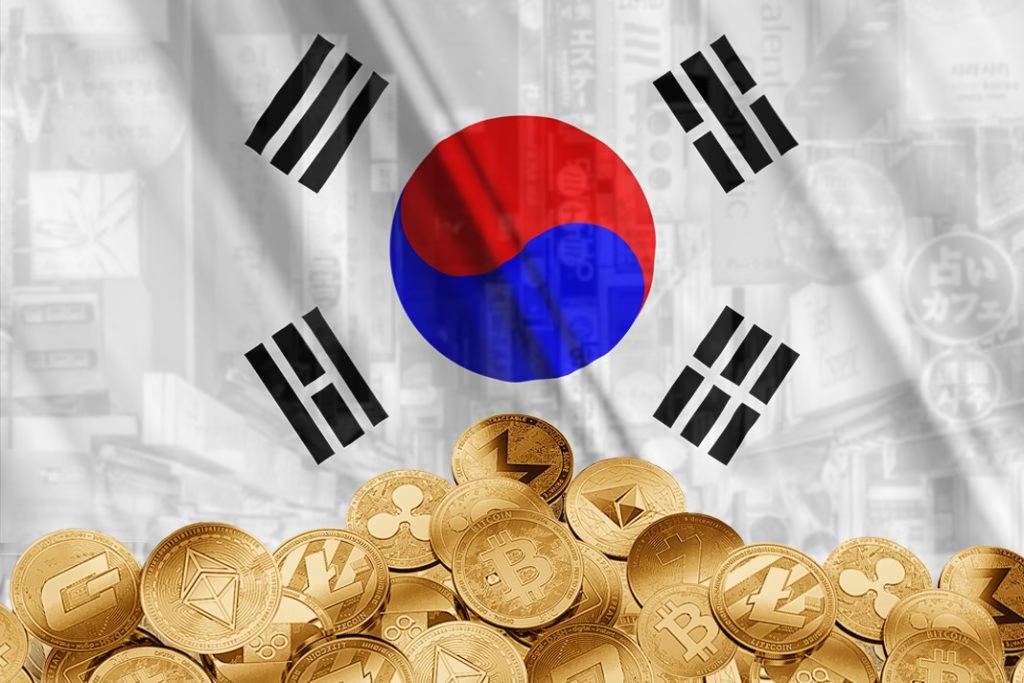
South Korea’s government confirmed on July 29 that it will implement the long-delayed cryptocurrency tax on Jan. 1, 2027, ending years of speculation over a fourth postponement. Deputy Prime Minister Koo Yun-cheol told the National Assembly’s Strategy and Finance Committee the plan will proceed as scheduled.
The debate now moves to parliament, where lawmakers will determine whether the measure survives or faces yet another delay.
The government plans to impose a South Korea crypto tax of up to 22% on annual cryptocurrency gains exceeding 2.5 million won (approximately $1,740).
The tax consists of a 20% national income tax and a 2% local income tax, while gains below the threshold will remain exempt.
Originally scheduled to take effect in January 2022, the policy has been repeatedly delayed amid political disagreements and concerns about market readiness.
Lawmakers first postponed the measure until 2025 before approving another two-year delay in December 2024, pushing implementation to Jan. 1, 2027.
Speaking before the National Assembly’s Finance and Economy Planning Committee on July 29, Deputy Prime Minister Koo Yun-cheol reaffirmed the government’s position.
“We are pushing forward with the plan to tax cryptocurrency starting next year as scheduled,” Koo Yun-cheol told lawmakers.
His comments indicate the administration is determined to proceed unless parliament formally repeals or postpones the legislation again.
Despite the government’s firm stance, the South Korea crypto tax continues to face significant political resistance.
Kim Sang-hoon, a senior lawmaker from the opposition People Power Party, criticized the proposal, arguing that the framework remains incomplete because it does not allow investors to carry forward trading losses into future tax years.
Kim also warned that introducing the South Korea crypto tax too early could encourage investors to move their assets away from domestic exchanges toward overseas centralized platforms, decentralized finance (DeFi) protocols, and peer-to-peer trading markets where enforcement could become more difficult.
According to Kim, South Korea should wait until the OECD’s Crypto-Asset Reporting Framework (CARF) is fully operational before implementing the new tax regime, allowing authorities to better monitor cross-border cryptocurrency transactions and improve compliance.
Under the current proposal, income earned from transferring or lending cryptocurrencies will be classified as “other income” under South Korea’s Income Tax Act.
According to the National Tax Service, every investor will receive an annual deduction of 2.5 million won before taxation applies.
Any gains exceeding that threshold would be taxed at 20%, increasing to an effective 22% once local income taxes are included.
Supporters argue the South Korea crypto tax aligns digital assets with broader taxation principles and helps establish a more transparent investment environment.
The proposal comes as governments worldwide continue developing clearer regulatory and tax frameworks for cryptocurrencies amid growing institutional adoption.
While the government appears committed, the future of the South Korea crypto tax ultimately rests with lawmakers.
Earlier this year, legislators introduced a bill seeking to abolish the cryptocurrency tax entirely by removing crypto income from the Income Tax Act.
That proposal was discussed by the parliamentary committee on July 29 before being referred to a subcommittee for further review.
Unless parliament approves legislation to repeal or delay the measure again, the South Korea crypto tax will officially take effect on Jan. 1, 2027.
Koo Yun-cheol acknowledged that any broader changes would require a comprehensive review of South Korea’s capital markets tax structure, particularly regarding whether cryptocurrency profits should eventually be treated as capital gains rather than separate miscellaneous income.
The South Korea crypto tax debate is being closely watched across Asia, where governments are balancing innovation with stronger oversight of digital assets.
South Korea remains one of the world’s largest cryptocurrency markets, with millions of retail investors actively trading Bitcoin, Ethereum, and other digital assets.
Whether lawmakers approve, amend, or repeal the proposal, the outcome will have significant implications for investor confidence, exchange competitiveness, and the country’s broader digital asset ecosystem.
For now, the government’s latest commitment suggests the long-delayed South Korea crypto tax is closer than ever to becoming reality, setting the stage for one of the country’s most consequential cryptocurrency policy decisions in years.



Copyright © 2025 - The Bit Gazette.

