






- Trending
- Comments
- Latest

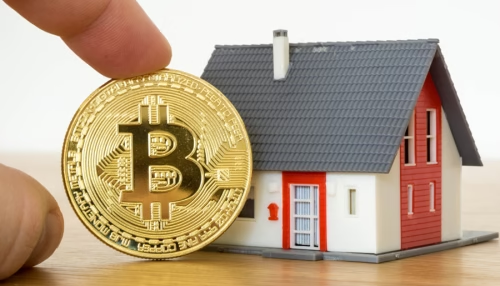
The crypto mortgage market is gaining momentum in the United States as banks show interest in financing a new type of home loan backed by digital assets, even as lawmakers and consumer advocates warn the model could introduce fresh risks to the country’s housing finance system.
The debate intensified after US mortgage lender Better Home & Finance (Better), in partnership with Coinbase, expanded its efforts to roll out a crypto mortgage product that allows borrowers to use digital assets as collateral instead of selling them to fund a home purchase. While supporters see the innovation as a bridge between traditional finance and crypto, critics argue it could expose borrowers, mortgage agencies and taxpayers to unnecessary risks if digital asset prices become unstable.
Interest in the crypto mortgage product has grown rapidly following its launch earlier this year by Better and Coinbase, the largest cryptocurrency exchange in the United States.
According to Forbes, Better Chief Executive Officer Vishal Garg said several major US banks are eager to purchase and finance the loans, describing them as assets suitable for bank balance sheets.
“Banks — including some of the largest in the United States — are lining up to buy and fund the loans.” — Vishal Garg, CEO, Better Home & Finance.
Garg added that he believes the crypto mortgage model could become “a gateway for digital assets to enter the banking system.”
Currently, Better accepts Bitcoin and the US dollar-backed stablecoin USDC as collateral. The lender also plans to expand the list of eligible assets to include Ethereum, Solana and tokenized shares of leading companies such as SpaceX, Tesla, Coinbase, Apple and Amazon. However, Garg said speculative memecoins would remain excluded because the company intends to focus only on assets with sufficient liquidity and institutional demand.
The company has also proposed broader applications for digital asset-backed lending. Among the ideas under consideration is allowing parents to use retirement savings as collateral to help children purchase homes. Garg also suggested future housing markets could allow individuals to own fractional interests in several homes and move more freely between them.
“The only reason that doesn’t exist today is friction in the transaction process.” — Vishal Garg, CEO, Better Home & Finance.
The crypto mortgage was introduced in March through a partnership between Better and Coinbase. Instead of selling cryptocurrency to raise a down payment, borrowers pledge their digital assets while taking out two separate loans.
The first is a conventional mortgage that complies with Fannie Mae guidelines. The second is a loan specifically designed to cover the down payment and is secured by both the pledged cryptocurrency and a second lien on the property. Better originates both loans, while Coinbase holds the pledged digital assets in custody until the second loan is fully repaid.
The first crypto mortgage transaction closed in June in Ann Arbor, Michigan, where a couple in their early thirties purchased a home using Bitcoin as collateral.
Ahead of a nationwide expansion, Better estimated demand from customers on its waiting list at roughly $250 million. The company also found that 41% of its pre-approved customers met income and credit requirements but lacked sufficient cash for a down payment.
Forbes, citing a Redfin survey, reported that 12.7% of younger homebuyers recently used digital assets to help fund their initial down payment, highlighting growing interest in integrating cryptocurrency into homeownership.
Qualifying for the crypto mortgage remains demanding. Bitcoin borrowers must pledge collateral worth 250% of the loan amount, while USDC requires collateral equal to 125% of the loan value.
Although borrowers are not required to provide additional collateral if cryptocurrency prices decline, pledged assets may be liquidated if mortgage payments become more than 60 days overdue.
Despite growing industry interest, the crypto mortgage has encountered strong resistance from US lawmakers.
In April, seven senators, including Dick Durbin and Elizabeth Warren, sent a letter urging Federal Housing Finance Agency Director Bill Pulte to withdraw approval related to the product.
The lawmakers argued that government-sponsored mortgage agencies Fannie Mae and Freddie Mac should not assume risks associated with crypto-backed lending. They also pointed to the high collateral requirements as evidence of cryptocurrency’s volatility.
According to the senators, borrowers could face higher financing costs because they must service two separate loans. They estimated the combined interest rate could be as much as 1.5 percentage points above that of a standard Fannie Mae mortgage.
The senators further warned that a significant decline in cryptocurrency values could leave borrowers vulnerable to default, potentially shifting financial losses onto taxpayers if federally backed mortgage institutions become exposed.
Consumer advocates have also expressed concern that the crypto mortgage structure resembles financing models linked to the 2008 financial crisis.
In June, the National Consumer Law Center and the Consumer Federation of America jointly warned that the product could revive the use of “piggyback loans,” where borrowers simultaneously take out a primary mortgage and a smaller second mortgage to cover a down payment.
The organizations argued that layering debt in this way increases financial vulnerability, particularly when the second loan is backed by highly volatile assets.
“People who take out mortgages backed by digital assets are more exposed to the risk of default and forced sale,” — National Consumer Law Center and Consumer Federation of America.
The groups added that “the federal government is at risk of repeating the mistakes that caused the 2008 mortgage crisis.”
As the crypto mortgage market expands, it is becoming a new battleground between financial innovation and regulatory caution. Supporters believe the model could unlock homeownership for cryptocurrency holders without forcing them to sell appreciating assets. Critics, however, argue that integrating volatile digital assets into the mortgage system could create new vulnerabilities for borrowers, lenders and the broader financial system.
Whether the crypto mortgage becomes a mainstream financing option may ultimately depend on how regulators balance innovation with the long-term stability of the US housing market.



Copyright © 2025 - The Bit Gazette.

