

- Trending
- Comments
- Latest

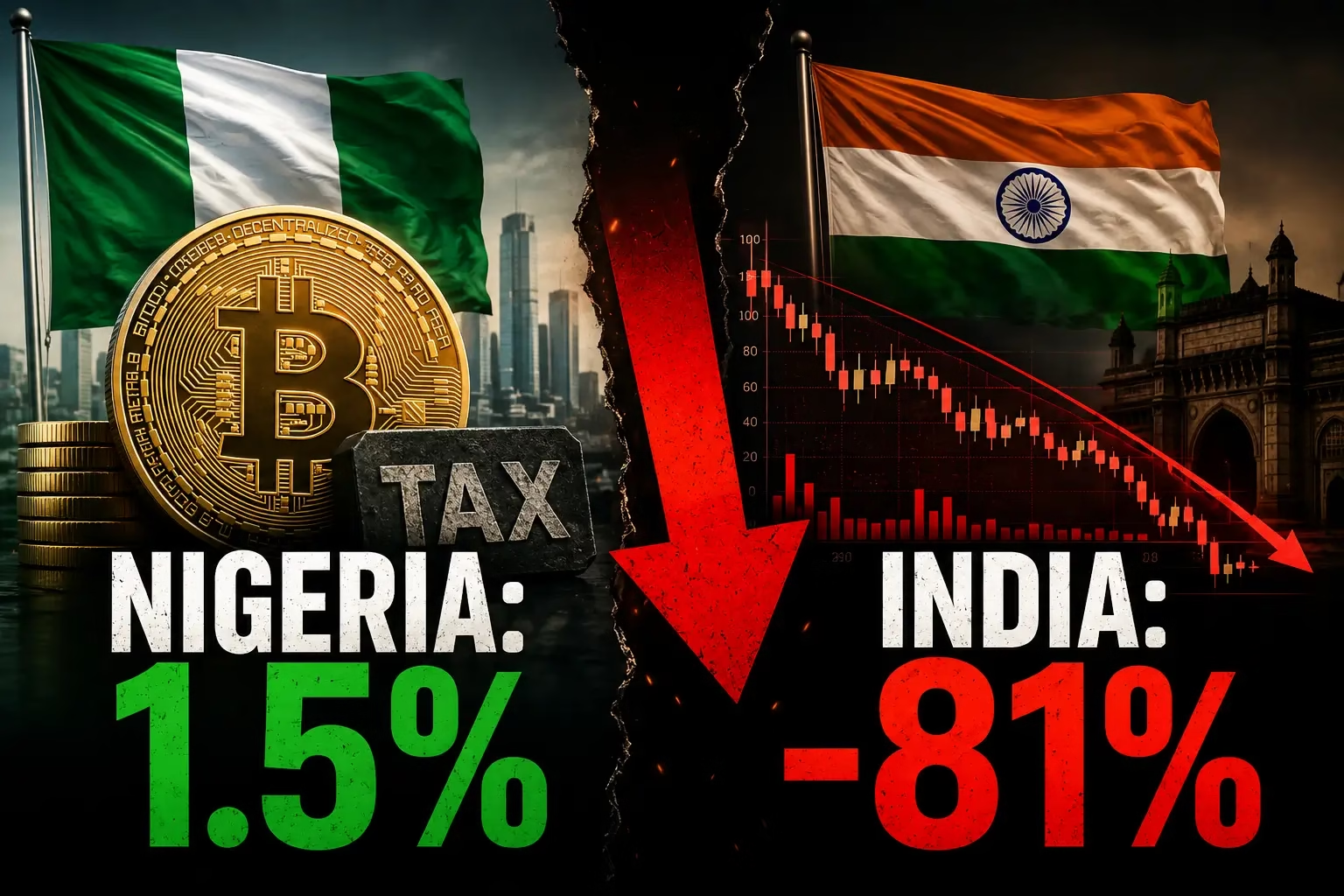
When India introduced a 1% withholding tax on every crypto transaction in July 2022, domestic exchanges lost 81% of their trading volume within four months, and roughly 1.7 million users moved to offshore platforms.
Nigeria’s Nigeria Revenue Service (NRS) has now built a strikingly similar model: a 1.5% stamp duty on every fiat-to-token conversion and a 1% withholding tax on every disposal, both enforced from August 3, 2026, under the Guidelines on the Taxation of Virtual Assets.
Digital Assets Coalition spokesperson Obinna Iwuno says Nigeria is walking into the same trap, and this time the stakes are Sub-Saharan Africa’s largest crypto market, worth $92.1 billion.
The NRS turns exchanges and other Virtual Asset Service Providers (VASPs) into tax collectors, and the levies stack at nearly every stage of a transaction:
Both the withholding tax and the stamp duty must be remitted to the NRS in the token used for the transaction; VAT is paid in the transaction currency, an unusual requirement among global tax authorities.
One design choice in the guidelines works in taxpayers’ favor. Rather than taxing gains that exist only because the naira has weakened, the NRS calculates gains in US dollars first, then converts the real dollar gain to naira at the CBN/NAFEM rate on the date of disposal.
In the NRS’s own worked example, a user who converts a naira gain of roughly ₦970,000 sees the taxable portion fall to about ₦470,000 once the currency-depreciation component is stripped out, sparing investors from paying tax purely because the naira fell.
Alongside the tax guidelines, Nigeria’s Securities and Exchange Commission has separately raised the bar for market entry. Digital Asset Exchanges and custodians must now hold ₦2 billion in shareholders’ funds, up from ₦500 million, a 300% increase that industry group SiBAN has publicly asked the SEC to reconsider, warning it could squeeze out early-stage domestic startups in favor of well-funded incumbents.
The loudest pushback has come from the Digital Assets Coalition (DAC), an industry alliance that represents Nigerian digital-asset operators and users.
At a Lagos press conference, DAC spokesperson Obinna Iwuno said the coalition “support[s] the taxation of virtual assets without qualification,” but objects to charges applied regardless of whether a trade produced a profit or a loss, the argument at the center of the group’s position paper, titled Tax the Profit, Not the Movement of Money.
Iwuno’s specific complaints echo the mechanics above: the 1% withholding tax hits gross sale value even on a loss-making trade, and the 1.5% stamp duty applies to stablecoin conversions that function as payment rails rather than investments, meaning ₦1,000 converted into a naira-pegged stablecoin like cNGN arrives as ₦985 before any gain has been realized.
Iwuno also flagged that remitting tax in tokens appears to conflict with Section 39 of the Nigeria Tax Administration Act, which he says mandates naira remittance. He is asking the NRS to suspend implementation and consult with industry before enforcement continues.
Blockchain lawyer Senator Ihenyen, who has reviewed the guidelines independently, points to the same structural tension: a high-frequency peer-to-peer trader operating on sub-1% margins cannot absorb a 1.5% stamp duty on every conversion without losing money on volume alone.
Nigeria isn’t the first market to test this model. When India introduced a 1% transaction-level withholding tax on crypto trades in July 2022, the Esya Centre found domestic exchanges lost 81% of their trading volume within four months, as roughly 1.7 million users moved to offshore platforms and an estimated $3.8 billion in trading value left the country between February and October 2022.
Iwuno has cited the same case directly, along with Kenya’s 2025 repeal of its 3% transaction tax and Turkey’s abandoned 2026 proposal, arguing that transaction-based crypto taxes consistently push trading underground rather than into government view.
Nigeria has produced something few of its regulatory peers have: a comprehensive, legally grounded tax framework for digital assets, paired with a genuinely investor-friendly mechanism for handling currency depreciation.
But the DAC’s position paper and Ihenyen’s analysis point to the same underlying risk, a system that taxes activity rather than profit tends to shrink the taxable base it was built to capture. Whether the NRS revises the framework before enforcement deepens, or holds its position and tests Nigeria’s $92 billion market against the same pressure that reshaped India’s, will likely become clear over the next several months.



Copyright © 2025 - The Bit Gazette.