

- Trending
- Comments
- Latest

Kazakhstan will exempt private crypto investors from personal income tax for three years if they move their holdings onto regulated domestic exchanges, an attempt to coax back the roughly 750,000 digital wallets currently sitting outside the country’s licensed platforms.
Under a government decree, Kazakh citizens will be encouraged to declare their cryptocurrency holdings and transfer assets to regulated domestic platforms. Private investors will receive an exemption from personal income tax on profits from digital-asset transactions for three years, provided the assets are not connected to fraud, money laundering or unlicensed cryptocurrency services.
The measure is part of a broader attempt to provide greater legal certainty for cryptocurrency users and businesses while encouraging activity to take place through licensed platforms.
Kazakhstan’s financial regulator, the Astana International Financial Centre (AIFC), estimates that Kazakh citizens hold approximately 1 million crypto wallets. That figure is nearly four times the 256,900 users registered on authorised domestic exchanges as of March.
The gap highlights the scale of digital-asset activity taking place outside the country’s regulated exchange ecosystem and explains why the government is using the crypto amnesty to encourage users to move their holdings back onshore.
General Manager of Binance Kazakhstan Nurkhat Kushimov described the tax incentive as one of the decree’s most significant provisions.
“This is a strong incentive for users to choose regulated jurisdictions and platforms operating within them,” — Nurkhat Kushimov, General Manager, Binance Kazakhstan, told Euronews.
“This approach makes working in a licensed environment more attractive, fosters trust in the market and creates the conditions for its further development,” he added.
Kazakhstan’s latest policy marks a significant shift from the conditions that followed its rapid emergence as a global cryptocurrency mining centre.
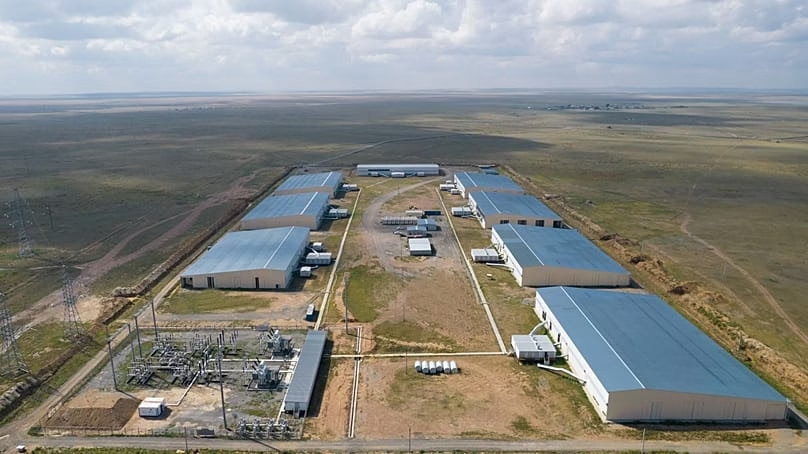
After China banned Bitcoin mining in 2021, miners moved to countries offering comparatively inexpensive energy. Kazakhstan quickly became the world’s second-largest Bitcoin mining destination after the United States, attracting large-scale operations as well as smaller participants.
The growth was difficult for the country’s ageing electricity infrastructure to absorb. Mining operations required powerful computers to run continuously, consuming substantial amounts of electricity in the process.
At the height of the boom, cryptocurrency miners were estimated to account for about 8% of Kazakhstan’s total electricity consumption. In October 2021, rising demand contributed to outages at three power plants in northeastern Kazakhstan, while rolling blackouts affected several regions.
Some mining operators attempted to conceal their activities by presenting facilities as vegetable-storage operations, greenhouses or artificial-intelligence data centres. Mining equipment was also reportedly installed in unconventional locations, including residential balconies.
Authorities subsequently tightened rules governing electricity consumption and digital-asset activity. The measures contributed to many miners leaving the country, while illegal mining operations continued to emerge.
Kazakhstan never imposed an outright ban on cryptocurrency mining, however, leaving open the possibility of rebuilding the sector under a more controlled framework.
The new crypto amnesty therefore goes beyond attracting investors. The decree also attempts to address the energy constraints that contributed to the earlier collapse of Kazakhstan’s mining boom.
Under the new approach, associated gas from oil fields that is not required for state use can be used to generate electricity for mining operations. The provision could give miners an alternative source of power rather than increasing pressure on the national electricity grid.
Kazakh industry representatives have welcomed the government’s attempt to make the domestic market more attractive but have warned that the crypto amnesty will not succeed on tax incentives alone.
Bakhytzhan Kenzhebayev, chairman of Kazakhstan’s Association of Fintech, AI and Crypto Industry, said the tax measure removes an important uncertainty for private investors, particularly around when and how tax obligations arise.
But he argued that investors make decisions based on a broader set of considerations.
“Users choose a platform not based on the tax rate, but on a combination of factors: how easy it is to deposit and withdraw (the local currency), the liquidity, and how clear the rules are,” — Bakhytzhan Kenzhebayev, Chairman, Kazakhstan’s Association of Fintech, AI and Crypto Industry, told Euronews.
“For a licensed participant, the predictability of the rule is more valuable than the benefit itself,” he said.
President of Kazakhstan’s Blockchain and Digital Mining Association Daniyar Mubarakov also welcomed government support but questioned how sustainable the tax advantage would be.
“For certain categories of entrepreneurs preferential tax regimes mean not only a reduction in taxes in the current period, but also a possible several-fold increase in taxes in the future due to increased volumes,” — Daniyar Mubarakov, President, Kazakhstan’s Blockchain and Digital Mining Association, told Euronews.
Vice Minister of AI and Digital Development Gizzat Baitursynov said the government was already considering what would follow the three-year exemption. His department is working on a simplified tax regime that could take effect after the exemption expires.
Officials are also considering cancelling tax audits for private investors covering the previous three years.
The government’s effort to rebuild the market could ultimately depend on whether Kazakhstan can make regulated platforms competitive with international alternatives.
Kushimov said convenience, liquidity, available financial instruments, transaction speeds and smooth integration with the banking system would remain decisive factors for users considering domestic platforms.
Kenzhebayev meanwhile identified legal definitions and regulatory terminology as key risks. He warned that overly broad language around the exemption could create opportunities for abuse and allow investors to avoid taxes on assets unrelated to cryptocurrency.
“This creates the risk of a reversal of the norm in a year or two, and that causes more damage to the market than an initially high but stable rate,” — Kenzhebayev told Euronews.
Another complication is the relationship between the AIFC’s regulatory framework and Kazakhstan’s national rules. The same digital asset can potentially be treated differently depending on which regulatory regime applies.
“The difficulty arises at the intersection. As a result, the participant builds two parallel infrastructures for one business, which reflects on the costs,” — Kenzhebayev said.
For the crypto amnesty to achieve its intended effect, Kenzhebayev said Kazakhstan would need more than temporary tax relief. Reliable banking access, clear rules for converting cryptocurrency into local currency, straightforward requirements for safeguarding customer assets and regulations that do not disadvantage licensed operators would all be necessary.
Kazakhstan’s strategy reflects a wider international effort to attract digital-asset activity through clearer regulation, licensing and tax incentives. Countries including the UAE, Hong Kong and Singapore have adopted similar approaches in an effort to draw cryptocurrency businesses and investors into regulated financial systems.
For Astana, the crypto amnesty represents an attempt to turn lessons from its mining boom into a more sustainable digital-asset sector—one that brings cryptocurrency activity back into the formal economy without repeating the energy pressures that accompanied the industry’s earlier expansion.



Copyright © 2025 - The Bit Gazette.