







- Trending
- Comments
- Latest

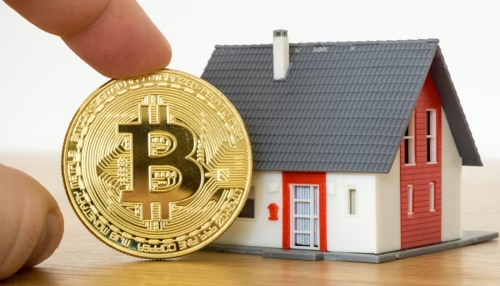
Coinbase and Better Mortgage have expanded Bitcoin-backed home loans to qualified U.S. borrowers, making the product generally available after an earlier limited rollout.
Announced on Aug. 26, the initiative allows eligible homebuyers to use Bitcoin as collateral for a separate down-payment loan while keeping the primary mortgage structured as a conventional Fannie Mae-compliant loan.
The development gives cryptocurrency investors another potential way to put their digital assets to work without selling BTC to raise cash for a property purchase.
Under the arrangement, Better handles the mortgage application, underwriting, closing and servicing, while Coinbase provides the infrastructure for transferring and holding the Bitcoin collateral.
The companies’ approach is built around two connected loans rather than a single mortgage secured partly by a home and partly by Bitcoin.
The first is a conventional first-lien mortgage designed to meet Fannie Mae’s conforming requirements. The second is a loan secured by Bitcoin that provides the funds needed for the down payment.
The Bitcoin-backed home loans come with a significant collateral requirement. Borrowers must pledge Bitcoin worth at least 250% of the amount borrowed for the down-payment loan.
In practical terms, someone borrowing $100,000 for a down payment would need to pledge at least $250,000 worth of Bitcoin when the collateral is posted.
Once Better approves the financing, the borrower authorizes the required Bitcoin to be transferred from a verified Coinbase account to a custodial account on Coinbase Prime.
The pledged BTC remains under Better’s control while the financing is outstanding, meaning the borrower cannot trade or withdraw those coins during that period.
The structure does provide one important distinction from many conventional crypto-backed loans. Normal Bitcoin price movements do not automatically produce a margin call or change the mortgage terms.
However, the arrangement does not eliminate liquidation risk. If the borrower becomes 60 days delinquent on loan payments, Better can liquidate the pledged Bitcoin under the applicable loan terms.
A borrower can retain potential upside from BTC while simultaneously putting those holdings at risk if the mortgage obligations are not maintained.
The expansion of Bitcoin-backed home loans also comes with an incentive for eligible Coinbase One members. Approved customers can receive a lender credit equal to 1% of the mortgage value, with the benefit capped at $10,000. The credit can be applied toward closing costs.
The incentive is not limited exclusively to the new crypto-backed mortgage. According to the companies, eligible Coinbase One members can also receive the 1% credit on Better’s standard mortgages, home equity lines of credit and refinancing products.
Demand during the initial stage helped support the decision to expand availability. Better said 76% of people on its June waitlist were already Coinbase One members, while 60% indicated that they expected to purchase a home within six months.
The companies said the waitlist represented more than $260 million in projected loan volume before the product became generally available.
Ziggy Jonsson, chief technology officer at Better Mortgage, said the initiative reflects the growing importance of digital assets in the finances of some younger borrowers.
The current product specifically identifies Bitcoin as the eligible collateral asset, according to Coinbase’s mortgage guidance.
Borrowers must also be U.S. residents, maintain a verified Coinbase account in good standing and satisfy Better’s credit, income and other underwriting requirements. Holding enough BTC alone does not guarantee approval.
The arrival of Bitcoin-backed home loans comes as U.S. mortgage policy becomes increasingly receptive to cryptocurrency as a financial asset.
In June 2025, the Federal Housing Finance Agency directed Fannie Mae and Freddie Mac to prepare proposals for considering cryptocurrency holdings in single-family mortgage risk assessments without first converting those assets into U.S. dollars.
The directive required attention to crypto volatility and other risk controls, with holdings subject to verification through U.S.-regulated centralized exchanges.
That policy direction provides an important backdrop for the Coinbase-Better product. The companies had already funded what they described as the first Fannie Mae-backed U.S. mortgage using Bitcoin as collateral in June 2026, involving a couple in Ann Arbor, Michigan. The transaction served as an early test before broader availability.
The product represents another point of contact between digital assets and traditional financial infrastructure, potentially giving long-term BTC holders additional ways to access liquidity without immediately disposing of their holdings.
At the same time, Bitcoin-backed home loans introduce risks that investors cannot ignore. The pledged Bitcoin remains inaccessible during the financing period, and prolonged payment delinquency can result in liquidation.
Borrowers must therefore consider not only the potential tax and investment consequences of selling BTC, but also the risks associated with using a volatile asset as collateral for a long-term housing obligation.
Ultimately, Bitcoin-backed home loans are an emerging financial product rather than a straightforward replacement for conventional mortgages. Their broader adoption will likely depend on borrower demand, lender risk management and the continued integration of digital assets into the U.S. financial system.
For investors watching the convergence of crypto and traditional finance, Bitcoin-backed home loans provide another example of Bitcoin moving from a speculative asset toward a form of collateral that can interact directly with established financial markets.



Copyright © 2025 - The Bit Gazette.

