
- Trending
- Comments
- Latest

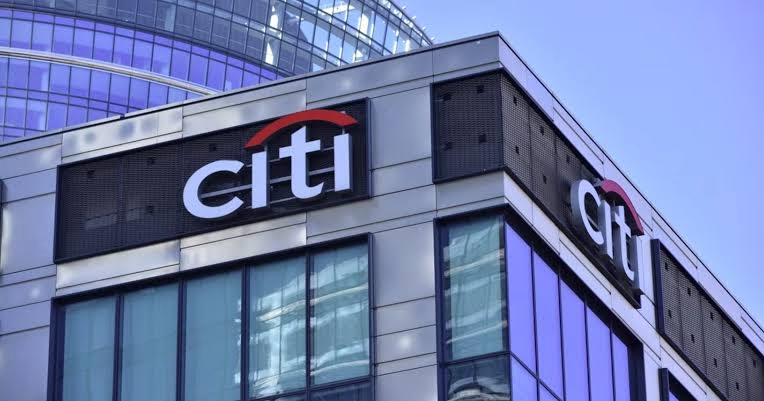
Bank of America, Citi, Goldman Sachs and 18 other financial institutions committed on Sept. 1, 2026, to form a company targeting a U.S. dollar stablecoin launch in the first half of 2027, the group said in a joint statement.
The proposed company will include institutions spanning North America, Europe, East Asia, the Middle East and Africa. North American participants include Bank of America, Capital One, Citi, Fidelity Investments, Goldman Sachs, PNC Financial Services, Scotiabank, TD Bank Group, Wells Fargo and WisdomTree.
European participants include Banco Santander, BBVA, Commerzbank, Crédit Agricole, Deutsche Bank, Lloyds Banking Group, Rabobank and UBS. MUFG Bank represents Japan, while Sirius International Holding and Standard Bank represent the Middle East and Africa.
The consortium says its combined banking infrastructure could support payments and settlement activity across multiple segments of the financial system. The proposed stablecoin could be used for cross-border transactions, institutional settlement and digital-asset transactions.
The project is not being presented as an immediate replacement for existing cryptocurrencies or stablecoins.
Instead, the Bank of America Citi stablecoin plan appears designed to use the participating institutions’ established customer networks, compliance systems and financial infrastructure to compete in a market currently dominated by established issuers such as Tether and Circle.
The consortium has also said the planned venture would combine distribution capabilities with compliance, governance and risk-management systems. Those advantages, however, remain theoretical until the company publishes its operating model and launches an actual token.
The Bank of America Citi stablecoin plan builds on work that began in October 2025, when 10 banks announced that they were examining a reserve-backed digital-money system designed to operate on public blockchains.
The latest announcement expands the initiative to 21 financial institutions and shifts the project from an exploratory study toward the creation of a dedicated company. The consortium has set the first half of 2027 as its target for launching a U.S. dollar-denominated stablecoin.
The group has also identified a euro-denominated stablecoin as its first priority for expansion beyond the U.S. dollar. Other G7 currencies could eventually be considered.
For investors, that potential expansion matters because it suggests the banks are considering stablecoins as part of a broader international payments strategy rather than as a single-market product.
Still, major uncertainties remain. The institutions have not disclosed which blockchain networks will support the token, how reserves will be held, who will act as custodian or whether customers will be able to transfer the asset directly through public blockchain infrastructure.
The Bank of America Citi stablecoin plan also leaves unanswered questions about retail access. While the consortium has identified retail payments as a potential use case, it has not published a detailed consumer distribution strategy.
Regulation will be a central factor in determining how the Bank of America Citi stablecoin plan develops.
The consortium said the dollar stablecoin “intends” to comply with the U.S. GENIUS Act where applicable.
The legislation, signed into law on July 18, 2025, establishes a federal framework for payment stablecoins, including requirements covering permitted issuers, reserves, redemption and disclosures.
The group also said it “intends” to comply with the European Union’s Markets in Crypto-Assets regulation when applicable.
MiCA provides a regulatory framework for stablecoins offered within the European market and establishes requirements covering authorization, reserves, disclosures and redemption.
These regulatory obligations could have a direct impact on the structure of any future token. The consortium has not yet identified the legal entity that would issue a euro stablecoin or disclosed where such an issuer would be licensed.
The timing could also prove important. U.S. agencies were still working on implementing rules for the GENIUS Act after a July 2026 rulemaking deadline, while the Office of the Comptroller of the Currency was targeting November 2026 for final rules, according to the supplied report.
The Bank of America Citi stablecoin plan could increase competition in an already crowded stablecoin sector while accelerating the integration of blockchain technology into traditional financial markets.
Its proposed use cases are particularly relevant to institutional crypto investors. Stablecoins can potentially reduce friction in cross-border payments and digital-asset settlement, while a bank-backed product could appeal to institutions that prioritize established compliance and risk-management structures.
At the same time, the initiative does not guarantee that the participating banks will successfully challenge existing stablecoin leaders.
The consortium must still establish the company, determine its technology stack, finalize its reserve and custody arrangements, obtain the necessary regulatory approvals and build demand for the product.
The Bank of America Citi stablecoin plan therefore represents a development milestone rather than a completed market launch.
Investors should watch for disclosures about the company’s legal structure, blockchain partners, reserve model, token distribution and regulatory approvals before assessing the venture’s potential competitive impact.
The broader trend is nevertheless clear: major financial institutions are increasingly treating stablecoins as part of the future payments and digital-asset infrastructure. Whether the banks can turn that interest into a widely used product will depend on execution, regulation and adoption.



Copyright © 2025 - The Bit Gazette.