





- Trending
- Comments
- Latest


- Trending
- Comments
- Latest


Bitcoin OG holders, the cohort whose coins have sat untouched for more than five years, have roughly doubled their onchain activity since May, and the number attached to that claim looks dramatic on its own: a 90-day moving average of 1,500 BTC in spent outputs, according to CryptoQuant analyst Darkfost.
Read that number in isolation and it sounds like early believers (Bitcoin OG holders) are finally cashing out. Read it next to what’s actually been happening in Bitcoin’s hardware wallet world over the same stretch, and a very different, far less dramatic explanation starts to look just as plausible.
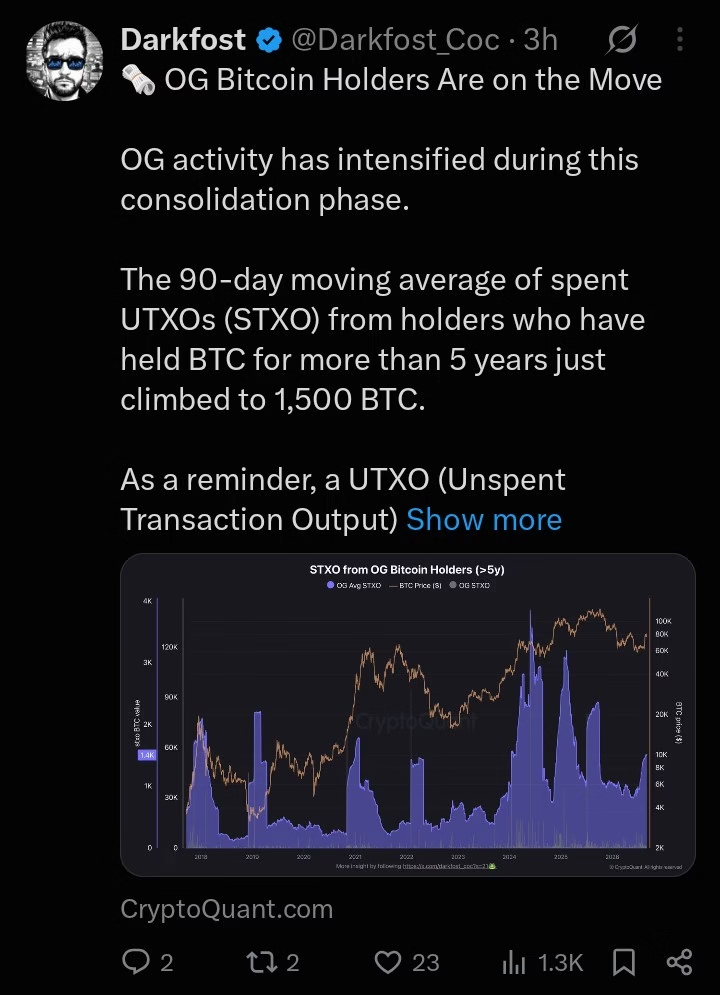
The 1,500 BTC average is roughly 56% above the 962 BTC reading recorded on June 24, which had itself marked the lowest point for this cohort’s activity in nearly two years, dipping under 1,000 BTC for the first time since November 2024. Context matters here: this isn’t close to the real historical spikes.
Single-day movements during past peaks in May 2024, February 2025, and September 2025 topped 10,000 BTC, 30,000 BTC, and, in one case, 142,000 BTC. A 1,500 BTC average is a genuine uptick, not a stampede. Bitcoin itself was trading near $79,600 at last check, down modestly over 24 hours and still struggling to hold above $80,000 after several failed attempts.
Here’s the part that gets lost in headlines about “OG selling”: Bitcoin’s ledger tracks spent outputs, not account balances, so an output only becomes “spent” once its owner does something with it. What that something is can’t be read off the transaction alone — a security upgrade looks identical onchain to a sale, and so does a holder splitting one wallet into several.
Recent examples make the point well. Galaxy Research tracked six wallets dormant for 12 to more than 15 years that moved a combined 553.59 BTC, worth roughly $40 million, between Aug. 16 and Aug. 26; five of those transfers went to addresses with no exchange connection at all, and the one that did, 40 BTC sent to Boerse Stuttgart Digital, landed at a custody and trading platform, which still doesn’t confirm a sale happened.
Galaxy separately documented a batch of 28 wallets moving 1,314.41 BTC on Aug. 20, over 1,200 BTC of it from addresses created back in 2014. Blockchain records show where the coins went. They don’t show why.
The likeliest single explanation for a chunk of this activity isn’t sentiment, it’s a scramble. A firmware flaw in certain Coldcard hardware wallets exposed seed phrases those devices had generated, and because a firmware patch can’t retroactively fix a bad seed, affected owners were told to generate new credentials and move their coins entirely.
In early August, K33 Research found that roughly 890,000 BTC changed hands over seven days, the highest weekly active-supply reading of 2026, even as Bitcoin sat in one of its narrowest 30-day trading ranges since 2023.
Head of research Vetle Lunde called the surge “very likely driven by the Coldcard attacks.” Galaxy Research, tracking the fallout separately, confirmed 1,596 BTC stolen from roughly 7,300 addresses across at least three attack waves, with losses potentially reaching 2,055 BTC, worth close to $130 million, if a suspected fourth wave gets confirmed.
About 90% of the stolen coins hadn’t moved again as of early August. Crucially, any wallet holding five-year-old coins that got swept up in this migration would show up in Darkfost’s cohort too, inflating the “OG selling” story with people who never intended to sell anything.
The incident has also revived a familiar argument. Direct Bitcoin holders own their coins outright but carry the full weight of seed generation, backups, and firmware maintenance, exactly the chain that broke down with Coldcard. Spot Bitcoin ETF holders skip all of that, since custody sits with the fund’s providers instead.
Bloomberg Intelligence’s Eric Balchunas put it bluntly on X in early August, arguing the Coldcard hack “could spur greater migration to ETFs” and that something long dismissed by crypto natives as a compromise, outsourcing custody to a bank, might suddenly look like a selling point next to, in his words, “a Canadian co w/ 5 employees.”
It’s a pointed jab at Coldcard’s small team size more than a general theory, but the underlying point stands regardless of the phrasing: institutional custodians bring resources a five-person hardware wallet company simply doesn’t have.

BlackRock’s iShares Bitcoin Trust, per its own SEC filing, holds its coins through Coinbase Custody in segregated cold storage, with Anchorage Digital Bank available as a backup custodian, though that same filing is candid that hacking, employee misconduct, and technical failure remain possible, and insurance may not cover every scenario.
No verified flow data has actually tied ETF demand to the Coldcard scare, and the trade-off cuts both ways regardless: ETF shareholders can’t withdraw the underlying Bitcoin or use it onchain, and their shares only trade during market hours, while a self-custodied coin is usable and transferable any time, with all the responsibility that implies.
Nothing here rules out that some long-term holders are genuinely taking profit during this consolidation, Darkfost himself only goes as far as linking the uptick to unease around Bitcoin’s price action, not confirmed distribution.
But a 1,500 BTC average sitting well below historical peaks, alongside a hardware wallet crisis that mechanically forces old coins to move regardless of intent, means the “Bitcoin OG holders are selling” framing is only one of several stories this data could be telling.
Which one turns out to be true will show up in destination data, whether these coins keep landing at labeled exchanges, long before it shows up in any single headline number.



Copyright © 2025 - The Bit Gazette.

