







- Trending
- Comments
- Latest

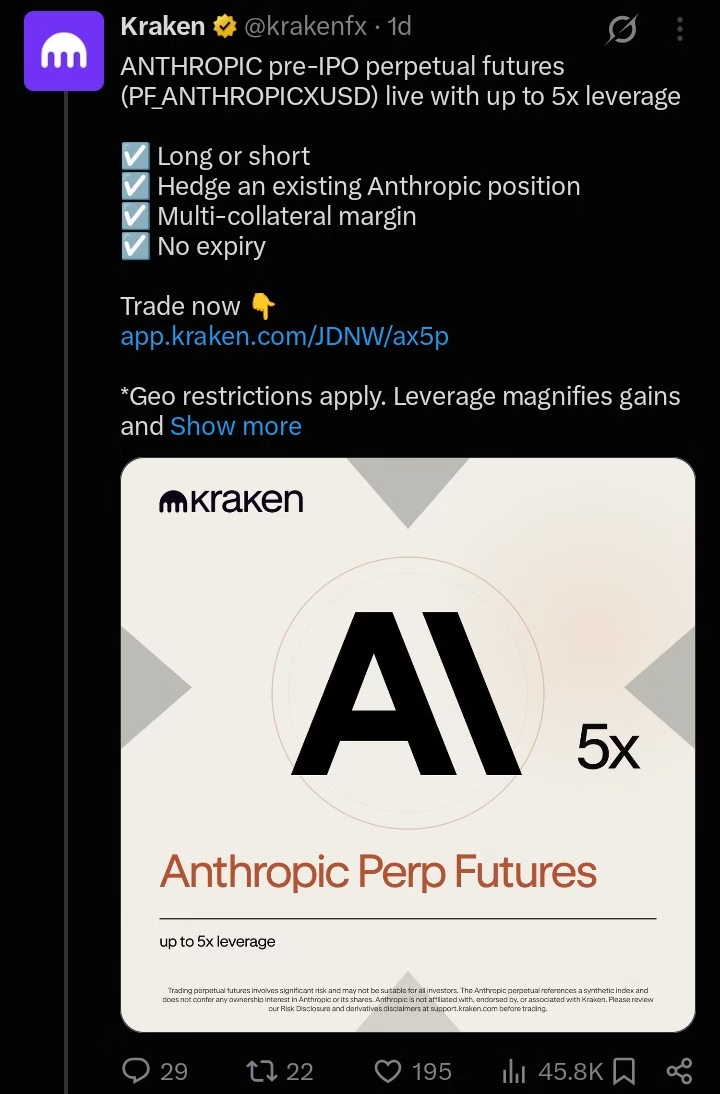
Kraken confirmed on September 6, 2026 that eligible traders can now go long or short on OpenAI and Anthropic through cash-settled perpetual futures — PF_OPENAIXUSD and PF_ANTHROPICXUSD — offering up to 5x leverage with no expiration date. Neither contract confers equity, voting rights, or dividends; traders are betting purely on a price Kraken itself generates, since neither company trades publicly.
There’s no equity changing hands here. No shares, no board votes, no dividend checks. What you’re actually trading is a number: the market’s best guess at what each company is worth, expressed through Kraken’s flex-margin account system that accepts multiple collateral types.
Neither OpenAI nor Anthropic trades on a public exchange, which leaves Kraken with nothing external to anchor a price to. Its fix is a homegrown benchmark it calls the PreMarket Synthetic index, a number generated entirely from bets placed inside Kraken’s own market, run through an exponential-smoothing formula that dampens the effect of any single large order.
The tradable price then gets locked to within a narrow 0.25% window around that benchmark at all times, a guardrail meant to stop thin order books from triggering a chain reaction of forced liquidations.
What that guardrail can’t fix is accuracy. Because the index is built purely from what traders on the platform collectively believe these companies are worth, there’s no outside reference to catch them if they’re wrong, a mistaken consensus just becomes the price. This isn’t theoretical: comparable Anthropic contracts on other exchanges have already moved as much as 9% purely on news of a fresh listing.
Getting in at the base tier means fronting 20% of a position’s value as initial margin for 5x leverage, then holding at least 10% maintenance margin to keep the trade open, a ratio that tightens further as position size grows. Funding changes hands hourly rather than the more typical eight-hour cycle, though Kraken expects those payments to stay small for now given how closely it’s managing the price band.
The downside math is unforgiving either way: a losing trade can burn through its entire margin, and under certain account setups, Kraken’s own disclosures leave room for losses beyond what a trader put down to begin with.
Worth flagging too: crypto.news pointed out that marketing these contracts as a way to “hedge an existing Anthropic position” is shakier than it sounds. Private shares change hands through secondary deals at inconsistent prices with transfer restrictions attached, so a synthetic futures contract can easily drift from what someone’s actual private stake is worth.
Eligibility is narrow by design. Traders based in the U.S., the EEA, Canada, Australia, and New Zealand can’t access these contracts at all, and UK residents need to qualify as professional clients before they’re let anywhere near them.
The entity actually operating the products, Payward Digital Solutions, runs them out of Bermuda, holding the license the Bermuda Monetary Authority issues for this kind of offering, a setup similar to what Coinbase and Hyperliquid already use to offer comparable private-company perpetuals to eligible traders outside the U.S.
None of this is built to last forever in its current shape. Once either company actually completes a public listing, Kraken plans to retire the synthetic index and reprice the contracts against its xStocks tokenized equity line instead. If neither ever goes public, Kraken has left itself room to pull the contracts and cash out anyone still holding them.
For now, Kraken pre-IPO futures sit at the sharper end of crypto’s push into private-market exposure, a fast-growing but thinly tested corner of trading where the underlying “stock price” is really just whatever the market agrees to believe.



Copyright © 2025 - The Bit Gazette.

