

- Trending
- Comments
- Latest

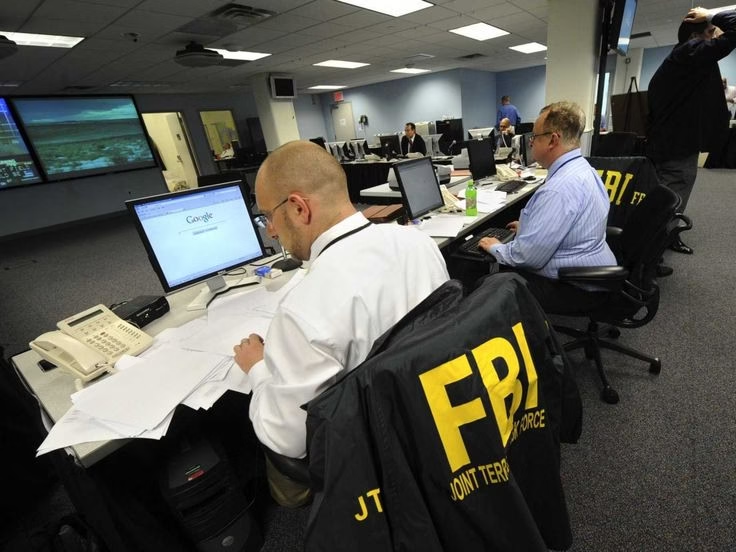
The FBI convened several hundred investigators, foreign police and blockchain-forensics firms in San Antonio on Sept. 2-3 for an invitation-only crypto crime meeting, as North Korea-linked hackers were blamed for about 66% of cryptocurrency stolen in the first half of 2026.
The bureau published no agenda or attendee list, so most details come from participants.
The gathering comes as the FBI reports a significant volume of cryptocurrency-linked crime complaints. According to the bureau’s 2025 Internet Crime Report, 181,565 complaints involving cryptocurrency were submitted during the year, with reported losses exceeding $11 billion.
Cryptocurrency investment fraud accounted for more than $7.2 billion of those reported losses. The FBI cautions that complaint data do not capture every crime, meaning the figures should be viewed as a measure of reported losses rather than a complete estimate of total crypto-related criminal activity.
The scale of the problem gives additional context to the gathering and the bureau’s decision to maintain specialized digital-asset capabilities. The FBI established its Virtual Assets Unit in 2022 to centralize expertise in cryptocurrency investigations, blockchain analysis, asset seizures and operational support.
Fraud, compromised credentials, social engineering and attacks against infrastructure can create losses even when an underlying blockchain or asset remains operational.
The FBI continues to direct victims of online crime to the Internet Crime Complaint Center, or IC3. Investors who encounter suspected fraud are encouraged to preserve transaction details and report the activity rather than attempting to recover funds through unverified third-party services.
North Korea-linked cryptocurrency theft was reportedly among the issues discussed during the San Antonio meeting. The subject has become increasingly important for digital-asset security firms following several large attacks during the first half of 2026.
TRM Labs estimates that approximately $643 million, or about 66% of cryptocurrency stolen during the first half of 2026, was attributable to North Korea-linked activity. Two major April incidents involving Drift Protocol and KelpDAO accounted for approximately $577 million combined.
The Drift Protocol incident alone resulted in roughly $285 million in losses. TRM Labs said attackers spent weeks preparing the operation before draining assets in about 12 minutes. The investigation identified social engineering and compromised signing authority as central elements of the attack.
Drift said it was cooperating with law enforcement and outside forensic specialists while working on a recovery framework for affected users.
The case illustrates why the FBI crypto crime forum reportedly included discussions about attacks in which criminals target people with privileged access rather than simply exploiting smart-contract code.
The threat has continued to evolve. In July, a wallet linked to the Drift exploit moved approximately $44 million worth of Ether into Tornado Cash after remaining largely inactive for months, according to the report.
The firm recorded 207 hacks during the first half of 2026, the highest number it had recorded in a six-month period, while total losses stood at approximately $972 million.
The FBI crypto crime forum also took place against a wider backdrop of concerns about cryptocurrency being used by sanctioned entities and state-linked actors.
Chainalysis estimates that sanctioned entities received approximately $104 billion in cryptocurrency during 2025, representing a 694% increase from the previous year. The company also estimated that identified illicit cryptocurrency addresses received at least $154 billion during the year.
Those figures require context. Chainalysis describes the illicit-volume estimate as a lower-bound figure because additional illicit addresses can be identified after transactions occur. At the same time, legitimate cryptocurrency activity remains substantially larger than the illicit activity identified by blockchain analytics firms.
Russia, Iran and North Korea were among the state-related actors highlighted in Chainalysis’ analysis, with cryptocurrency activity linked to sanctions evasion, cross-border trade, procurement and other forms of financial infrastructure.
The FBI crypto crime forum signals the growing intersection between blockchain investigations, financial crime enforcement and national-security concerns. It also reinforces the importance of operational security for exchanges, protocols, custodians and investors.
The FBI has not published a public agenda, attendee list or post-event report for the September meeting. Much of the available information therefore comes from participants, industry disclosures and reporting by specialist cryptocurrency media.
As blockchain adoption grows, investigators are increasingly relying on transaction tracing, private-sector intelligence and international cooperation to identify illicit flows and connect on-chain activity with real-world actors.
The immediate issue is not market direction but risk awareness. Strong custody practices, careful verification of investment opportunities and prompt reporting of suspicious activity remain important safeguards in an environment where scams and infrastructure attacks can move quickly across borders.
The FBI’s own guidance warns that cryptocurrency investment fraud can involve fake investment platforms, social engineering and attempts to move victims into private messaging channels. The bureau also advises victims to stop sending funds and report suspected fraud through IC3.
As the digital-asset sector matures, cooperation between law enforcement, blockchain analytics companies, exchanges and security specialists is likely to remain an important part of efforts to trace stolen assets and disrupt criminal networks.
The September meeting in San Antonio provides another indication of how cryptocurrency investigations have become an established component of broader cybercrime and financial-crime enforcement.



Copyright © 2025 - The Bit Gazette.