

- Trending
- Comments
- Latest

A Prince Edward Island woman is out $9,800 in retirement savings after a scammer posing as a TD Bank fraud investigator convinced her to withdraw the money and deposit it into a bitcoin machine, using a phone number that matched the one listed on TD’s own website. Six months later, the bank has refused to reimburse her.
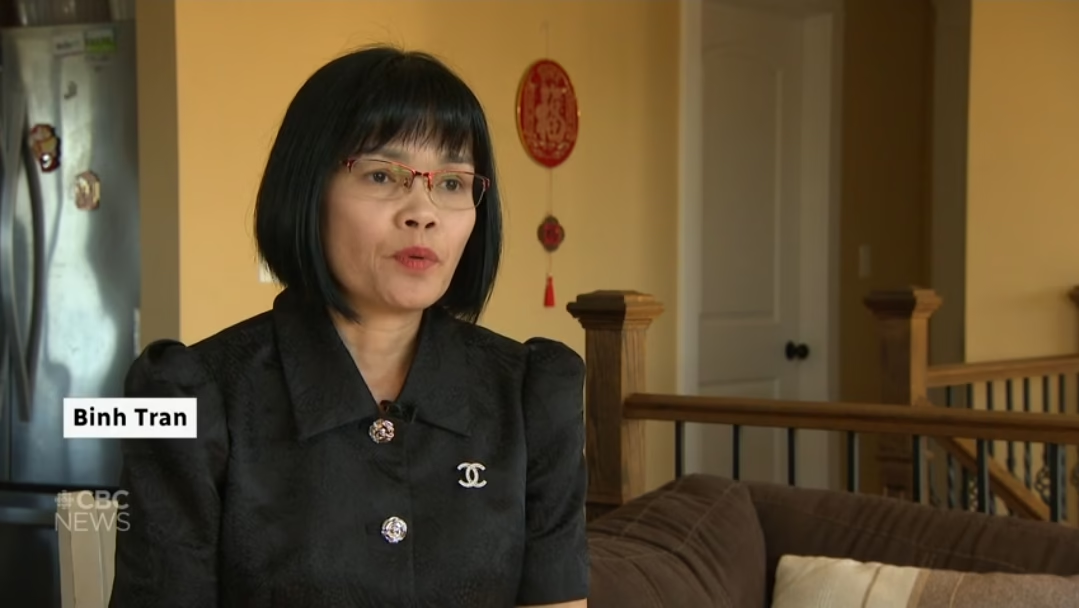
Tran said the caller told her she needed to withdraw her money to keep it safe and instructed her to remain on the phone while she went into the bank.
“He told me that I … need to withdraw my money for safety,” — Binh Tran, P.E.I. resident and bitcoin scam victim.
Although she became suspicious during the interaction, Tran said she searched the caller’s phone number online and found that it matched the number listed on TD Bank’s website.
That search reassured her that she was speaking with a legitimate representative. She proceeded with the withdrawal through a teller before depositing the money into a bitcoin machine.
In total, Tran lost $9,800.
The incident illustrates one of the difficulties victims can face when scammers use information that appears to confirm their identities. In Tran’s case, finding a matching bank telephone number gave her another reason to believe the caller was genuine.
Tran said she later discovered that she had fallen victim to a bitcoin scam and began trying to recover the money.
Earlier in September, TD Bank informed Tran that it would not reimburse the $9,800 she lost.
The bank declined to discuss the specific details of Tran’s case but said it understands the distress that can result from fraud. It also said reports of scams are taken seriously.
“I can confirm TD thoroughly reviewed this matter, shared our findings with Binh, and explained to her the rationale behind our decision,” — TD Bank spokesperson.
The bank said it maintains several security measures intended to protect customers, including monitoring and customer education.
“Helping protect our clients remains a top priority. We have multiple layers of security, monitoring and customer education in place,” — TD Bank spokesperson.
TD also warned customers not to automatically trust unsolicited calls or assume that a telephone number is legitimate simply because it appears to belong to the bank.
According to the bank, TD will never ask customers to assist with an investigation or request passwords or one-time security codes delivered by email or mobile device.
A key point in the dispute is a form Tran signed when withdrawing the money from the bank.
The document states that TD had warned her that fraudsters could instruct victims to purchase gift cards or bitcoin. It also records the customer’s confirmation that the withdrawal was made voluntarily and without coercion or pressure from a third party.

Tran believes the circumstances surrounding her withdrawal should still have prompted a deeper investigation into the transaction.
“I think that the TD Bank, they didn’t do anything for investigation,” — Binh Tran.
She also criticized the bank’s handling of her case, saying:
“They don’t care about a customer. They don’t care about a customer loss.” — Binh Tran.
Tran reported the bitcoin scam to police and spoke with an officer before filing a report. She said, however, that she does not know how the police investigation is progressing.

The case highlights the difficulty of determining responsibility when a customer voluntarily withdraws money but does so after being deceived by a third party.
Tran does not accept TD Bank’s decision and plans to appeal the matter to the federal banking ombudsman.
She said she believes she took reasonable precautions before acting on the caller’s instructions, including checking the telephone number against information available on the bank’s website.
For Tran, the $9,800 involved is significant because she considers the money part of her retirement savings.
“I just work at a Superstore at [a] part-time job, so this is a huge amount. This is my retirement nest, so I cannot lose that amount,” — Binh Tran.
“I just want my money back to my account. It’s not easy.” — Binh Tran.
The bitcoin scam has left Tran pursuing multiple avenues for recovery, including the bank’s internal process, a police report and a planned appeal to the federal banking ombudsman.
TD, meanwhile, continues to advise customers to be cautious with unsolicited communications and to remember that legitimate bank representatives will not request passwords, one-time security codes or participation in an investigation in the manner described by Tran.
The dispute remains unresolved, with Tran seeking reimbursement and TD maintaining that it has reviewed the matter and communicated the basis for its decision.



Copyright © 2025 - The Bit Gazette.