

- Trending
- Comments
- Latest

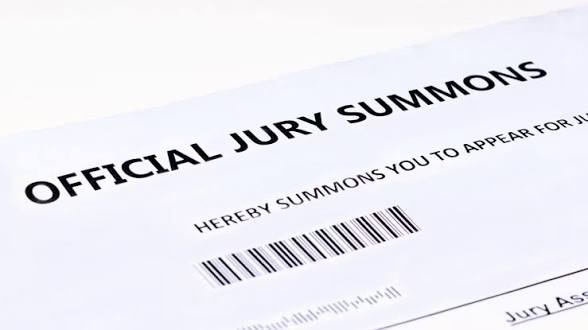
A Forsyth County, Georgia, woman lost $4,900 after scammers posing as court officials threatened her with arrest over a missed jury duty summons and directed her to a cryptocurrency kiosk, according to local reporting published Sept. 16, 2026.
The case illustrates how a Bitcoin ATM scam can combine impersonation, legal threats and cryptocurrency payments to pressure victims into acting before verifying the underlying claim. In this instance, the alleged missed jury duty provided the scammers with a reason to demand money urgently.
The Federal Trade Commission (FTC) warned in June that scammers have been contacting people while claiming they missed jury duty and threatening arrest unless they make a payment, including through cryptocurrency. The agency emphasizes that courts do not demand payment over the phone.
“Courts do not demand payment by phone,” Federal Trade Commission, in its June 2026 consumer alert.
The warning is particularly relevant to a Bitcoin ATM scam because the machines can provide a fast way to convert cash into cryptocurrency and send it to a wallet specified by another person. A victim may therefore believe they are resolving a legal problem when they are actually transferring funds directly to a scammer.
Bitcoin ATMs, also known as cryptocurrency kiosks, allow users to purchase or transfer cryptocurrency using cash or other payment methods. In legitimate transactions, users control where their cryptocurrency is sent. In a Bitcoin ATM scam, however, a caller may instruct the victim to enter a wallet address controlled by the fraudster.
The Georgia case reportedly followed this pattern. The woman was allegedly persuaded that she faced legal consequences and then instructed to use a Bitcoin ATM to make the required payment. Instead of paying a court or law enforcement agency, the $4,900 was transferred through the cryptocurrency system.
The FBI has separately warned about schemes in which criminals impersonate law enforcement officers or other authorities and pressure victims into making cryptocurrency payments through kiosks.
The FTC also warns that scammers can manipulate caller identification information to make calls appear to originate from legitimate law enforcement agencies. A displayed police number, therefore, does not establish that a call is genuine.
A Bitcoin ATM scam can be particularly effective when the fraudster creates a sense of urgency. Claims involving arrest warrants, court proceedings or missed jury service can make victims reluctant to end the call and independently contact the relevant institution.
The FTC’s jury duty warning states that law enforcement will not call to threaten someone with arrest for hanging up, while courts will not demand payment by phone. Those details provide an important distinction between legitimate court procedures and the tactics used in a Bitcoin ATM scam.
The Georgia incident is part of a broader pattern of reported cryptocurrency kiosk fraud. According to the FBI’s Internet Crime Complaint Center, more than 13,400 complaints involving crypto kiosks were recorded in 2025, with reported losses exceeding $388 million.
“Some complaints also involved other types of transactions,” Federal Bureau of Investigation, in its May 15, 2026 state-by-state data release.
The qualification is significant because the FBI’s reported figure should not be interpreted as losses caused exclusively by cryptocurrency kiosks. The data cover complaints involving kiosks alongside other transaction types.
Nevertheless, the figures demonstrate the scale of losses reported in connection with crypto-kiosk fraud. Each Bitcoin ATM scam can involve a different approach, but impersonation and pressure to make an immediate payment remain recurring elements in warnings from authorities.
The FBI has advised people who believe they have been defrauded through a cryptocurrency kiosk to preserve transaction records and receipts. Information such as the kiosk’s location, the destination wallet address, if available, and details about the person who made the demand can assist investigators.
Victims can also report suspected fraud to local law enforcement and the FBI’s Internet Crime Complaint Center.
Authorities and governments have taken different approaches to cryptocurrency kiosk-related losses. In Arizona, 35 victims of crypto ATM fraud received a combined $171,332 in refunds under a state law that established eligibility and reporting requirements.
That Arizona action does not establish whether the Georgia woman will recover her $4,900. Her case remains a separate incident involving a reported Bitcoin ATM scam and an alleged false jury duty claim.
The recurring warnings from regulators and law enforcement focus on verification before payment. A person receiving an unexpected demand involving a warrant, arrest or court obligation can independently contact the relevant court or law enforcement agency rather than relying on the caller’s contact information.
This is especially important when the requested payment involves cryptocurrency. Unlike a conventional court payment process, a Bitcoin ATM scam can direct cash into a digital wallet that may be difficult to recover once the transaction is completed.
The Forsyth County case therefore highlights a broader warning for consumers: an urgent legal threat combined with instructions to use a cryptocurrency kiosk should be independently verified before any money is sent. A legitimate court obligation should be confirmed through official channels, rather than through the telephone number or payment instructions supplied by an unexpected caller.
As reported cryptocurrency kiosk losses continue to draw attention, the Georgia incident shows how established impersonation tactics can be adapted to newer payment technology. For victims, recognizing the warning signs of a Bitcoin ATM scam before completing a transaction may provide the opportunity to stop the payment and seek assistance.



Copyright © 2025 - The Bit Gazette.