






- Trending
- Comments
- Latest

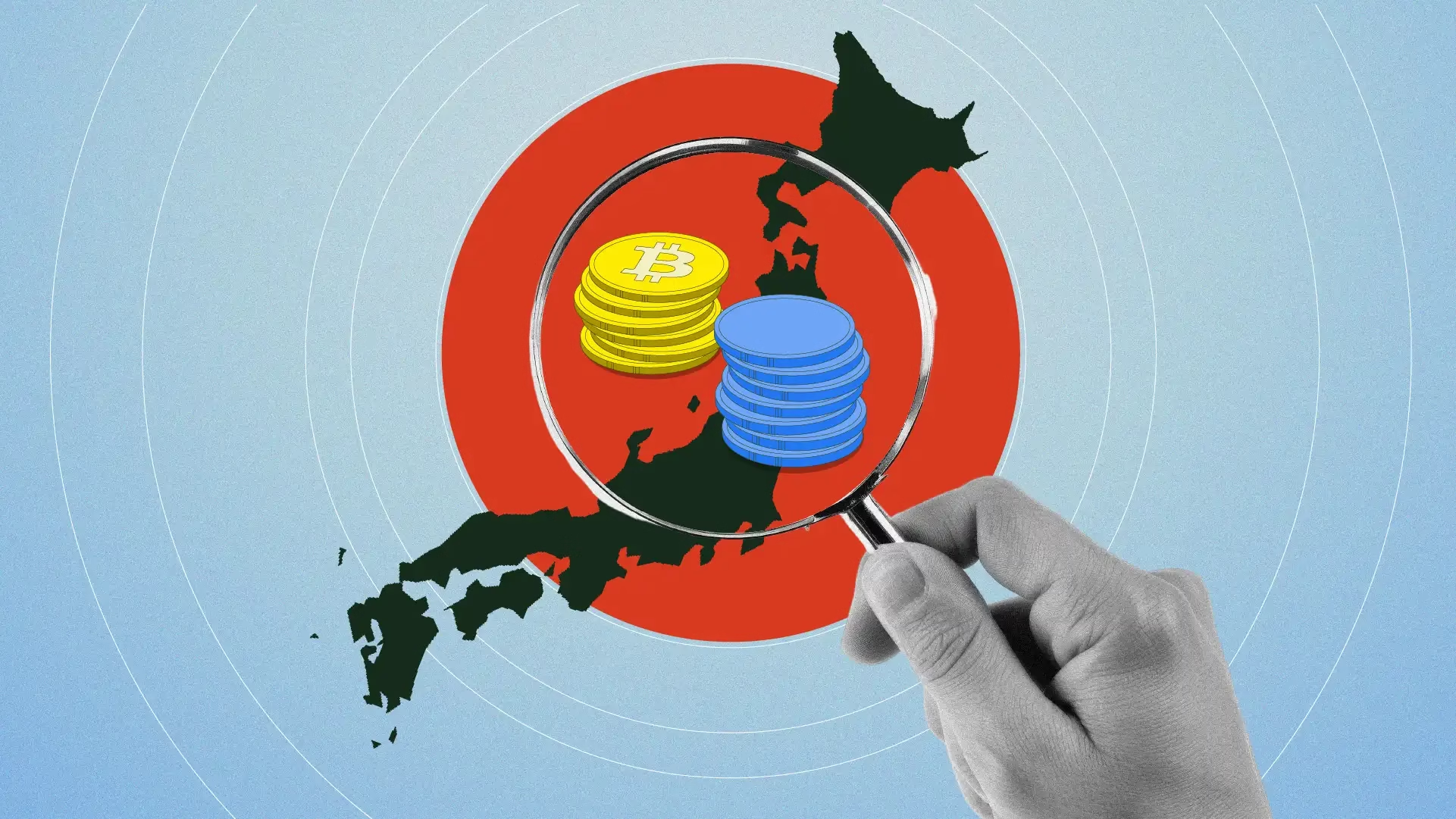
Japan has frozen the assets of Russian crypto exchange Garantex Europe OU, joining the United States and European Union in sanctioning a platform that Elliptic estimates processed more than $96 billion. But the exchange’s customers and deposits had already moved to Grinex, which Tokyo’s Oct. 2 sanctions list does not name.
Garantex appears at No. 402 on the annex, alongside defense contractors, industrial firms and 35 vessels tied to Russia’s oil trade.
Garantex appeared at No. 402 on Japan’s Oct. 2 sanctions annex, alongside defense contractors, industrial companies and 35 vessels connected to Russia’s oil trade. Its inclusion in the Russia sanctions package reflects Tokyo’s broader effort to restrict financial and commercial activity associated with Moscow.
Under Japan’s Foreign Exchange and Foreign Trade Act, Japanese residents and companies now require permission for payments to Garantex Europe OU and for certain deposit, trust and loan arrangements involving the exchange. The restrictions effectively create an asset freeze within Japan’s jurisdiction.
Contracts entered into before Oct. 2 are subject to a limited transition period, with obligations allowed to be completed before Nov. 1 under the stated conditions.
The measure is part of a much wider package. Japan also imposed export restrictions on four entities outside Russia and Belarus, introduced controls covering 35 vessels and expanded restrictions on goods considered capable of strengthening Russia’s industrial base.
For Tokyo, the Garantex designation adds a cryptocurrency component to a sanctions framework otherwise dominated by traditional companies, industrial assets and shipping interests.
The latest Russia sanctions package arrives more than four years after the U.S. Treasury’s Office of Foreign Assets Control first sanctioned Garantex on April 5, 2022. At the time, Treasury identified the exchange as operating in Russia’s financial-services sector.
U.S. authorities later said more than $100 million in transactions processed through Garantex since 2019 were connected to ransomware, terrorism and other illicit activity. That history placed the exchange at the center of international efforts to disrupt cryptocurrency networks associated with illegal financial flows.
Blockchain analytics firm Elliptic estimated that Garantex processed more than $60 billion after the 2022 U.S. sanctions and more than $96 billion in total. Estonia had previously revoked the exchange’s license over anti-money-laundering concerns, while the European Union subsequently imposed its own sanctions.
The scale of activity is central to understanding why Garantex remains a target in the latest Russia sanctions package, even though the platform itself had already suffered major enforcement actions in other jurisdictions.
The March 2025 U.S. operation appeared to mark a major setback for Garantex. The U.S. Secret Service and international partners seized the exchange’s domain, while the Justice Department unsealed indictments against executives Aleksandr Mira Serda and Aleksej Besciokov. Besciokov was arrested in India.
But the enforcement action did not necessarily eliminate the underlying network.
According to the material cited by the U.S. Treasury, Garantex personnel transferred customer deposits to Grinex, a separate exchange incorporated in Kyrgyzstan in December 2024. That timing meant the successor platform existed months before authorities seized Garantex’s website.
The development illustrates one of the central difficulties facing the Russia sanctions package and similar international enforcement campaigns: shutting down a particular website or legal entity does not necessarily dismantle the infrastructure, relationships and customer base behind it.
By Aug. 14, 2025, OFAC had re-designated Garantex and sanctioned Grinex, three executives and six related companies in Russia and Kyrgyzstan. Another platform, Exved, was also named.
Research from TRM Labs described the broader mechanism as part of a pattern in which exchanges facing enforcement can establish replacement venues before authorities act, allowing customers, wallets and trading activity to move to another platform.
Japan’s decision gives the international Russia sanctions package another layer of reach, but it does not erase the activity that took place before the restrictions were imposed.
Tokyo’s designation does not list Grinex, freeze cryptocurrency held outside Japanese jurisdiction or recover funds that had already passed through Garantex. The action instead limits transactions and financial relationships involving the exchange within the scope of Japanese law.
That distinction is significant because the Garantex case demonstrates how quickly cryptocurrency operations can move between platforms and jurisdictions. A domain can be seized, assets can be frozen and executives can face prosecution, yet customers and financial activity may migrate elsewhere.
The Russia sanctions package therefore addresses both the exchange itself and the wider financial environment surrounding Russia-linked crypto activity. Japan’s action also demonstrates that sanctions coordination can continue even after another jurisdiction has already taken enforcement action.
For international regulators, the challenge extends beyond identifying and sanctioning a single exchange. The Garantex case shows that successor entities, replacement platforms and cross-border transfers can complicate efforts to permanently disrupt a cryptocurrency operation.
Japan’s latest Russia sanctions package ultimately closes another route for Garantex to interact with Japanese financial and commercial interests, while leaving the larger question of successor platforms unresolved.
The case also underscores why the Russia sanctions package increasingly involves more than traditional banks, companies and shipping networks. Cryptocurrency exchanges can operate across jurisdictions, move assets rapidly and establish alternative infrastructure before enforcement arrives.
For authorities pursuing the Russia sanctions package, the Garantex saga demonstrates the difference between disabling a platform and dismantling the network that supported it. Japan’s asset freeze adds pressure, but the emergence of Grinex shows why sanctions enforcement increasingly requires coordination across jurisdictions and continued monitoring of replacement entities.



Copyright © 2025 - The Bit Gazette.

