

- Trending
- Comments
- Latest

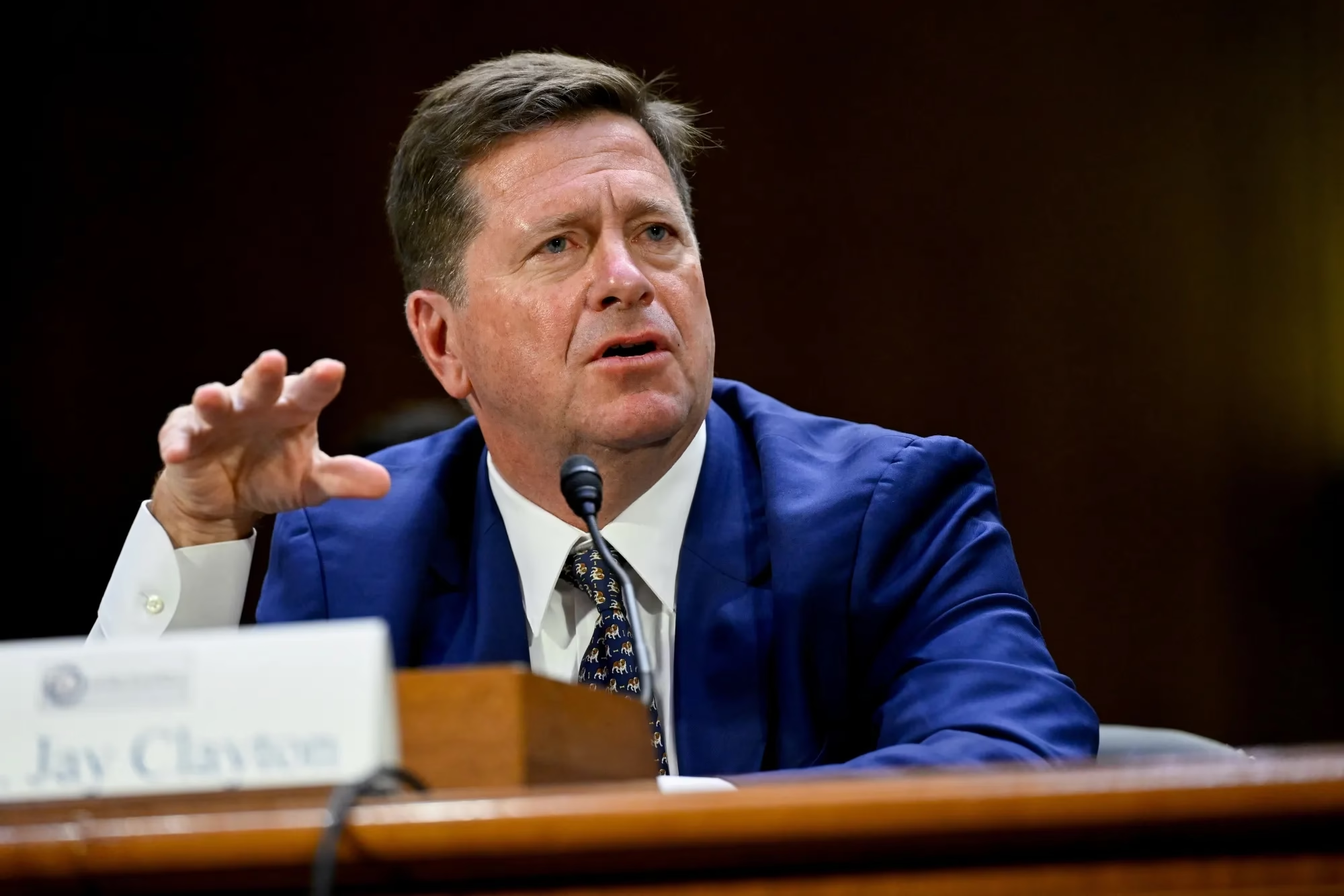
President Donald Trump has put Jay Clayton, the former SEC chairman who oversaw the Ripple lawsuit, in charge of a new federal superintelligence task force with 120 days to report on the opportunities and risks of advanced AI.
The development is notable because the administration has increasingly linked technological competitiveness across artificial intelligence, advanced computing and digital assets.
The Super intelligence force represents a new attempt by the Trump administration to consolidate federal thinking around advanced AI.
Clayton, who currently serves as director of national intelligence, will lead the four-person leadership team alongside Federal Trade Commission Chairman Andrew Ferguson, Pentagon technology chief Emil Michael and Office of Personnel Management Director Scott Kupor.
The group is expected to engage a broad range of stakeholders, including technology companies, consumers, public-interest organizations, religious groups and operators of critical infrastructure. Its work will ultimately report to Trump and White House Chief of Staff Susie Wiles.
Trump described the initiative as part of a wider effort to keep the United States ahead in advanced technology.
In announcing the task force, he said it was created to “ensure that America continues to lead the World in Super Intelligence“. The president also connected the program to public welfare, saying it “will protect the interests, and improve the lives, of all Americans.” — Donald Trump, U.S. president.
The administration’s objective is therefore broader than simply encouraging AI development. The task force is expected to examine how the government should respond to the technology while attempting to avoid policies that could weaken U.S. competitiveness.
A central responsibility of the Super intelligence force will be producing a report within 120 days examining the opportunities and risks associated with increasingly capable AI systems.
According to the supplied report, Clayton said the group would assess both the potential benefits and dangers of the technology while determining what responsibilities should fall to the federal government.
The mandate places Clayton in a position that combines his current national-security responsibilities with a broader technology-policy role.
The task force is also expected to consider how existing federal mechanisms could respond to problems involving advanced AI.
The development is particularly relevant to crypto investors because the Trump administration has repeatedly presented American leadership in digital assets and advanced technology as part of a broader economic and geopolitical competition.
The supplied report notes that Trump has previously argued that the United States should not surrender its position in cryptocurrency to China, placing digital assets alongside other strategic technologies in his competitiveness agenda.
The creation of the Super intelligence force comes shortly after Trump signed an executive order changing how the federal government refers to artificial intelligence. On September 29, Trump signed Executive Order 14434, titled Inaugurating the Era of Super Intelligence.
The order directs executive departments and agencies, where legally permitted, to use Super Intelligence and “SI” instead of Artificial Intelligence and “AI” in official communications, websites, reports, policy documents and other nonstatutory materials.
The order does not create an entirely new legal category of technology. Instead, it states that Super Intelligence and “SI” will, for purposes of the order, use the existing statutory definition of artificial intelligence unless Congress or a later presidential action changes that framework.
The White House science adviser has also been instructed to propose legislative language for a federal definition within 60 days.
The appointment also gives the Super intelligence force a leader with significant experience in financial regulation.
Before becoming director of national intelligence, Clayton served as chairman of the U.S. Securities and Exchange Commission from May 2017 through December 2020.
His tenure included the SEC’s legal action against Ripple Labs and two executives over the sale of XRP, a case that became one of the most closely watched regulatory disputes in the cryptocurrency industry. The SEC filed its lawsuit against Ripple in December 2020, shortly before Clayton left the agency.
The litigation subsequently continued through several years of appeals before the parties dismissed their appeals in 2025, leaving a civil penalty and restrictions concerning future securities-registration violations in place, according to the supplied report.
Clayton’s return to a prominent government technology role is therefore likely to attract attention from digital-asset market participants. His previous position at the SEC gives him firsthand experience with financial markets, securities regulation and the legal questions surrounding cryptocurrency.
However, his new assignment is substantially broader. The Super intelligence force is not a cryptocurrency regulator, and its immediate mandate centers on artificial intelligence, technological opportunity, national security and the appropriate role of the federal government.
Both industries depend heavily on advanced computing, cybersecurity and access to capital, while policymakers increasingly view technological leadership as an element of national economic strategy.
The Super intelligence force will now have 120 days to translate those priorities into recommendations. Its eventual findings could provide investors with a clearer indication of how the Trump administration intends to balance technological innovation, national security and government oversight.
The Super intelligence force is consequently worth monitoring as its review progresses, particularly for any recommendations that affect technology companies, data infrastructure, cybersecurity, digital assets or federal approaches to innovation.



Copyright © 2025 - The Bit Gazette.