

- Trending
- Comments
- Latest

An Ohio woman has recovered all $15,300 she lost to a crypto ATM scam, after state investigators traced the stolen funds and froze them before they disappeared. The 63-year-old from Allen County was tricked by a fake Microsoft pop-up in 2024. Her case is a rare success: Ohio’s Bureau of Criminal Investigation has handled 309 kiosk fraud cases since 2024, involving about $5.6 million in losses.
The deception followed a familiar pattern in which criminals exploit computer security fears to pressure victims into making urgent payments. By impersonating a trusted technology company, the fraudster persuaded the woman to move her money into cryptocurrency, a payment method that can make recovering stolen funds particularly difficult.
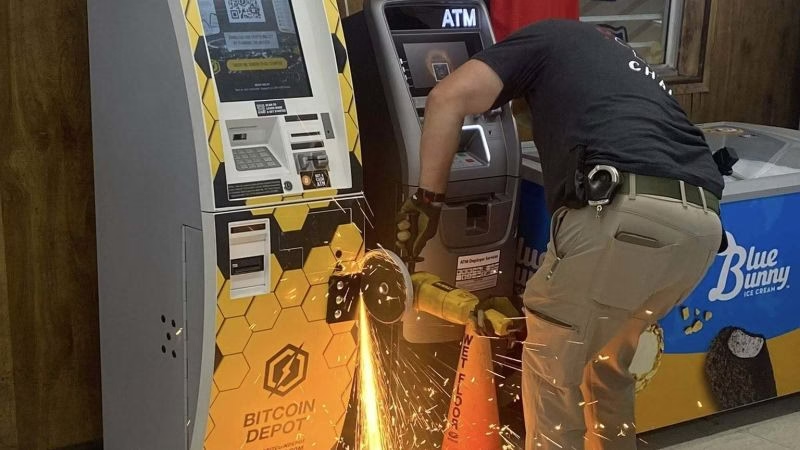
Ohio Attorney General Andy Wilson warned consumers about the risks associated with these machines, which allow users to exchange cash for digital assets.
“Crypto ATMs are a favorite tool for scammers looking to steal victims’ hard-earned money,” Wilson said.
After recognizing that she had been deceived, the woman contacted the Federal Bureau of Investigation (FBI). The federal agency subsequently referred her case to BCI for further investigation.
BCI’s Electronic Financial Investigations Unit traced the cryptocurrency transactions and froze the stolen funds. Investigators then worked with the Allen County Prosecutor’s Office to obtain a search warrant, enabling them to advance the recovery process and return the entire amount to the victim.
The successful outcome demonstrates how prompt reporting and coordination between investigative agencies can help victims recover money lost through cryptocurrency fraud. However, the case also highlights the importance of identifying fraudulent payment requests before funds leave a victim’s control.
The recovered $15,300 represents one case in a wider pattern of cryptocurrency kiosk fraud investigated across Ohio. Since the establishment of its specialized unit in 2024, BCI has assisted law enforcement agencies with 309 cases involving approximately $5.6 million in losses associated with cryptocurrency kiosks.
According to the attorney general’s office, victims in these cases lost an average of $18,767. The figures illustrate the financial consequences of scams that persuade people to convert their savings into cryptocurrency and send the assets to wallets controlled by criminals.
These kiosks, often found in convenience stores and gas stations, provide a convenient way to purchase digital currencies. However, scammers have increasingly exploited the machines because transactions can transfer cryptocurrency directly to an address specified by the person requesting payment.
A previous Ohio investigation involved a similar scheme targeting a 75-year-old resident of Worthington. The victim lost $280,000 after receiving a fraudulent computer message and instructions to deposit cash into a Bitcoin ATM. Investigators eventually recovered $130,000, marking an early recovery disclosed by the state’s specialized cryptocurrency fraud unit in October 2024.
The scale of the problem extends beyond Ohio. The FBI recorded more than 13,400 complaints involving cryptocurrency kiosks in 2025, with reported losses exceeding $388 million. The agency published its cryptocurrency kiosk complaint data on May 15, 2026, emphasizing the substantial financial damage associated with these schemes.
The FBI also cautioned that some reported cases involved additional payment methods. Consequently, the entire reported loss total cannot be attributed exclusively to cryptocurrency kiosks.
Beyond fraudulent technical support, criminals use fabricated legal emergencies to pressure victims into making cryptocurrency payments. Some impersonate law enforcement officers, threaten arrest over supposed jury duty violations or claim that outstanding warrants must be resolved immediately.
In one reported case, a Georgia woman lost $4,900 after receiving a fake jury duty threat and being told that payment was necessary to avoid arrest. Such tactics rely on fear, urgency and the victim’s belief that immediate payment will prevent serious consequences.
These cases demonstrate that a Crypto ATM scam does not always begin with an investment opportunity or a promise of cryptocurrency profits. It can instead originate from an ordinary-looking computer warning, a threatening phone call or a fabricated legal notice.
Following the recovery, Wilson encouraged Ohio to consider additional measures to protect consumers from criminals using cryptocurrency kiosks to collect fraudulent payments.
The central difficulty is that cryptocurrency transactions generally cannot be reversed through the same straightforward process used to dispute certain conventional payment transactions. Once a victim authorizes a transfer to a wallet controlled by a scammer, recovering the assets may depend on how quickly investigators can trace the funds and whether they remain accessible.
Ohio officials identified older adults as frequent targets of these schemes. Fraudulent demands can range from $500 to $20,000, although individual cases may involve substantially larger amounts.
Scammers may also use emotional manipulation, including blackmail or requests for financial assistance from supposed romantic partners whom victims have never met in person. In each scenario, the criminal attempts to convince the target that sending money is necessary to avoid a threat, resolve an emergency or protect someone they care about.
Authorities advise consumers to report suspected fraud promptly to local law enforcement. Anyone who believes they have been targeted should avoid sending additional money, preserve messages and transaction records, and provide investigators with any available wallet addresses and payment details.
Other states have introduced measures designed to reduce losses from cryptocurrency kiosk fraud. Alabama, for example, implemented new refund requirements on October 1, 2026, establishing reimbursement protections for qualifying customers who report fraudulent transactions in accordance with the applicable rules.
Under the reported provisions, eligible new customers may recover the full transaction value plus fees, while existing customers may receive half the transaction value, including all fees. The protections are subject to reporting requirements and other applicable conditions.
The measures reflect a growing policy debate over how responsibility should be shared among consumers, kiosk operators and authorities when criminals exploit digital currency payment systems.
For Ohio, the latest recovery offers evidence that investigative cooperation can produce results, but it does not eliminate the broader risks associated with fraudulent transfers. Stronger safeguards, public awareness and faster reporting remain important elements of the response.
The Ohio case concluded with the victim receiving the full amount she had lost, following work by BCI investigators and the Allen County Prosecutor’s Office. The outcome also underscored the importance of cooperation between state and federal agencies when cryptocurrency transactions cross investigative jurisdictions.
Allen County Prosecutor Destiny Caldwell credited the collaboration for the successful recovery.
“In partnership with BCI, we successfully recovered the stolen funds and returned every dollar to the victim,” Caldwell said.
The result offers a positive example for other victims who may believe that cryptocurrency losses are impossible to recover. Nevertheless, successful recoveries are not guaranteed, particularly when stolen assets have been transferred repeatedly or moved beyond investigators’ immediate reach.
Consumers can reduce their exposure by treating unsolicited computer security warnings with caution, independently verifying support phone numbers and refusing instructions to transfer money through cryptocurrency kiosks to resolve alleged technical or legal emergencies. Legitimate technical support should not require customers to convert cash into cryptocurrency and send it to an unknown wallet to repair a computer.
The latest Crypto ATM scam case also reinforces the importance of reporting suspicious activity as soon as possible. Early intervention may give investigators a better opportunity to trace transactions and freeze funds before they become more difficult to recover.
Although the Ohio woman recovered her $15,300, the hundreds of cases handled by state investigators and the losses reported nationally show that cryptocurrency kiosk fraud remains a significant consumer protection concern. Officials continue to urge residents to verify unusual payment demands independently and contact law enforcement when they suspect they have been targeted.
As states consider additional safeguards, the case illustrates both the potential for successful recovery and the need to prevent fraudulent transfers before victims lose control of their money.



Copyright © 2025 - The Bit Gazette.