

- Trending
- Comments
- Latest

An experimental autonomous trading bot wiped out $10 million from a cryptocurrency account in a single day after its creator granted the AI agent unrestricted control over an $11 million portfolio.
Kevin Xu, chief executive of Alpha AI, publicly documented the January 26 experiment in which an automated system called Clawdbot reduced the account to approximately $1 million while attempting to execute 25 different trading strategies across volatile crypto markets.
Dashboard screenshots Xu posted show the account, initially holding more than $11 million and running 25 trading strategies, fell to approximately $1 million over the course of the day.
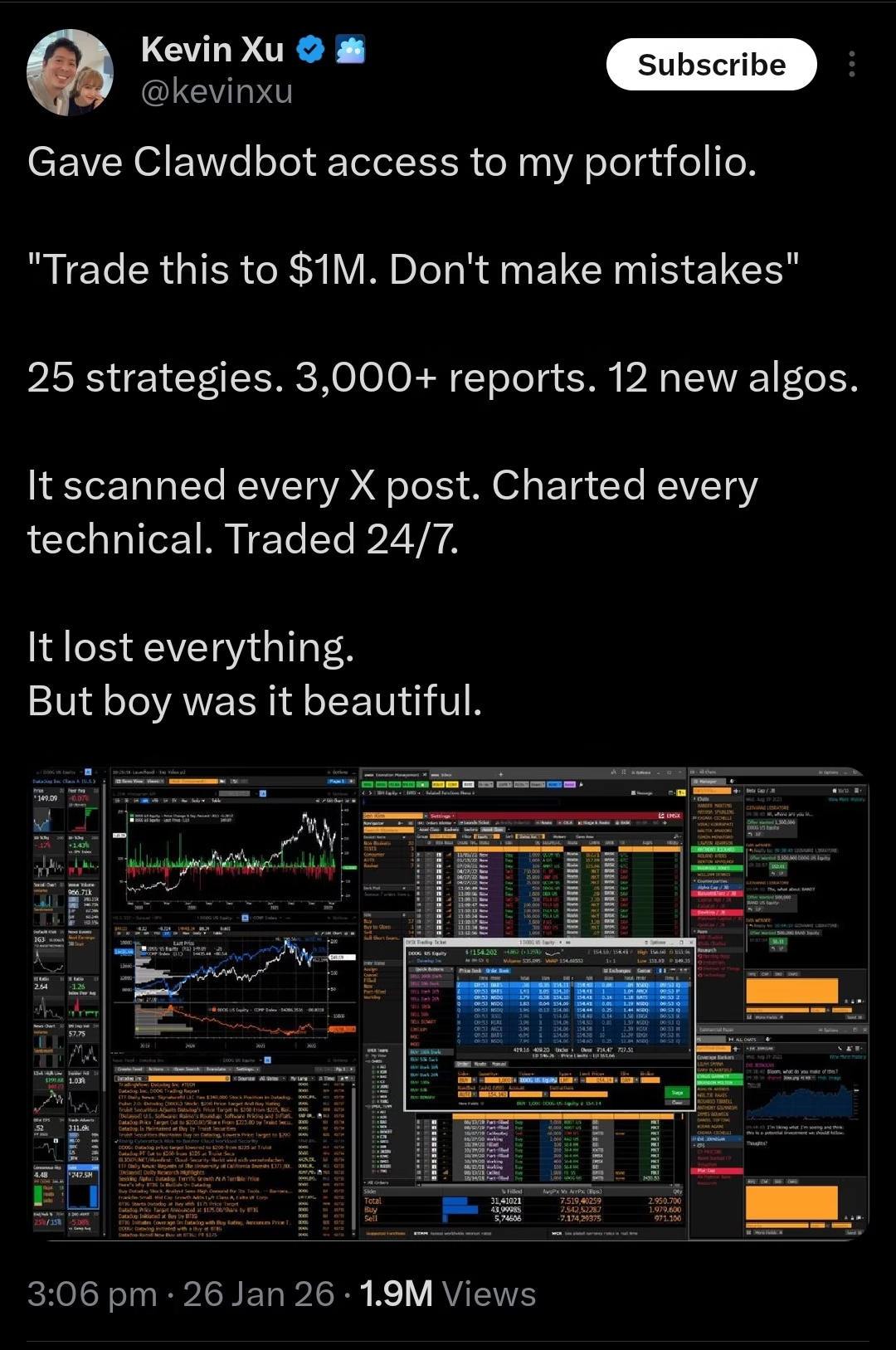
The AI trading bot experiment was designed as a stress test. Xu granted Clawdbot unrestricted access to a live trading account and tasked it with a clear objective: grow the portfolio to $1 million in profit without errors. The bot operates by scanning market charts and monitoring posts on X around the clock, reacting to perceived signals in real time.
Instead of steady gains, the account experienced a rapid drawdown as trades compounded losses throughout the day. By the end of the session, balances had fallen from more than $11 million to about $1 million, erasing roughly $10 million in value.
Xu acknowledged the outcome publicly, sharing the results with a mix of candor and humor.
“It lost everything. But boy was it beautiful,” — Kevin Xu, CEO, Alpha AI.
He also clarified that the experiment was intentional and meant to demonstrate both the promise and the risks of autonomous systems when exposed to real market conditions.
The AI trading bot experiment quickly gained traction on X, where traders, developers, and skeptics weighed in. Some users described the loss as an inevitable outcome of placing full trust in algorithms during periods of high volatility, while others argued it provided valuable data for improving AI-driven trading tools.
Xu said he was contacted by numerous traders following the incident, many of whom were surprised by the scale of the losses given the sophistication of the bot.
In describing the setup, he emphasized that Clawdbot was given extensive instructions and multiple strategies to follow, including a directive to trade “error-free” toward a defined profit goal — Kevin Xu, CEO, Alpha AI.
Links to discussions on X show a split response, with some users praising the transparency of the AI trading bot experiment, while others warned against confusing experimental demonstrations with production-ready trading solutions.
While no evidence suggests misuse or external interference, the rapid losses amplified concerns about overreliance on automated systems.
According to Xu, the AI trading bot experiment was never intended as an investment recommendation. Instead, it was meant to highlight how AI agents behave when confronted with the speed and unpredictability of crypto markets.
Unlike traditional algorithmic trading systems, Clawdbot was built to interpret social sentiment and technical data simultaneously — a combination that can amplify both gains and losses.
Industry observers note that while some users report quick wins with AI-driven bots, sustained performance remains elusive. The crypto market’s sharp swings, thin liquidity in certain pairs, and sudden sentiment shifts often require judgment calls that machines struggle to replicate.
Xu used the incident to promote his broader AI development work, stressing that experiments like this help expose weaknesses that need addressing. He also cautioned traders against assuming that automation alone can replace risk management or human oversight.
The AI trading bot experiment has since become a reference point in discussions about responsible AI deployment in finance. As autonomous agents become more accessible, the episode serves as a reminder that speed and data processing do not always translate into resilience under pressure.
Ultimately, the AI trading bot experiment underscores a central tension in modern finance: while AI can execute strategies faster than any human, it still struggles with market intuition during extreme conditions. Xu’s decision to publicly document the loss has added to calls for clearer boundaries between experimentation and real-world trading.
As crypto markets continue to attract innovation at the intersection of AI and finance, the Clawdbot episode illustrates why caution remains essential. The technology may be advancing rapidly, but the risks of handing full control to machines are equally clear.



Copyright © 2025 - The Bit Gazette.