






- Trending
- Comments
- Latest

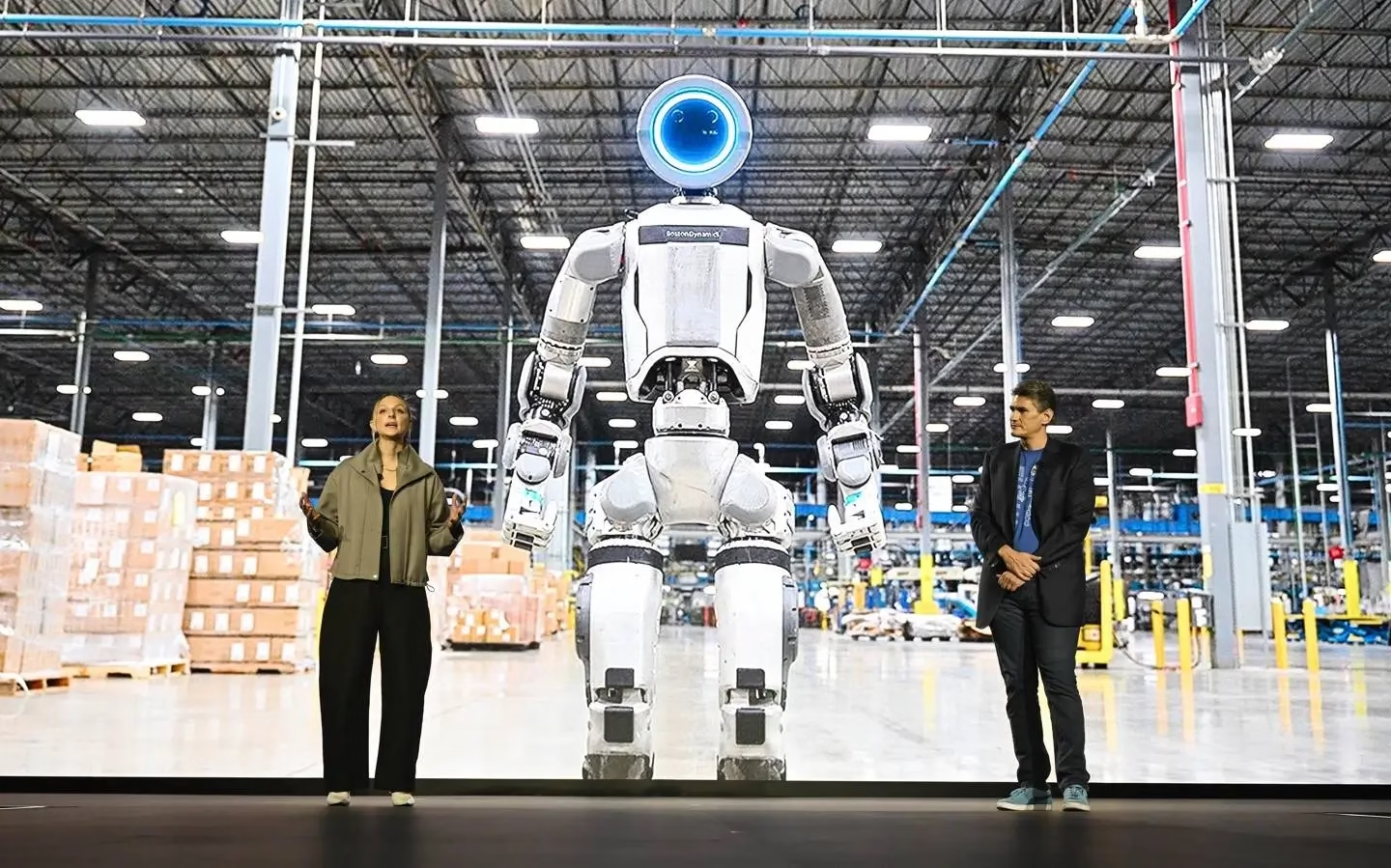
Google DeepMind and Boston Dynamics have integrated Gemini AI into Atlas humanoid robots, enabling autonomous navigation and task execution in factory environments as Hyundai tests the technology on automotive production lines.
Google DeepMind has partnered with Boston Dynamics to integrate its Gemini artificial intelligence system into Atlas humanoid robots, according to an announcement from the companies. The collaboration is designed to significantly enhance how the robots perceive their surroundings, plan actions, and manipulate objects in real-world industrial settings.
The companies said the integration focuses on factory use cases, particularly in automotive production lines where robots must operate in dynamic and often unpredictable environments.
“Google DeepMind and Boston Dynamics are integrating Gemini into Atlas humanoid robots to handle navigation, manipulation, and complex workflows in factories,” — Google DeepMind and Boston Dynamics, joint announcement.
By embedding Gemini’s AI stack, Atlas humanoid robots gain advanced reasoning, spatial awareness, and real-time decision-making. These capabilities allow the machines to carry out tasks that previously required close human supervision, such as sorting components, moving materials, and responding to physical obstacles on production floors.
Boston Dynamics’ Atlas platform is being used as a testbed to refine Gemini’s control systems. The companies explained that this approach allows continuous improvement of how the robots respond to task-specific challenges while maintaining safety standards expected in industrial environments.
Hyundai has emerged as a key industrial partner testing Gemini-powered Atlas humanoid robots on factory floors, according to sources familiar with the initiative. The automaker is using its production facilities as a controlled environment to evaluate how humanoid robots can improve efficiency without disrupting safety or workflow reliability.
“Hyundai is testing Gemini-powered Atlas units on production floors, using them as a testbed to scale intelligent robotics in manufacturing and logistics,” — company sources, as cited in the report.
For Hyundai, the trials are part of a broader strategy to explore automation technologies that combine flexibility with precision. Unlike traditional industrial robots, Atlas humanoid robots are designed to move and operate in spaces originally built for humans, making them suitable for tasks that require adaptability rather than repetitive motion.
The companies emphasized that Gemini enables the robots to operate autonomously in unstructured settings, adjusting their actions in real time as conditions change. This capability is critical in automotive factories, where layouts, tools, and workflows can vary between production lines.
A central focus of the collaboration is safety. According to the announcement, Gemini equips Atlas humanoid robots with perception and planning systems that allow them to assess risks and avoid hazards while working alongside human employees.
“Gemini provides the robots with advanced perception, planning, and problem-solving capabilities, enabling autonomous operation in dynamic, unstructured settings,” — Google DeepMind, in its statement.
The AI system allows Atlas robots to recognize objects, understand spatial relationships, and decide how best to complete tasks without relying on pre-programmed instructions alone. This marks a shift from traditional automation toward more intelligent robotics capable of judgment and contextual awareness.
Boston Dynamics said the Atlas platform will continue to evolve as Gemini’s control models are refined through real-world testing. The goal is to ensure that Atlas humanoid robots can safely perform physically demanding tasks while maintaining the precision required in manufacturing and logistics operations.
The partnership between Google DeepMind and Boston Dynamics reflects a growing push to bring general-purpose AI into robotics. By combining Gemini’s reasoning capabilities with Boston Dynamics’ hardware expertise, the companies aim to accelerate adoption of humanoid robots across industries where flexibility is essential.
The companies said the collaboration is intended to support manufacturing, logistics, and other sectors where robots must adapt quickly to changing conditions. This approach positions Atlas humanoid robots as a potential bridge between human labor and fully automated systems.
As Hyundai and other industrial partners continue testing, the trials will determine whether Gemini-powered robots can scale beyond pilot programs. If successful, the integration could reshape how factories deploy automation, moving from static machines to adaptable humanoid workers.
For now, the factory trials signal a significant milestone: Atlas humanoid robots, guided by Gemini AI, are no longer confined to research labs but are being evaluated in live industrial environments where safety, efficiency, and reliability are critical.



Copyright © 2025 - The Bit Gazette.