• Trending
  • Comments
  • Latest
The Louvre needed police escorts to move crypto attendees: Decentralised money just decentralised the danger

The Louvre needed police escorts to move crypto attendees: Decentralised money just decentralised the danger

04/18/2026 - Updated on 05/25/2026
AI People joins Dubai’s innovation one — Declares war on the forgetting of humanity

AI People joins Dubai’s Innovation One program: Declares war on the forgetting of humanity

07/22/2025 - Updated on 07/23/2025
XRP community

Ripple CEO reassures community after SWIFT selects rival blockchain for pilot

02/10/2026
Polygon Discord Channel Hacked, Throws Crypto Community in Turmoil

Polygon Discord Channel Hacked, Throws Crypto Community in Turmoil

2
Bitcoin reclaims $107,000 as Iran-Israel ceasefire cools market tensions

Bitcoin reclaims $107,000 as Iran-Israel ceasefire cools market tensions

2

Hello world!

1
Beyond the Stock Ticker

Lower transaction costs could turn crypto into everyday payment infrastructure

07/06/2026
Nigeria's SEC Sanctions: Bold Moves Empowering Regulated Crypto Growth

Nigeria SEC admits seven crypto firms to regulatory sandbox, Luno among them

07/06/2026
Crypto ransom kidnapping exposes growing threat to families in france

Hidden camera glasses used to steal $1.7 million in France villa scam

07/04/2026
  • Trending
  • Comments
  • Latest
The Louvre needed police escorts to move crypto attendees: Decentralised money just decentralised the danger

The Louvre needed police escorts to move crypto attendees: Decentralised money just decentralised the danger

04/18/2026 - Updated on 05/25/2026
AI People joins Dubai’s innovation one — Declares war on the forgetting of humanity

AI People joins Dubai’s Innovation One program: Declares war on the forgetting of humanity

07/22/2025 - Updated on 07/23/2025
XRP community

Ripple CEO reassures community after SWIFT selects rival blockchain for pilot

02/10/2026
Polygon Discord Channel Hacked, Throws Crypto Community in Turmoil

Polygon Discord Channel Hacked, Throws Crypto Community in Turmoil

2
Bitcoin reclaims $107,000 as Iran-Israel ceasefire cools market tensions

Bitcoin reclaims $107,000 as Iran-Israel ceasefire cools market tensions

2

Hello world!

1
Beyond the Stock Ticker

Lower transaction costs could turn crypto into everyday payment infrastructure

07/06/2026
Nigeria's SEC Sanctions: Bold Moves Empowering Regulated Crypto Growth

Nigeria SEC admits seven crypto firms to regulatory sandbox, Luno among them

07/06/2026
Crypto ransom kidnapping exposes growing threat to families in france

Hidden camera glasses used to steal $1.7 million in France villa scam

07/04/2026
Monday, July 6, 2026
  • Login
The Bit Gazette
  • Home
  • Crypto News
  • Expert Analysis
  • Finance
  • Tech
  • Sponsored
  • Press Release
  • Opinion
No Result
View All Result
The Bit Gazette
No Result
View All Result
Home Opinion

Lower transaction costs could turn crypto into everyday payment infrastructure

Reducing friction on blockchain transactions could shift digital assets away from speculation and toward mainstream payments, innovation, and real-world utility.

by Elizabeth Omotoke
55 minutes ago
in Opinion
Reading Time: 6 mins read
0
Beyond the Stock Ticker

Beyond the Stock Ticker

Share on FacebookShare on Twitter

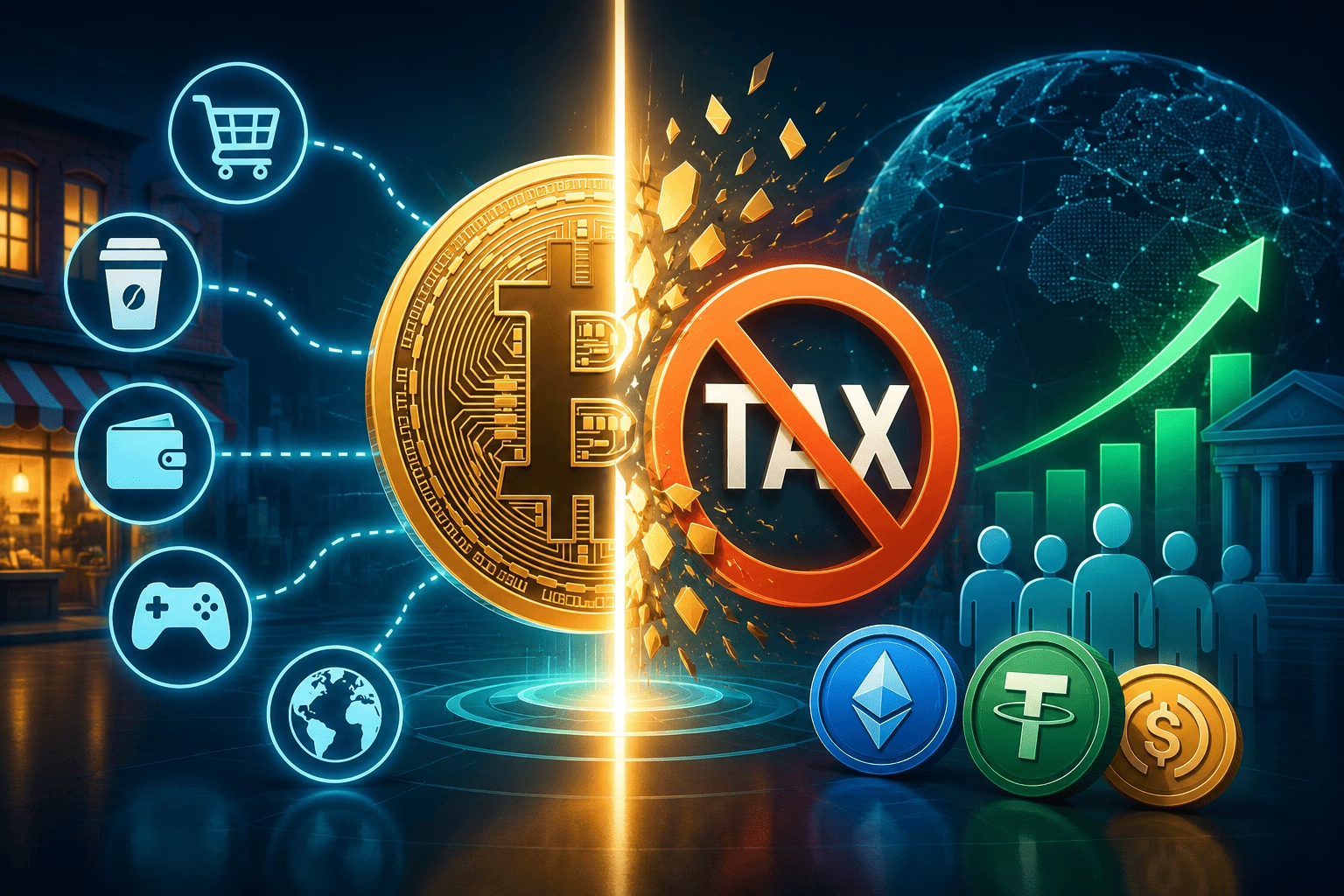
Crypto’s biggest advocates are pushing to strip out unnecessary transaction taxes and fees, arguing that lower friction, not price speculation, is what will finally make blockchain useful for everyday payments.

For years, crypto has struggled with an identity crisis, shifting between being viewed as a speculative investment during bull markets and being dismissed as little more than a risky asset during downturns.

Now, a growing debate over reducing unnecessary transaction taxes is putting the focus back on blockchain’s original purpose: creating an efficient, decentralized financial system that people use every day.


Supporters believe this shift could redefine how cryptocurrencies are perceived, encouraging consumers, developers, businesses, and institutions to embrace blockchain technology for practical applications rather than short-term speculation.

The cost barrier holding crypto back

One of the biggest obstacles to widespread blockchain adoption remains transaction friction. Whether the cost comes from government taxation, protocol-level fees, or token-specific tax mechanisms, every additional charge makes users think twice before transferring digital assets.

The impact extends far beyond trading. Paying for a cup of coffee with cryptocurrency, sending money abroad, purchasing digital collectibles, or interacting with decentralized finance (DeFi) platforms all become less attractive when every transaction carries an extra financial burden.

According to Vitalik Buterin, reducing unnecessary complexity and costs is essential to making blockchain networks accessible to everyday users. He has repeatedly argued that affordable transactions are critical for scaling adoption and enabling meaningful applications beyond speculation.

This reality has unintentionally encouraged many investors to hold tokens instead of spending them. While long-term investing remains an important part of the ecosystem, excessive friction works against blockchain’s original purpose as a peer-to-peer financial network.

Moving Beyond the Stock Ticker requires creating an environment where digital assets are used as seamlessly as traditional electronic payments.

Developers and businesses could benefit the most

Financial technology has consistently evolved by making transactions faster, cheaper, and simpler. Credit cards transformed retail commerce, mobile banking expanded financial inclusion, and digital wallets gained widespread acceptance because they removed barriers for consumers.

Blockchain technology is expected to follow a similar path.

When transaction costs decline, developers gain greater freedom to build applications requiring frequent user interactions. Subscription services, blockchain gaming, decentralized social networks, machine-to-machine payments, and microtransactions all become considerably more practical.

Andreas M. Antonopoulos has long emphasized that blockchain’s true value lies in enabling decentralized financial interactions rather than merely creating speculative investment opportunities. Lower friction aligns closely with that broader vision.

Businesses also stand to gain. Payment companies, financial institutions, multinational corporations, and technology firms generally prioritize predictable operating costs when evaluating new infrastructure. Lower transaction expenses make blockchain integration more attractive for payroll systems, international settlements, supply chain tracking, and digital identity management.

Instead of competing solely on token appreciation, blockchain ecosystems would increasingly compete through security, scalability, reliability, developer tools, and user experience.

That evolution would take the industry further Beyond the Stock Ticker and toward becoming genuine financial infrastructure.

Stablecoins could accelerate mainstream adoption

Among blockchain’s most practical innovations, stablecoins have emerged as one of the strongest use cases by combining digital efficiency with relatively stable value.

Today, millions of users rely on stablecoins for remittances, cross-border commerce, freelance payments, and merchant settlements. However, additional transaction costs can still reduce their effectiveness, particularly for small-value transfers.

According to a report by Chainalysis, stablecoins continue to account for a significant share of on-chain transaction volume, reflecting their growing role in global payments and emerging-market finance.

Reducing unnecessary transaction taxes would strengthen that position further. Lower costs would make sending money internationally faster and more affordable while encouraging merchants to accept digital payments without worrying about excessive overhead.

For developing economies, where access to efficient financial services remains uneven, this could significantly improve financial inclusion.

In this scenario, Beyond the Stock Ticker becomes more than a slogan—it represents a shift toward blockchain serving ordinary economic activity instead of primarily fueling speculative trading.

Balancing innovation with regulation

While reducing transaction taxes presents compelling opportunities, it is not without legitimate concerns.

Governments depend on tax revenue to fund public services and increasingly classify digital assets as taxable financial instruments. Regulators also remain focused on preventing tax evasion, illicit finance, and money laundering through appropriate compliance measures.

Likewise, several blockchain ecosystems incorporate transaction taxes into their tokenomics to fund ecosystem development, treasury reserves, validator incentives, or token-burning mechanisms designed to support network sustainability.

Removing these funding models entirely would require alternative economic structures capable of supporting long-term development.

The conversation, therefore, is not necessarily about eliminating every form of taxation. Instead, many industry participants advocate removing unnecessary friction that discourages legitimate economic activity while maintaining responsible regulatory oversight.

  • This balanced approach could gradually reshape investor psychology as well.
  • Rather than judging projects solely by daily price movements, investors may increasingly evaluate active users, developer activity, merchant adoption, network utilization, and ecosystem growth.
  • That transition reflects the broader movement Beyond the Stock Ticker, where long-term utility becomes a stronger measure of value than short-term market volatility.

Ultimately, blockchain was conceived as an open financial network capable of moving value efficiently across borders without unnecessary intermediaries. Lowering avoidable transaction costs alone will not solve every challenge facing the industry—scalability, cybersecurity, regulation, and user experience remain major priorities—but it could remove one of the most persistent barriers to mainstream adoption.

As blockchain networks mature, their success will likely depend less on speculative enthusiasm and more on whether people actually use them in their daily lives. When individuals no longer hesitate over the cost of every transaction, they can focus instead on the services, products, and opportunities blockchain technology enables.

That is the vision Beyond the Stock Ticker seeks to achieve: a digital economy where cryptocurrencies function not merely as investment vehicles but as practical infrastructure supporting payments, commerce, innovation, and global financial connectivity. In the long run, that may prove to be the industry’s most meaningful measure of success.

Tags: Bitcoinblockchaincross-border paymentscrypto economycrypto paymentscryptocurrency adoptionCryptocurrency Newsdigital assetsdigital paymentsethereumfintechpayment infrastructurestablecoinstransaction costsweb3
Share197Tweet123
Elizabeth Omotoke

Elizabeth Omotoke

  • Trending
  • Comments
  • Latest
The Louvre needed police escorts to move crypto attendees: Decentralised money just decentralised the danger

The Louvre needed police escorts to move crypto attendees: Decentralised money just decentralised the danger

04/18/2026 - Updated on 05/25/2026
AI People joins Dubai’s innovation one — Declares war on the forgetting of humanity

AI People joins Dubai’s Innovation One program: Declares war on the forgetting of humanity

07/22/2025 - Updated on 07/23/2025
XRP community

Ripple CEO reassures community after SWIFT selects rival blockchain for pilot

02/10/2026
Polygon Discord Channel Hacked, Throws Crypto Community in Turmoil

Polygon Discord Channel Hacked, Throws Crypto Community in Turmoil

2
Bitcoin reclaims $107,000 as Iran-Israel ceasefire cools market tensions

Bitcoin reclaims $107,000 as Iran-Israel ceasefire cools market tensions

2

Hello world!

1
Beyond the Stock Ticker

Lower transaction costs could turn crypto into everyday payment infrastructure

07/06/2026
Nigeria's SEC Sanctions: Bold Moves Empowering Regulated Crypto Growth

Nigeria SEC admits seven crypto firms to regulatory sandbox, Luno among them

07/06/2026
Crypto ransom kidnapping exposes growing threat to families in france

Hidden camera glasses used to steal $1.7 million in France villa scam

07/04/2026
The Bit Gazette

Copyright © 2025 - The Bit Gazette.

Navigate Site

  • About
  • Advertise
  • Privacy & Policy
  • Contact

Follow Us

Welcome Back!

Login to your account below

Forgotten Password?

Retrieve your password

Please enter your username or email address to reset your password.

Log In
No Result
View All Result
  • Home
  • Crypto News
  • Expert Analysis
  • Finance
  • Tech
  • Sponsored
  • Press Release
  • Opinion

Copyright © 2025 - The Bit Gazette.