







- Trending
- Comments
- Latest

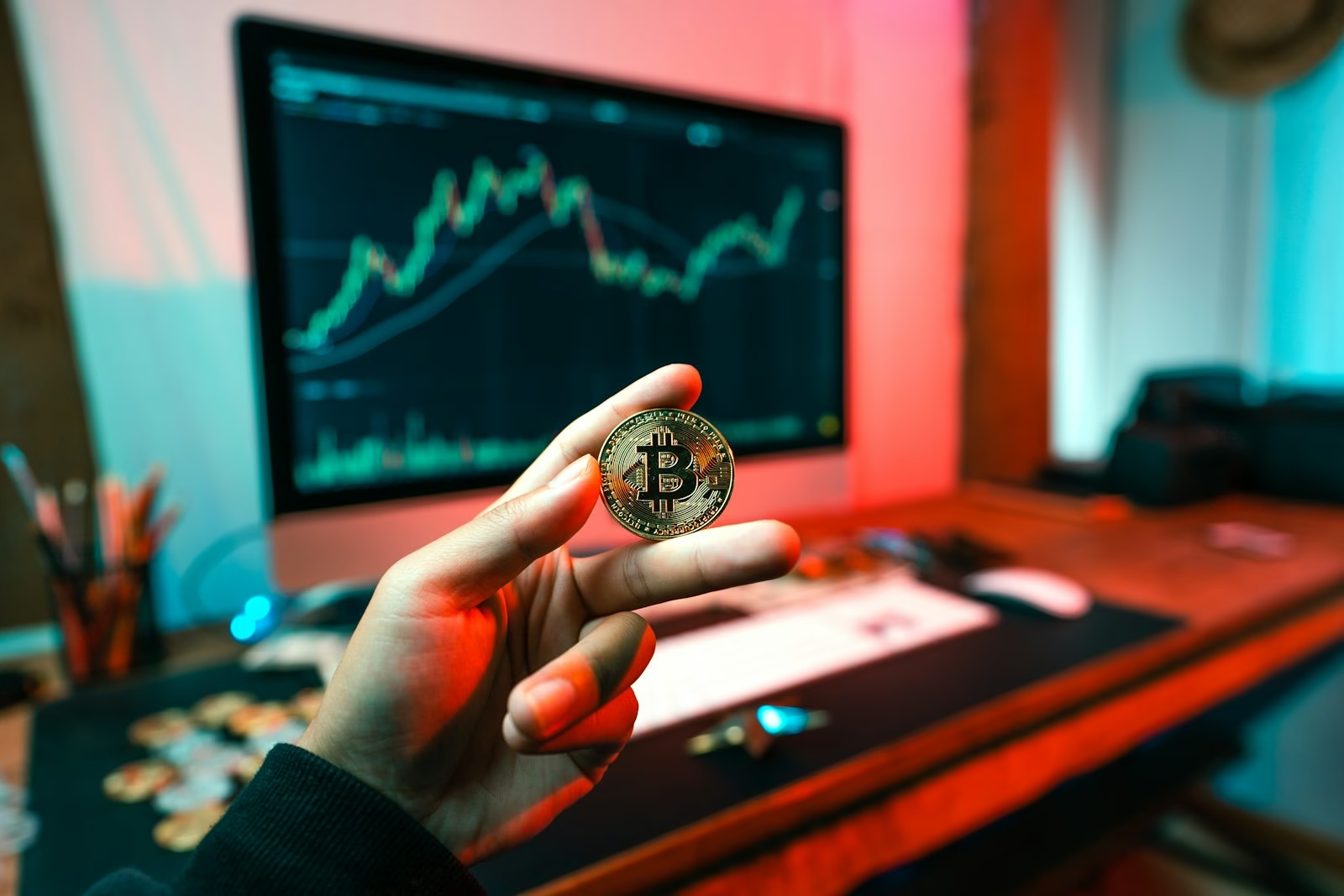
Bitcoin capital inflows stall as institutional treasuries break whale-retail cycle, CryptoQuant says
Bitcoin capital inflows have stalled as institutional treasury holdings prevent the whale-driven sell-offs that historically triggered market crashes, according to CryptoQuant CEO Ki Young Ju.
With Bitcoin consolidating near $94,000, Ju argues the market is no longer governed by whales flooding exchanges and sparking retail panic, but by long-term corporate balance sheets—led by MicroStrategy’s 673,000 BTC position—that refuse to sell. Instead of dramatic crashes, investors may face months of “boring sideways” price action.
Historically, large Bitcoin holders—so-called whales—would distribute holdings near cycle tops, flooding exchanges and igniting retail-driven selloffs. That playbook appears broken.
Ju pointed to institutional treasuries, most notably MicroStrategy’s massive 673,000 BTC position, as the reason.
These holdings are not speculative inventory but long-term strategic assets, effectively neutralizing the traditional whale-retail sell cycle that once dictated price direction.
“The market structure has changed,” Ju explained, adding that Bitcoin capital inflows are no longer reactive to short-term volatility but tied to corporate balance sheets and macro positioning.
Despite Bitcoin’s rebound from recent lows, whale exchange activity has declined rather than surged—an anomaly by historical standards. CryptoQuant data shows large holders are not rushing to exchanges, even as price volatility persists.
Crypto analyst Maartunn underscored the shift, stating, “Retail is still missing in action.” Without retail enthusiasm or whale distribution, Bitcoin capital inflows remain stagnant, trapping the market in a narrow trading range.
This unusual equilibrium leaves Bitcoin drifting without a clear catalyst—neither fear nor euphoria strong enough to dominate price action.
Adding to short-term anxiety, Bitcoin recently dipped below $90,000, filling its first CME gap and raising concerns of a deeper retracement toward the $88,000 region.
Yet even this move failed to spark panic selling. Analysts note that in previous cycles, similar breakdowns triggered aggressive outflows.
This time, Bitcoin capital inflows remained muted, reinforcing the thesis that institutional hands are steady—even stubbornly so.
Glassnode data paints a cautiously optimistic picture beneath the price noise. According to the analytics firm, Bitcoin entered 2026 after completing decisive drawdown and consolidation phases.

“In late December 2025, Realized Profit (7D-SMA) declined sharply to $183.8 million per day, down from over $1 billion seen throughout Q4,” Glassnode reported.
The slowdown suggests exhaustion of profit-taking pressure and structural stabilization near current levels.
Corporate treasury demand, the firm noted, continues to provide downside support—though Bitcoin capital inflowsremain episodic rather than structurally persistent.
Speaking with Cryptonews, VALR CEO Farzam Ehsani attributed Bitcoin’s consolidation to capital rotating into traditional safe havens. Over the past year, gold and silver have surged 69% and 161%, respectively.
“Bitcoin and ETH will see capital inflows once the rally in precious metals comes to an end,” Ehsani said, projecting Bitcoin at $130,000 and Ethereum at $4,500 by Q1 2026.
That view contrasts sharply with early Bitcoin investor Michael Terpin, who warned that 2026 could resemble historical down years like 2014, 2018, and 2022.
“If history rhymes, we could bottom near $60,000 in early fall,” Terpin said—though he acknowledged a 20% chance of an extended bull cycle.
Ju offered a long-term analogy for investors uneasy with stagnation: Bitcoin, like aging whiskey, rewards patience.
While Bitcoin capital inflows may feel disappointingly quiet today, the structural changes beneath the surface suggest a market maturing—not weakening.
For now, volatility may be muted. But when capital returns, it may do so with unprecedented force.



Copyright © 2025 - The Bit Gazette.

