




- Trending
- Comments
- Latest

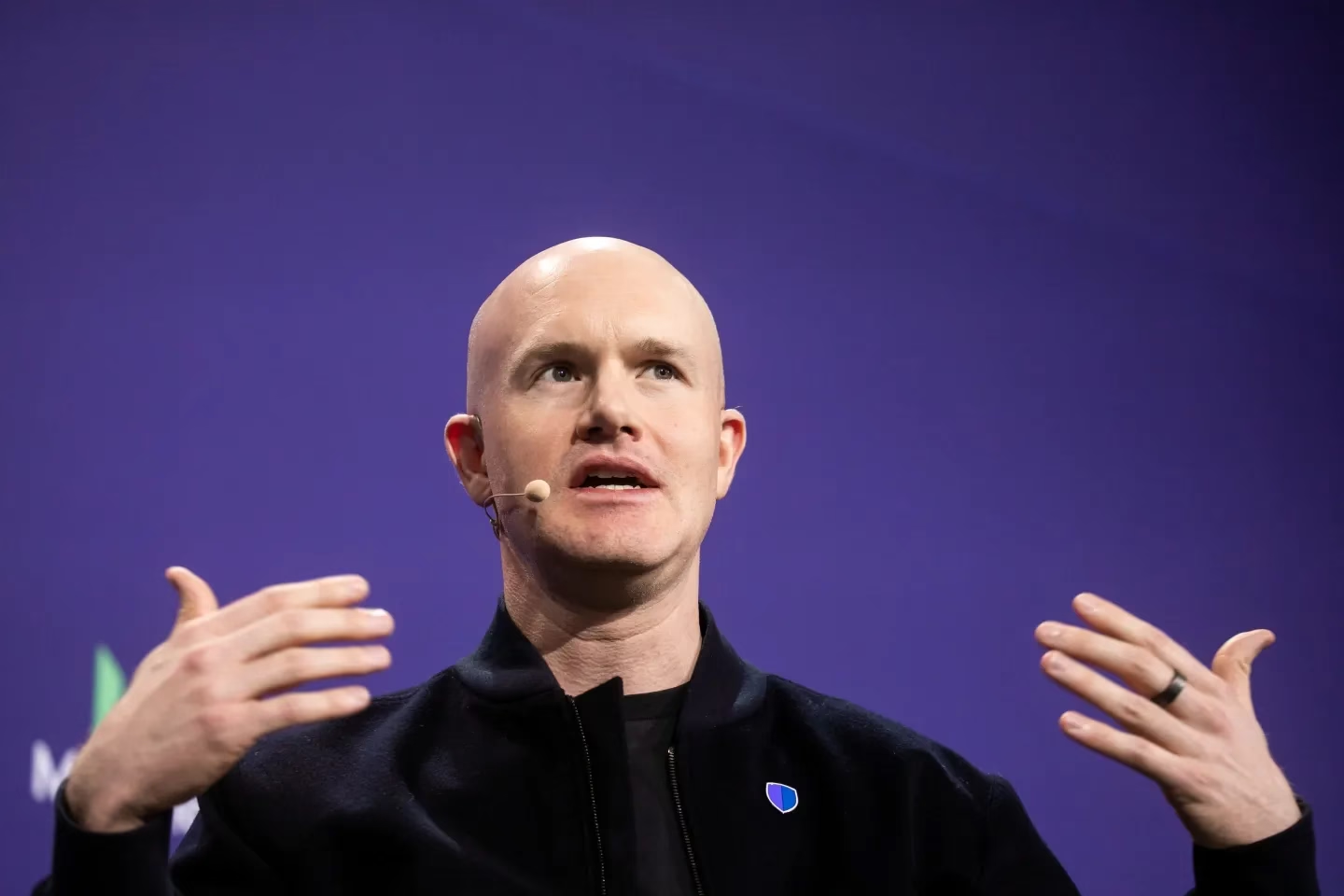
Coinbase chief executive Brian Armstrong has identified eight areas of global finance he says require immediate modernisation, arguing that stablecoins, tokenized assets, AI-driven payments, and 24/7 capital markets must replace infrastructure he describes as slow, fragmented, and expensive.
The financial system update proposal, published on May 25, 2026, comes as policymakers in Washington continue debating crypto regulation and as financial institutions accelerate experiments with tokenized assets and blockchain-based payment systems.
Armstrong said both governments and technology firms must collaborate to modernize capital markets, payments, and financial access.
“Tokenized real-world assets, stablecoins, AI, and sound money are all areas where the financial system still needs major updates,” — Brian Armstrong, CEO of Coinbase.
The financial system update agenda reflects Coinbase’s broader strategy of positioning itself at the center of the growing on-chain economy. The company has increasingly focused on stablecoins, institutional blockchain services, and AI-powered financial infrastructure as it seeks to diversify beyond traditional crypto trading revenue.
At the core of the financial system update is Armstrong’s argument that traditional financial rails remain slow, fragmented, and expensive compared with blockchain-based alternatives. He identified tokenized assets and stablecoins as two of the most immediate opportunities for reform.
According to Armstrong, tokenization could allow stocks, bonds, and real-world assets to trade continuously on blockchain networks without the restrictions of traditional market hours. Stablecoins, meanwhile, are increasingly being used for faster international settlements and digital commerce.
“We believe there will soon be billions of agents transacting and they need rails that can keep up,” — Brian Armstrong, CEO of Coinbase, during the company’s Q1 earnings release.
Coinbase reported strong growth in stablecoin-related activity during the first quarter of 2026. The company said USDC balances on its platform reached an all-time high, while stablecoin transactions on its Base blockchain network increased tenfold year-over-year.
The financial system update also includes support for 24/7 trading markets, expanded global access to capital formation, and AI-driven payment systems capable of handling automated transactions between software agents.
Industry analysts say the proposals reflect a broader shift within crypto markets away from speculation and toward infrastructure development. Several major banks and fintech firms have also begun exploring tokenized deposits and blockchain settlement systems over the past year.
The financial system update outlined by Armstrong arrives alongside major operational changes within Coinbase itself. Earlier this month, the company announced plans to cut approximately 14% of its workforce as part of a broader restructuring centered around artificial intelligence.
Armstrong said AI tools are already transforming productivity inside the company, allowing smaller teams to complete tasks that previously required larger departments. Coinbase has begun restructuring around what executives describe as “AI-native” workflows.
“We’re seeing great results using AI to update how we do compliance,” — Brian Armstrong, CEO of Coinbase, in a post on X.
The company claims AI systems have reduced restriction-resolution times by as much as 90%, particularly in compliance operations where human staff continue to review outcomes. Armstrong has also suggested that future financial infrastructure will increasingly rely on autonomous AI agents capable of handling transactions and executing contracts independently.
Still, the financial system update strategy has generated criticism from some workers and industry observers who argue that AI-driven restructuring could increase operational risks while reducing employment opportunities in the technology sector. Online discussions following Coinbase’s layoffs reflected concerns about the speed of automation across major tech companies.
Armstrong has repeatedly argued that the success of any financial system update will depend on clearer crypto regulation in the United States. Coinbase executives have spent years pushing lawmakers to establish legal frameworks for digital assets, stablecoins, and decentralized finance platforms.
The company recently welcomed progress on the proposed CLARITY Act, a bill designed to define how crypto assets are regulated across US agencies. Armstrong described the legislation as an important step toward modernizing financial infrastructure and expanding blockchain adoption.
Analysts say the debate around financial system update policies is likely to intensify as governments balance innovation with consumer protection concerns. Regulators in the US, Europe, and Asia continue to examine how tokenized assets and AI-powered financial services fit into existing legal frameworks.
Despite market volatility and recent losses reported by Coinbase, the company maintains that blockchain-based finance represents a long-term structural shift rather than a short-term trend.
“The underlying fundamentals of our business remain strong,” — Alesia Haas, Chief Financial Officer, Coinbase.
For Coinbase and Armstrong, the financial system update is no longer framed as an experimental concept. Instead, it is increasingly being presented as a necessary evolution of global finance, driven by digital assets, programmable payments, and AI-enabled economic systems.
Primary sources:
Coinbase investor relations
BeInCrypto report



Copyright © 2025 - The Bit Gazette.