




- Trending
- Comments
- Latest

CME Group is moving toward near-continuous cryptocurrency derivatives trading, a structural change that institutional investors and crypto-native exchanges are watching closely, because it narrows one of the clearest operational advantages decentralised platforms have held for years.
The crypto market may still be decentralized in philosophy, but capital ultimately follows efficiency. That reality is becoming increasingly important.
The rise of Web3 Exchanges was fueled by several factors, including self-custody, permissionless access, global participation, and continuous market availability.
Traditional financial institutions simply could not compete on trading hours. When major geopolitical events occurred over a weekend, crypto markets reacted instantly while traditional markets waited for Monday’s opening bell. Traders seeking immediate exposure naturally gravitated toward Web3 Exchanges because they offered uninterrupted access to opportunities and risk management.
This always-on model became deeply embedded within crypto culture. It wasn’t merely a feature. It became part of the industry’s identity.
Now that legacy financial infrastructure is beginning to embrace continuous trading, the competitive landscape is changing rapidly.
CME is not just another exchange operator. It is one of the world’s most influential derivatives marketplaces and serves many of the largest institutional investors globally. When CME embraces extended trading, it sends a powerful signal that traditional finance is adapting rather than resisting.
The significance extends far beyond operational convenience. Institutional investors have historically tolerated limited trading windows because alternatives were scarce. As CME moves closer to providing uninterrupted access, the gap between traditional venues and Web3 Exchanges begins to narrow.
That development matters because institutional capital remains the largest untapped liquidity pool in digital assets.

If investors can gain exposure to crypto-linked products through familiar, regulated environments operating nearly around the clock, some trading activity may shift away from crypto-native platforms.
The future of Web3 Exchanges may ultimately depend on liquidity rather than technology.
Markets thrive when buyers and sellers can transact efficiently. The deeper the liquidity pool, the lower the spreads and the more attractive the trading venue becomes.
Historically, Web3 Exchanges benefited from being the primary destination for continuous price discovery. As traditional exchanges expand trading hours, they gain the ability to compete more directly for that flow.
This doesn’t mean Web3 Exchanges will disappear. However, they may lose one of their most powerful differentiators.
The consequence could be a gradual redistribution of trading volume, particularly among institutional participants that prioritize regulatory certainty and operational familiarity.
One lesson repeatedly demonstrated throughout financial history is that institutions tend to follow infrastructure rather than ideology.
Many crypto advocates assumed institutions would eventually adopt decentralized systems because of their technological advantages. In reality, large financial firms often prefer solutions that integrate with existing compliance, reporting, and risk-management frameworks.
CME’s expansion addresses a major operational limitation. Instead of forcing institutions to adapt entirely to crypto-native environments, traditional finance is bringing crypto-like functionality into its own ecosystem.
This could significantly reduce the urgency for some participants to migrate toward Web3 Exchanges.
Despite the growing challenge, declaring victory for traditional finance would be premature. Web3 Exchanges continue to offer capabilities that traditional venues struggle to replicate.
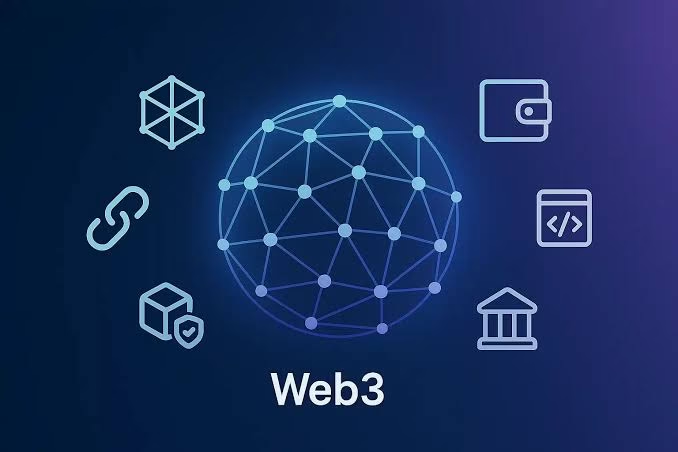
Self-custody remains a major attraction for many market participants. Permissionless access allows users worldwide to engage with digital assets without relying on centralized gatekeepers. Decentralized finance integrations create opportunities unavailable through conventional brokers.
Most importantly, innovation cycles remain significantly faster within crypto. While traditional exchanges often require lengthy regulatory approval processes, Web3 Exchanges can deploy new products, liquidity mechanisms, and market structures at remarkable speed.
Rather than eliminating Web3 Exchanges, CME’s move may accelerate convergence between traditional finance and decentralized markets.

The distinction between crypto-native and traditional platforms is already becoming blurred.
Asset managers are launching tokenized products. Banks are exploring blockchain settlement. Exchanges are experimenting with digital asset infrastructure.
Meanwhile, Web3 Exchanges are increasingly incorporating compliance tools and institutional-grade services.



Copyright © 2025 - The Bit Gazette.