





- Trending
- Comments
- Latest

Crypto markets have survived exchange collapses, regulatory crackdowns, and liquidity crises. What’s unsettling traders now is harder to point at, it’s the slow, grinding anxiety of a global economy that hasn’t decided where it’s going.
This is not the type of fear triggered by a single exchange collapse or a major protocol exploit. Instead, it reflects something broader and potentially more dangerous: growing uncertainty about the direction of the global economy itself.
That shift matters because crypto no longer trades in isolation from traditional finance. The industry has become deeply tied to macroeconomic sentiment, and Crypto Market Fear is increasingly behaving as a mirror of wider investor anxiety.
For much of crypto’s early history, traders believed digital assets existed outside the traditional financial system.
Today, Crypto Market Fear rises and falls alongside Treasury yields, Federal Reserve policy decisions, inflation reports, and geopolitical instability. Bitcoin and other major digital assets are now highly sensitive to liquidity conditions and broader investor risk appetite.
Federal Reserve Chair Jerome Powell has repeatedly warned that inflation risks remain persistent and that interest rates may stay elevated longer than markets originally anticipated.
As borrowing costs rise and liquidity tightens, investors naturally become more defensive. Crypto Market Fear intensifies because traders understand that digital assets historically struggle during periods of restrictive monetary policy.
The result is a market environment where even bullish crypto developments are being overshadowed by macroeconomic uncertainty.
What makes the current environment unique is the psychological nature of the downturn. Traditional market panic usually involves violent liquidations, dramatic crashes, and emotionally charged reactions. Sentiment capitulation, however, develops more slowly.
Crypto Market Fear in this cycle feels rooted in fatigue rather than hysteria. Retail investors have spent years navigating exchange failures, regulatory battles, inflation shocks, and repeated volatility cycles. Many participants are no longer aggressively bullish or aggressively bearish. They are simply tired.
That emotional exhaustion often becomes one of the most dangerous phases of any market cycle because investors gradually disengage.
Trading activity slows. Social media enthusiasm fades. Speculative appetite weakens. Market participants stop believing that short-term rallies will last.
This is how Crypto Market Fear quietly spreads through the industry without necessarily triggering immediate collapse.
One major reason Crypto Market Fear behaves differently today is the growing role of institutional capital.
The approval and expansion of spot Bitcoin ETFs fundamentally changed how traditional investors interact with crypto markets. Large financial firms now access Bitcoin exposure through regulated investment products rather than purely speculative offshore trading venues.
BlackRock CEO Larry Fink has repeatedly described Bitcoin as a potential macro asset with long-term relevance in global portfolios.
That institutionalization has strengthened crypto’s legitimacy, but it has also connected the market more directly to global financial cycles.
Crypto Market Fear is therefore no longer driven solely by blockchain-specific events. It increasingly reflects concerns about recession risks, sovereign debt pressures, interest rates, and global liquidity conditions.
In many ways, crypto has matured into a macro-sensitive asset class. That evolution brings credibility, but it also exposes the industry to the same fear-driven cycles affecting traditional finance.
The emotional state of retail traders remains one of the clearest signs that Crypto Market Fear is spreading again.
Earlier bull markets were fueled heavily by retail enthusiasm. Traders embraced volatility because rapid price swings represented opportunity and excitement.
Many retail investors are reducing leverage, lowering exposure, or stepping away from the market entirely as uncertainty continues building. Crypto Market Fear is replacing the aggressive optimism that dominated previous speculative phases.
This shift is visible across trading volumes, social engagement metrics, and derivatives activity.
The market is not completely collapsing, but participation levels suggest growing hesitation among smaller investors who once drove much of crypto’s momentum.
What makes the return of Crypto Market Fear particularly striking is that it is happening despite several fundamentally positive developments within the industry.
Institutional inflows remain relatively healthy. Regulatory clarity is improving in several jurisdictions. Blockchain infrastructure continues evolving rapidly.
Macroeconomic fear is overpowering crypto-specific optimism. Investors are increasingly focused on inflation trends, central bank policy, debt concerns, and geopolitical instability rather than blockchain innovation alone.
Crypto Market Fear has therefore become part of a much larger global sentiment cycle affecting nearly all risk assets.
This reality reinforces how deeply interconnected crypto has become with traditional finance.
Despite current anxiety levels, market history suggests periods of extreme fear often create long-term opportunity.
Veteran investor Warren Buffett famously advised investors to become “fearful when others are greedy and greedy when others are fearful.”
That philosophy has repeatedly resurfaced during major crypto downturns. Historically, some of Bitcoin’s strongest recoveries emerged after sentiment reached deeply pessimistic levels. Crypto Market Fear tends to peak when investors become emotionally exhausted and market positioning turns highly defensive.
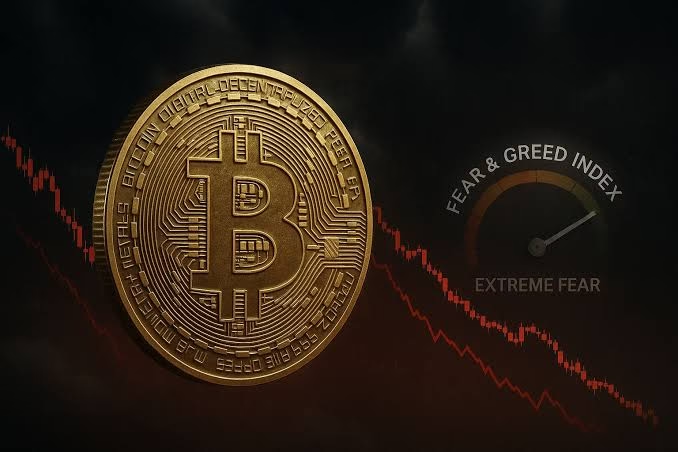
Fear cycles can persist far longer than traders expect, especially during uncertain macroeconomic conditions. But capitulation phases often clear excessive leverage and speculation from the market, creating healthier long-term foundations.
The crypto industry once viewed volatility and fear as temporary growing pains. Now, those emotions are becoming embedded within a broader global financial framework shaped by monetary policy, institutional capital flows, and macroeconomic uncertainty.
Crypto Market Fear is no longer just a reaction to blockchain-specific problems. It is increasingly tied to how investors perceive economic stability itself.
That transformation marks an important shift for the industry. Crypto has matured enough to become part of the global financial conversation, but that also means it inherits the psychological pressures affecting traditional markets.



Copyright © 2025 - The Bit Gazette.