




- Trending
- Comments
- Latest

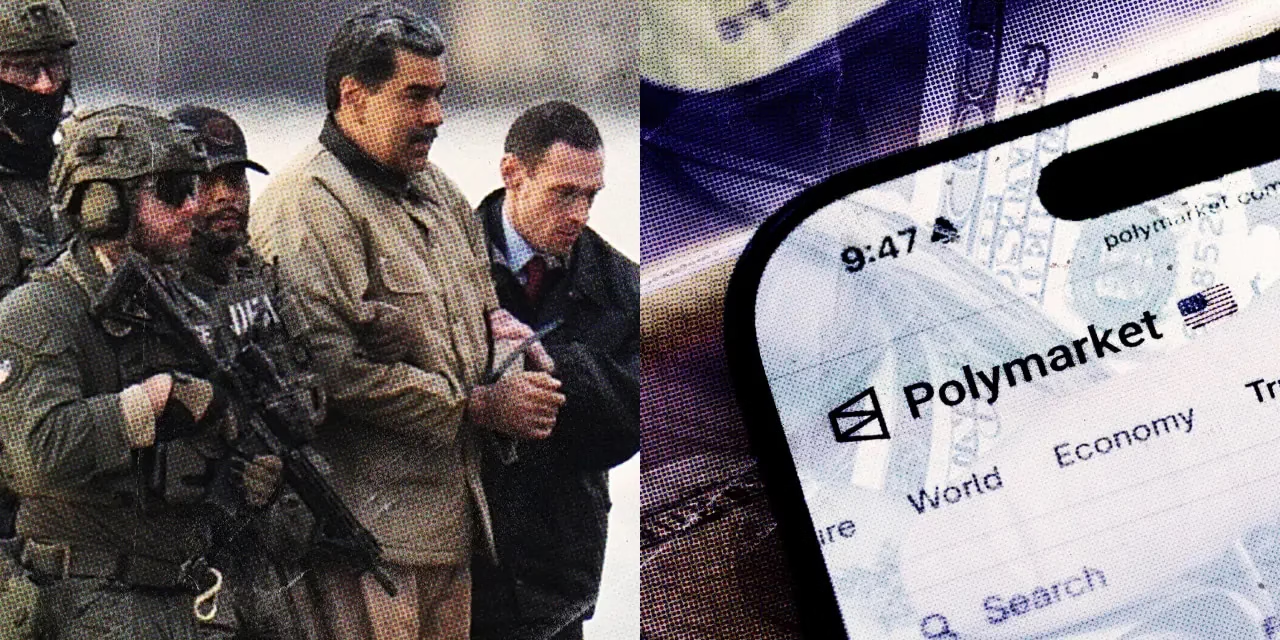
The night before the U.S. military announced the capture of Venezuelan leader Nicolás Maduro, an anonymous trader placed a $32,000 bet on Polymarket predicting his removal from power by January 31. Hours later, the operation went public, the bet paid out, and the trader collected more than $400,000.
The trade wasn’t just lucky—it was suspiciously prescient. And it has since ignited a debate that cuts to the heart of prediction markets: what happens when financial speculation is fueled not by analysis, but by access to classified government intelligence?

At the center of the controversy is timing. The wager was placed just hours before a highly sensitive U.S. military operation became public. While no public evidence yet proves wrongdoing, the optics alone have made the Maduro bet a defining case study in prediction market insider trading.
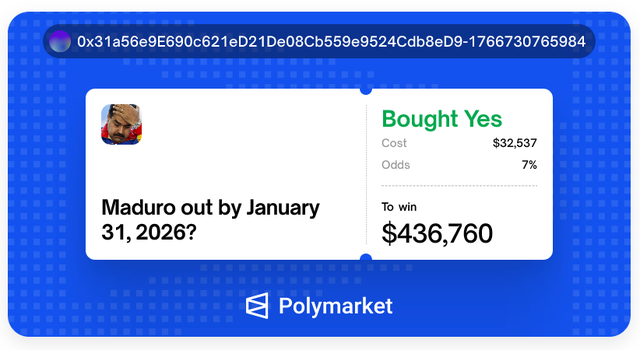
The concern is not merely that someone made a lucky guess, but that non-public information—possibly among the most tightly guarded secrets of the U.S. government—may have been used to secure a private financial windfall.
Dennis Kelleher, president of Better Markets and a long-time advocate for financial market regulation, articulated why this trade stands out.
“The facts are not known publicly yet. However, this particular trade really has all the hallmarks of an insider trade,” — Dennis Kelleher, President, Better Markets.
From an opinion standpoint, that assessment matters. Markets rely on trust, and trust erodes when outcomes suggest privileged access rather than informed analysis.
In traditional securities markets, even the appearance of insider trading can prompt investigations, sanctions, and sweeping reforms. Yet prediction markets, especially those operating with anonymity, have so far occupied a gray zone—one now illuminated by allegations of polymarket insider trading.
What makes this case qualitatively different from most market controversies is the subject matter itself. Polymarket and similar platforms allow users to bet on elections, cultural events, and increasingly, geopolitical and military outcomes.
In the Maduro case, critics argue that if insider information was involved, it means someone may have monetized classified U.S. military intelligence.
“That’s the only reason that this is a story and a real problem, because it happens to involve highly, highly classified information,” Kelleher explained during the discussion.
From an opinionated lens, this shifts prediction market insider trading from a financial ethics issue into a national security risk. Military operations depend on secrecy. If even a small circle of insiders believes they can safely profit from that secrecy on anonymous platforms, the incentive structure becomes dangerously distorted.
Polymarket’s silence has not helped ease these concerns. The company did not respond to multiple requests for comment, leaving observers to speculate about safeguards, monitoring, and internal controls.
The Commodity Futures Trading Commission (CFTC), the federal agency responsible for regulating prediction markets, also declined to comment. The FBI, meanwhile, stated it “declines to confirm or deny the existence of any investigation into possible insider trading.”
In the absence of clarity, polymarket insider trading has become less about proven misconduct and more about systemic vulnerability.
Long before this controversy, Polymarket CEO Shane Koplen acknowledged that prediction markets inherently reward information advantages. In an earlier interview with 60 Minutes, he framed that edge as a feature rather than a flaw.
“Predictive markets do rely on someone having some inside information,” — Shane Koplen, CEO, Polymarket.
“I think that people going and having an edge to the market is a good thing. Obviously, you need to curate them, and you need to be really clear and stringent on where the line is drawn, and ethics, and we spend a lot of time on that,” — Shane Koplen, CEO, Polymarket.
Opinionally, this is where the argument becomes most uncomfortable. Markets do thrive on information asymmetry—but only within ethical and legal boundaries.
In equities, “inside information” is explicitly defined and restricted. In prediction markets, the line is fuzzier, especially when platforms allow bets on events tied directly to government action.
The Maduro case suggests that prediction market insider trading may not be an abstract risk but an emerging reality. Even if no laws were technically broken, the episode exposes how easily prediction markets can drift into ethically indefensible territory when they intersect with classified intelligence.
Against this backdrop, Kalshi CEO Tarek Mansour’s public support for legislation banning insider trading on prediction markets takes on added significance. Writing on LinkedIn, Mansour endorsed a bill introduced by Rep. Ritchie Torres that would bar federal officials and executive branch employees from betting on markets tied to government policy or action.
“Kalshi is supportive of the bill Ritchie Torres is looking to introduce to affirm the ban on insider trading on prediction markets,” — Tarek Mansour, CEO, Kalshi.
Mansour went further, drawing a sharp distinction between regulated U.S. platforms and what he described as “offshore, unregulated” markets.
“This should be obvious, but some recent reporting has been conflating regulated prediction markets with unregulated, offshore prediction markets,” — Tarek Mansour, CEO, Kalshi.
“What non-American, unregulated platforms do has no relationship to what regulated, American platforms do.”
From an opinion perspective, this positioning underscores a growing rift within the industry. Kalshi, which operates under U.S. regulatory oversight, appears eager to separate itself from allegations of polymarket insider trading, even as both platforms post record trading volumes.
Mansour also emphasized that Kalshi adopts insider trading rules modeled after the New York Stock Exchange and Nasdaq, barring users with access to non-public information from trading. Yet he acknowledged a crucial limitation: U.S. legislation applies only to regulated American companies, not to offshore platforms where many of the alleged problems are occurring.
This leaves prediction market insider trading as a partially regulated problem in a global market.
The Maduro bet should be understood as a warning, not an anomaly. Prediction markets are scaling rapidly, attracting billions in monthly volume and mainstream attention.
As they grow, so too does the incentive for misuse. Anonymous platforms, high-stakes geopolitical markets, and uneven regulation form a perfect storm for polymarket insider trading and its broader cousin, prediction market insider trading.
Opinionally, the choice facing regulators is stark. They can either treat this episode as a curiosity of a new market—or as an early signal of systemic risk.
The latter view suggests urgent action: clearer prohibitions, stronger enforcement, and perhaps hard limits on markets tied to classified or sensitive government actions.
Until then, the unanswered question lingers: who placed the bet, and what did they know? In the absence of transparency, confidence in prediction markets—and their claim to reflect collective wisdom rather than privileged access—remains fragile.
The Maduro wager may ultimately prove legal. But legality alone is a low bar. For prediction markets to mature responsibly, they must confront the ethical implications laid bare by this case. Otherwise, prediction market insider trading will not be a hypothetical risk—it will be the defining flaw of an industry still struggling to define its own boundaries.



Copyright © 2025 - The Bit Gazette.