

- Trending
- Comments
- Latest

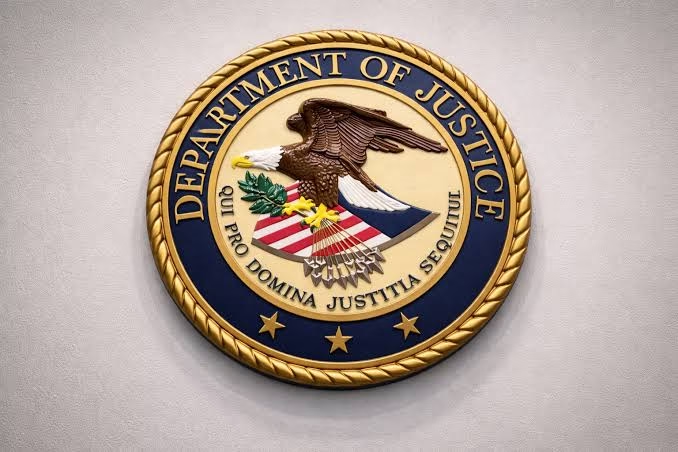
A joint operation led by the U.S. Department of Justice and involving Coinbase, Meta, Microsoft, and Starlink has disrupted large-scale fraud networks across Southeast Asia, resulting in the removal of more than 1.4 million fraudulent accounts, the suspension of 20,000 Microsoft accounts, and the freezing of over $701 million in cryptocurrency linked to scam compounds that use trafficked workers to target victims globally.
The action forms part of a broader crackdown on criminal organizations that have increasingly relied on cryptocurrency, social media platforms, and digital infrastructure to target victims worldwide.
The operation was led by the DOJ’s Scam Center Strike Force and focused on identifying, disrupting, and dismantling Southeast Asia scam networks that have become a major source of global cyber-enabled financial crime.
Participants shared intelligence on scam compounds, fraudulent accounts, infrastructure providers, and financial flows to help authorities connect online fraud activity with physical criminal operations.
The effort reflects growing concern among regulators, technology companies, and law enforcement agencies about the scale and sophistication of cross-border scam enterprises operating across the region.
The latest operation demonstrates how governments and private companies are increasingly collaborating to combat Southeast Asia scam networks.
According to Coinbase, the exchange shared intelligence with the DOJ, Meta, Microsoft, Starlink, and international law enforcement agencies as part of the coordinated effort.
“This operation is proof that scammers can’t be stopped by any single company or agency acting alone,” — Coinbase, in a public statement.
The exchange said fraud prevention now requires cooperation between social media platforms, financial institutions, internet service providers, and law enforcement authorities.
Authorities have repeatedly warned that many Southeast Asia scam networks operate through organized criminal compounds where workers are often coerced or trafficked into conducting online fraud campaigns targeting victims around the world.
These operations frequently combine social engineering tactics, fake investment opportunities, cryptocurrency transfers, and sophisticated digital infrastructure to extract funds from victims.
By pooling intelligence across industries, investigators were able to identify broader criminal networks rather than focusing solely on individual fraudulent transactions.
The crackdown resulted in significant disruption to the online infrastructure supporting Southeast Asia scam networks.
Meta reported that it removed more than 1.4 million accounts, pages, and groups across Facebook and Instagram that were linked to fraudulent activity.
According to the company, shared intelligence helped investigators identify scam-related accounts, infrastructure, and physical locations connected to criminal operations.
Microsoft also took action by suspending approximately 20,000 accounts associated with fraud networks.
Meanwhile, Starlink terminated connectivity services for thousands of devices allegedly tied to unlawful activity.
Meta said the collaborative effort helped bridge the gap between online investigations and real-world enforcement actions.
The company noted that intelligence sharing allowed participants to identify “scam locations, accounts, infrastructure, and networks” for law enforcement review.
In Thailand, authorities reportedly arrested 63 individuals linked to scam operations as part of the broader initiative.
The arrests underscore how Southeast Asia scam networks increasingly rely on both digital platforms and physical compounds, making international cooperation essential to enforcement efforts.
A key component of the operation involved tracking cryptocurrency transactions connected to Southeast Asia scam networks.
Coinbase emphasized that blockchain technology provides investigators with valuable tools for tracing stolen funds after victims transfer assets to fraudulent actors.
“Blockchain technology gives law enforcement something traditional financial systems often can’t: a transparent, immutable and permanent record of every transaction,” — Coinbase, in its statement.
The exchange argued that public blockchain records enable authorities to follow money flows across wallets and exchanges, helping identify criminal networks and recover assets where possible.
The role of cryptocurrency in scam investigations has become increasingly important as many Southeast Asia scam networks encourage victims to deposit funds through digital assets rather than traditional banking channels.
Federal authorities have repeatedly identified so-called “pig butchering” scams and fake investment schemes as among the most financially damaging forms of fraud affecting consumers.
The latest operation follows several major enforcement actions targeting Southeast Asia scam networks over the past year.
In April, U.S. authorities announced the freezing of more than $701 million in cryptocurrency allegedly connected to international fraud operations.
Investigators also targeted more than 500 fake investment websites that used fabricated dashboards and false profit claims to lure victims into depositing additional funds.
Authorities said many of those platforms were linked to organized criminal enterprises operating across multiple jurisdictions.
Countries including the United States, Thailand, Singapore, the United Arab Emirates, Austria, and Albania have all participated in recent actions against scam compounds and transnational fraud groups.
The latest crackdown highlights how Southeast Asia scam networks have evolved into a major international security and financial crime concern.
For crypto investors and consumers, the operation serves as a reminder that exchanges, technology firms, and law enforcement agencies are increasingly working together to identify fraudulent activity, disrupt criminal infrastructure, and protect users from sophisticated online scams.
As authorities continue to target Southeast Asia scam networks, industry participants expect further collaboration between public and private organizations aimed at reducing fraud and strengthening digital financial security worldwide.



Copyright © 2025 - The Bit Gazette.