

- Trending
- Comments
- Latest

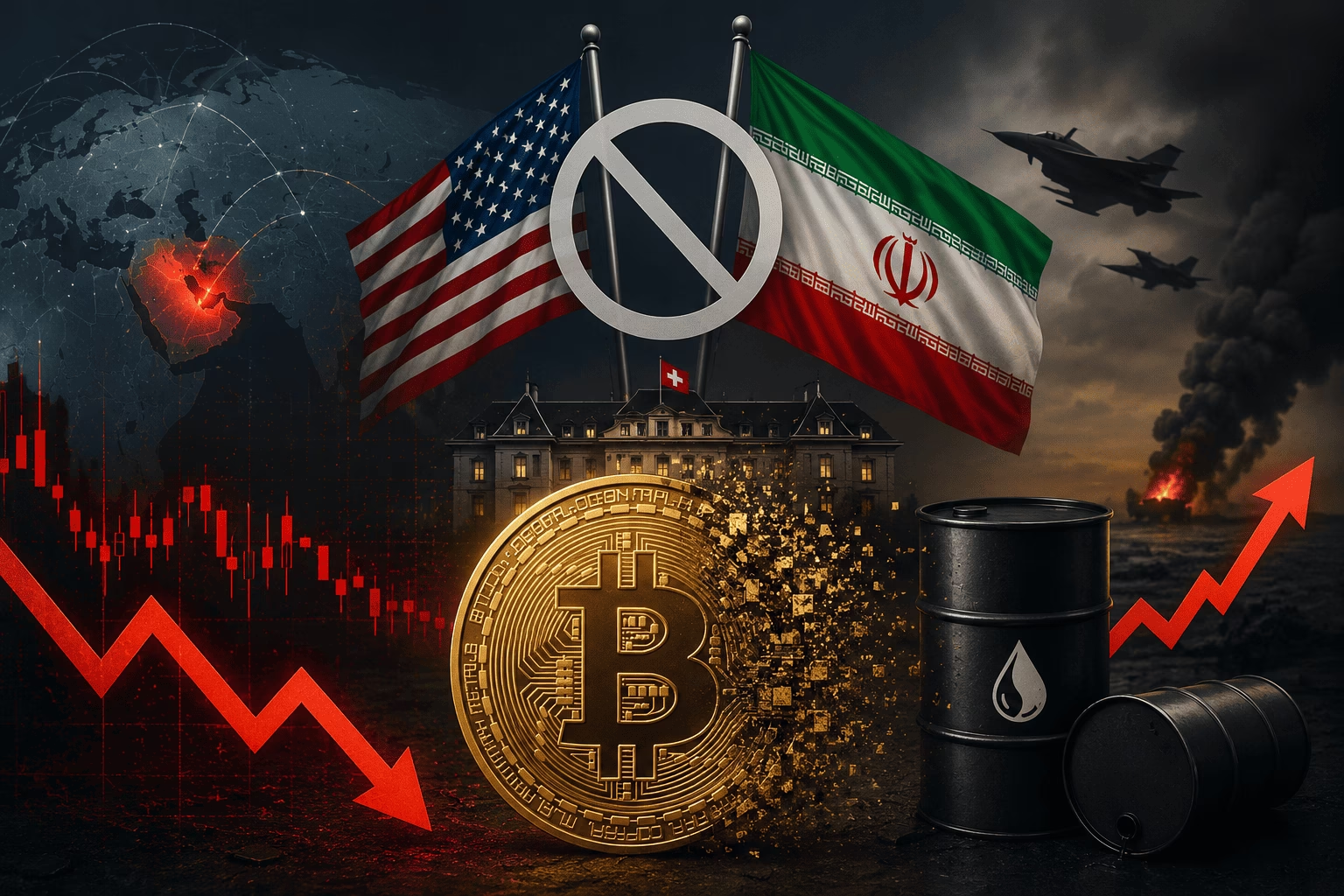
The collapse of US-Iran negotiations at Switzerland’s Bürgenstock resort has done more than delay a diplomatic milestone. It has punctured the narrative that crypto investors spent much of 2026 building: that geopolitical turmoil had stopped being a threat to digital assets and started being a catalyst for them. That thesis is now under serious pressure.
But the indefinite postponement of planned U.S.-Iran talks at Switzerland’s Bürgenstock resort has forced markets to reconsider that assumption.
The sudden delay has pushed Crypto Geopolitical Risk back into focus, reminding investors that digital assets remain closely linked to broader macroeconomic conditions.
The meeting, intended to build on a preliminary ceasefire agreement and lay the groundwork for a more durable settlement, had been widely viewed as a turning point toward regional stability.
Instead, intensifying violence and the withdrawal of key negotiators derailed the process before discussions could begin.
What many investors saw as a pathway to de-escalation has quickly become another lesson in the unpredictability of international diplomacy.
Financial markets do not react to events in isolation—they price future expectations.
Over recent weeks, traders had increasingly positioned for a scenario in which energy markets stabilized, sanctions pressures eased, and the threat of wider regional escalation diminished.
That optimism quietly created a supportive backdrop for digital assets.
The real cushion beneath crypto prices was not Bitcoin’s fixed supply, institutional adoption, or even spot ETF demand.
It was the belief that geopolitical tensions were moving toward resolution.
The Bürgenstock negotiations symbolized a transition from military uncertainty to diplomatic predictability. Once those talks stalled, investors were forced to reassess risks that had been fading from view.
Could tensions spread beyond Iran and Israel?
Could disruptions return to the Strait of Hormuz?
Could higher oil prices reignite inflation concerns?
Could central banks delay expected rate cuts?
Each of those questions increases the importance of Crypto Geopolitical Risk, because digital assets remain highly sensitive to shifts in global liquidity.
As energy prices rise, inflation expectations tend to follow. That can keep policymakers hawkish for longer, reducing appetite for higher-risk investments.
Despite years of debate over Bitcoin’s role as a safe haven, the asset continues to trade more like a high-beta technology stock during periods of acute uncertainty.
Bitcoin supporters have long argued that geopolitical instability strengthens the case for decentralized financial systems.
In some circumstances, that argument holds.
But history suggests those benefits typically emerge only after the initial market shock subsides.
During the first phase of a crisis, investors often sell the assets they can access most easily—not necessarily the assets they want to exit.
Bitcoin trades continuously and offers deep liquidity around the clock, making it one of the first instruments investors use to reduce exposure.
That pattern was evident during the early stages of the Middle East conflict, when Bitcoin initially sold off before recovering sharply as fears eased.
The rebound fueled renewed claims that the cryptocurrency had matured into a geopolitical hedge.
Yet evidence remains mixed.
Research from multiple market analysts has shown that Bitcoin’s correlation with equities often rises during stress events, undermining its safe-haven credentials.
Its market identity continues to shift between inflation hedge, liquidity proxy, speculative technology play, and long-term store of value.
The collapse of the Switzerland talks has amplified concerns around Crypto Geopolitical Risk, exposing the unresolved debate over where Bitcoin belongs in investor portfolios.
“If Bitcoin were a pure safe-haven asset, geopolitical shocks would consistently drive capital toward it,” said market analyst Noelle Acheson in a recent newsletter. “Instead, its reaction function still depends heavily on liquidity conditions.”
That uncertainty alone suggests the market has yet to reach a consensus.
The idea that digital assets have become immune to macroeconomic forces has always been overstated.
Crypto’s most important driver remains global liquidity.
Every geopolitical event matters only to the extent that it influences inflation expectations, interest-rate policy, fiscal spending, and cross-border capital flows.
The Switzerland negotiations mattered because successful diplomacy would likely have reduced energy risk premiums and supported a more dovish outlook among central banks.
Their collapse has produced the opposite effect.
Extended instability increases the likelihood of elevated commodity prices, persistent inflation pressures, and tighter financial conditions.
Those conditions rarely favor speculative assets.
This is why Crypto Geopolitical Risk cannot be viewed separately from broader macroeconomic trends.
“Liquidity is the primary driver of digital asset prices,” said Arthur Hayes, co-founder of BitMEX, in previous market commentary. “When central banks tighten, crypto feels it quickly.”
The uncomfortable reality is that crypto’s real buffer was never decentralization alone.
It was the expectation that monetary conditions would gradually improve.
That expectation has weakened.
None of this guarantees a prolonged downturn for digital assets.
Bitcoin has demonstrated greater resilience during recent geopolitical shocks than in previous cycles. Institutional participation has expanded, corporate treasury adoption continues to grow, and spot ETF products have broadened market access.
But resilience should not be mistaken for immunity.
The postponed talks in Switzerland have reinforced the importance of Crypto Geopolitical Risk as digital assets become increasingly integrated into the global financial system.
Wars affect energy markets.
Energy markets influence inflation.
Inflation shapes interest-rate expectations.
Interest rates determine liquidity.
And liquidity drives crypto valuations.
For years, the industry has promoted the idea that digital assets are decoupling from traditional finance.
Yet every major geopolitical event continues to pull the market back into the same macroeconomic orbit.
That is not a sign of weakness—it is evidence of maturation.
As crypto becomes a mainstream asset class, it inherits the same vulnerabilities as every other market.
The Switzerland setback did not invalidate Bitcoin’s long-term investment thesis.
It simply shattered the illusion that Crypto Geopolitical Risk had disappeared.



Copyright © 2025 - The Bit Gazette.