







- Trending
- Comments
- Latest

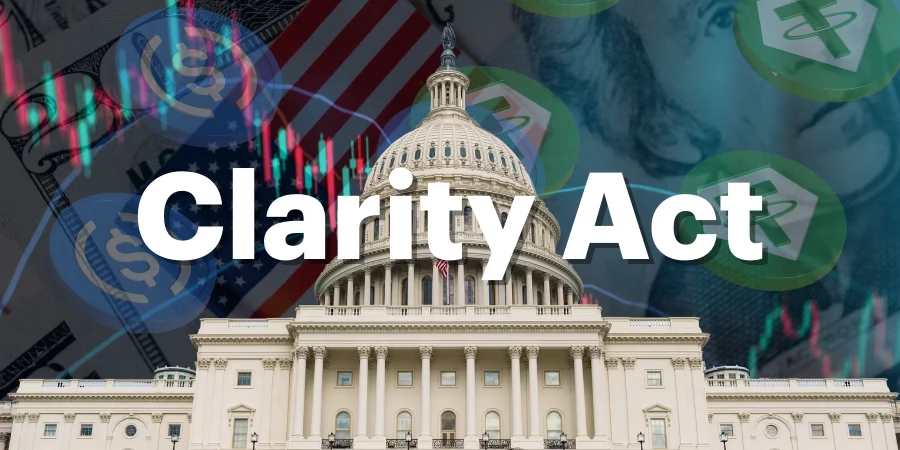
Galaxy Digital has cut its odds of the CLARITY Act becoming law in 2026 to 50%, down from 60% earlier this month, as the Senate’s shrinking pre-recess calendar threatens to delay the crypto industry’s most significant market-structure bill.
The legislation needs 60 votes to clear the Senate, meaning at least seven Democratic defections, before lawmakers leave Washington for their August recess.
Momentum behind the CLARITY Act has slowed despite earlier progress in Congress. The bill previously advanced through committee, but it must still overcome the Senate’s 60-vote threshold before lawmakers leave for their summer break.
Industry observers estimate Republicans will require support from several Democratic senators to move the legislation forward.
While some Democrats have publicly supported the measure, negotiations remain complicated by disagreements over ethics provisions, regulatory authority, and concerns surrounding political conflicts of interest linked to cryptocurrency investments.
Galaxy Digital recently reduced its estimated probability of the CLARITY Act becoming law this year to roughly 50%, citing legislative timing rather than opposition to the bill itself.
Unlike previous crypto-related legislation that focused primarily on stablecoins, the CLARITY Act addresses the broader structure of U.S. digital asset markets.
Among its key objectives are: Defining whether digital assets fall under SEC or CFTC oversight, Creating clearer compliance standards for crypto exchanges, Establishing disclosure requirements for token issuers, and Providing greater legal certainty for blockchain developers and institutional investors.
Supporters argue these reforms would reduce years of regulatory ambiguity that have resulted in enforcement-driven policymaking.
The legislation also complements the GENIUS Act, which established a federal regulatory framework for stablecoins after being signed into law in 2025. Together, the two measures are widely viewed as the foundation for a modern U.S. crypto regulatory regime.
Although many lawmakers agree on the need for regulatory clarity, negotiations have become increasingly political.
According to multiple reports, Senate Democrats continue pushing for stronger ethics provisions related to public officials’ cryptocurrency holdings. Those discussions have delayed bipartisan consensus and complicated efforts to bring the legislation to a floor vote.
A revised version of the bill is reportedly under development, with lawmakers attempting to merge proposals from multiple Senate committees while addressing Democratic concerns.
“The new version of the bill will combine the efforts from the Senate Banking and Agriculture Committees.” According to people familiar with the negotiations cited by CoinDesk.
Even if Senate negotiators reach agreement, the House of Representatives would still need to approve any revised version before the legislation could be signed into law.
A successful Senate vote would mark the most comprehensive overhaul of U.S. cryptocurrency regulation to date and could encourage greater institutional investment by reducing long-standing legal uncertainty.
Conversely, failure to pass the legislation before the August recess could significantly delay reform efforts as lawmakers shift their focus toward the midterm election campaign.
Many analysts believe that postponement would extend the regulatory ambiguity that has shaped U.S. crypto markets for years.
Investors should closely monitor several developments: Release of the revised Senate draft, Public support from additional Democratic senators, Senate floor scheduling announcements, and House leadership’s willingness to fast-track any Senate-approved version.
Until those milestones materialize, the CLARITY Act remains one of the crypto industry’s most consequential unresolved policy initiatives.



Copyright © 2025 - The Bit Gazette.

