

- Trending
- Comments
- Latest

Kansas lawmakers are considering legislation that would create a state bitcoin reserve funded entirely by abandoned cryptocurrency, airdrops, and staking rewards—without purchasing any digital assets on the open market.
Senate Bill 352, introduced this week by senator Craig Bowser, would establish a “bitcoin and digital assets reserve fund” managed by the state treasurer and capitalized through crypto that falls under Kansas’ unclaimed property laws.
The bill explicitly prohibits direct bitcoin purchases, instead relying on assets already under state control.
The proposal joins similar initiatives in Wyoming, Texas, and Florida as states experiment with digital asset exposure while avoiding direct market risk.
Under the Kansas Bitcoin Bill, the reserve would be funded through digital assets that fall under Kansas’ unclaimed property laws. These include cryptocurrencies that have been deemed abandoned after owners fail to claim them within the legally required time frame.
The bill explicitly names sources such as airdrops, staking rewards, and interest generated from unclaimed digital assets. Bitcoin, along with other cryptocurrencies and digital-only assets, would be eligible once classified as abandoned.

Crucially, SB 352 bars the state from buying Bitcoin on the open market. Instead, it mirrors a broader policy trend where governments seek indirect exposure to crypto through forfeitures or unclaimed property.
State of Kansas introduces State Senate Bill 352 to create a Strategic State Bitcoin and Crypto Reserve.
It would permit up to 10% of state trust fund assets to be invested into digital asset ETFs.https://t.co/LqRxRlkKMv pic.twitter.com/NVJYLEqj4N
— MartyParty (@martypartymusic) January 22, 2026
“This approach avoids speculative buying while ensuring the state responsibly manages assets it already holds,” said a policy analyst familiar with the Kansas Bitcoin Bill.
The Kansas Bitcoin Bill also sets out clear rules for how funds would be handled once deposited. Ten percent of each digital asset contribution would be transferred to the state’s general fund. Bitcoin itself, however, would be excluded from general fund use and retained entirely within the reserve.
The remaining assets would stay under reserve management, potentially allowing Kansas to benefit from long-term appreciation or yield generation over time.
By separating Bitcoin from general fund spending, the Kansas Bitcoin Bill aims to prevent short-term budget pressures from forcing liquidation of crypto holdings.
Beyond creating a reserve, the Kansas Bitcoin Bill updates state unclaimed property statutes to formally recognize “digital assets” and related concepts such as “airdrops.” It also clarifies custody standards, accounting practices, and reporting requirements once assets are deemed abandoned.
Legal experts say this modernization is long overdue. “Unclaimed property laws were never designed with blockchain assets in mind,” said a former state regulator. “The Kansas Bitcoin Bill brings clarity to how these assets are identified, stored, and managed.”
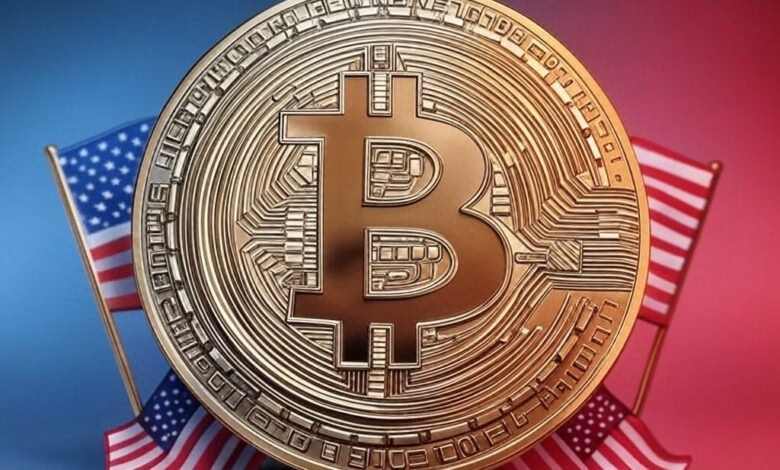
After passing an initial review by the Federal and State Affairs Committee, SB 352 was referred to the Senate Committee on Financial Institutions and Insurance, where further debate is expected.
The Kansas Bitcoin Bill does not exist in isolation. It follows another proposal, Senate Bill 34, introduced earlier this year, which would allow the Kansas Public Employees Retirement System to allocate up to 10% of its portfolio to spot Bitcoin exchange-traded funds.
That bill remains under consideration, but together, the two measures signal growing legislative comfort with digital assets—albeit under controlled conditions.
Kansas now joins a list of US states exploring crypto reserves, regulatory task forces, and limited investment frameworks. States such as Wyoming, Texas, and Florida have also floated ideas around Bitcoin reserves or public-sector exposure.
At the federal level, similar thinking is emerging. The White House has reiterated plans to establish a US Strategic Bitcoin Reserve funded by seized and forfeited Bitcoin rather than new purchases. A senior administration official said in January that the initiative remains a priority.
The Kansas Bitcoin Bill closely mirrors that philosophy, emphasizing stewardship of existing assets rather than speculative accumulation.
Internationally, other countries have gone further. El Salvador famously adopted Bitcoin as legal tender, while Bhutan has quietly accumulated Bitcoin through state-backed mining initiatives. Those approaches carry higher risk but also higher potential rewards.
“This is about governance, not hype,” said a former treasury official. “The Kansas Bitcoin Bill is structured to manage what the state already has, not gamble on price movements.”

While the reserve itself may start small, the Kansas Bitcoin Bill carries symbolic weight. It signals that digital assets are no longer fringe considerations in public finance discussions.
By formally integrating crypto into unclaimed property management, Kansas is setting a precedent that other states could follow—especially as more digital assets remain unclaimed over time.
Critics argue the administrative burden may outweigh the benefits. Supporters counter that ignoring digital assets is no longer an option.
“States are already holding crypto, whether they like it or not,” said a blockchain policy researcher. “The Kansas Bitcoin Bill simply acknowledges that reality and puts structure around it.”
As SB 352 moves through committee review, all eyes will be on whether Kansas becomes one of the first states to operationalize a Bitcoin reserve without ever buying a single coin. If passed, the Kansas Bitcoin Bill could quietly reshape how governments think about crypto stewardship in the years ahead.



Copyright © 2025 - The Bit Gazette.