
- Trending
- Comments
- Latest

North Carolina has become one of the first U.S. states to explicitly recognize federally regulated prediction markets.
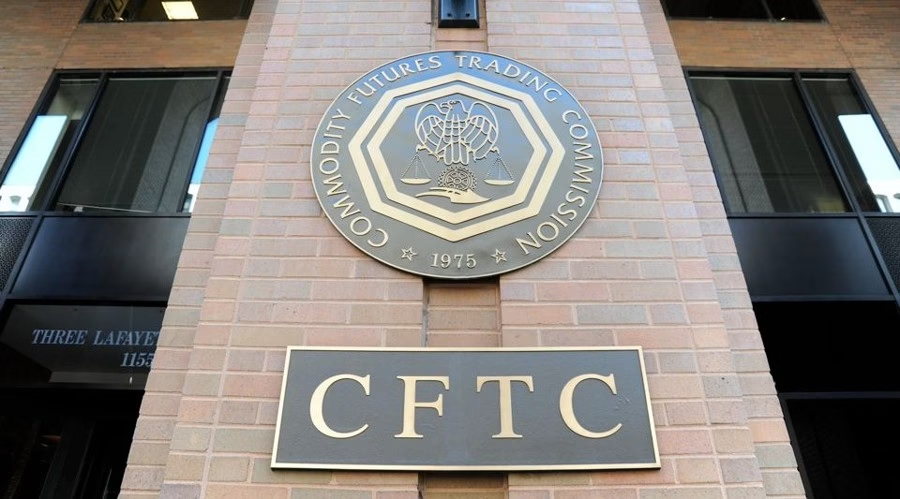
The proposal which was signed this week, has formally acknowledge the authority of the U.S. Commodity Futures Trading Commission (CFTC) over qualifying prediction markets while introducing a tax regime for their operators.
The measure arrives as state governments and federal regulators continue to clash over whether event contracts should be treated as financial derivatives or gambling products.
The provision forms part of North Carolina’s latest state budget proposal and would recognize prediction markets regulated by the CFTC rather than classifying them as traditional gambling operations.
As approved by Governor Josh Stein, North Carolina has become the first U.S. state to explicitly provide statutory recognition for CFTC-regulated prediction markets while applying a 6% tax on qualifying trading fee revenue generated within the state.
Supporters argue the legislation acknowledges a rapidly expanding financial market that already operates under federal oversight.
“The growing popularity of prediction markets means North Carolina needs to address them responsibly,” — Destin Hall, Speaker of the North Carolina House, as reported by Axios.
Unlike conventional sportsbooks, CFTC-approved prediction markets operate through event contracts that allow participants to trade on the probability of future outcomes ranging from elections and inflation reports to weather events and sporting competitions.
Although Polymarket itself is not currently CFTC-regulated, the broader prediction market sector has become closely associated with crypto after blockchain-based platforms attracted billions of dollars in trading volume during major political and economic events.
North Carolina’s signed bill arrives during an increasingly aggressive campaign by the CFTC to defend its exclusive jurisdiction over federally regulated event contracts.
Over recent months, the agency has sued multiple U.S. states including Arizona, Illinois, Minnesota, Kentucky and Rhode Island, arguing that state gambling laws cannot override federal authority granted under the Commodity Exchange Act.
“The CFTC will continue to safeguard its exclusive regulatory authority over these markets and defend market participants against overzealous state regulators.” Michael S. Selig, Chairman, Commodity Futures Trading Commission.
Federal officials maintain that prediction markets serve legitimate financial purposes beyond speculation.
According to the CFTC, event contracts can help businesses hedge risk, improve price discovery, and provide valuable information about future probabilities.
Those arguments have become increasingly relevant as institutional investors explore tokenized financial products and blockchain settlement infrastructure.
The significance of North Carolina’s signed proposal extends beyond traditional finance.
Prediction markets have emerged as one of crypto’s fastest-growing use cases, particularly after decentralized platforms demonstrated their ability to aggregate real-time market sentiment through blockchain technology.
Institutional investors increasingly view regulated event contracts as another category of financial derivatives that could eventually integrate with tokenized securities, stablecoins and on-chain settlement systems.
For crypto-native firms, clearer regulation may also encourage institutional participation by reducing legal uncertainty surrounding event-based trading products.
At the same time, critics argue that many prediction contracts remain functionally similar to sports betting.
That criticism continues to fuel legal challenges across multiple jurisdictions despite growing federal support for the industry.
As North Carolina have ultimately enacts the proposal, this will become an important signal for both crypto markets and financial regulators.
Being signaled into law, the legislation will provide one of the clearest state-level endorsements yet of federally regulated prediction markets, which will encourage other states to adopt similar frameworks instead of pursuing litigation against CFTC-regulated platforms.
Meanwhile, the broader legal battle remains far from over. Court decisions involving Kalshi, ongoing CFTC lawsuits against several states, and forthcoming federal rulemaking on prediction markets are expected to shape how blockchain-based prediction platforms evolve over the next year.
As tokenization expands across financial markets, prediction markets are evolving from a niche trading product into a potential bridge between traditional derivatives and decentralized finance.
North Carolina’s move is one of the clearest state-level endorsements yet of federally regulated prediction markets, and it could encourage other states to adopt similar frameworks instead of pursuing litigation against CFTC-regulated platforms.



Copyright © 2025 - The Bit Gazette.