

- Trending
- Comments
- Latest

Oklahoma lawmakers have introduced a bill that would allow state employees, vendors and even private residents to negotiate and receive compensation in bitcoin, part of a broader trend of U.S. states experimenting with cryptocurrency in public finance.
Senate Bill 2064 (and its legislative ancestor SB 325) was advanced by Republican Senator Dusty Deevers during the 2026 session and would create a legal framework for bitcoin to be used as a voluntary medium of exchange.
This will be done without designating it as legal tender while clarifying that such use does not conflict with the U.S. Constitution’s prohibition on states coining money.
Under the proposal, Oklahoma state employees could elect to receive some or all of their wages in bitcoin, with values pegged to the cryptocurrency’s market price either at the start of a pay period or at payment time.
The choice would remain voluntary, and employees could switch back to U.S. dollars or choose a hybrid approach at the beginning of each pay period.
If enacted, the bill would take effect on November 1, 2026, with the Oklahoma State Treasurer tasked with selecting a payment processor by January 1, 2027.
Senate Bill 2064, crafted to align with existing legal frameworks, extends beyond public payroll. It also allows vendors contracting with the state to opt into bitcoin payments on a per-transaction basis, with the bitcoin value set according to market conditions at the time of each transaction unless otherwise agreed in writing.
The legislation notably reduces regulatory friction for bitcoin-native firms: companies exclusively dealing in digital assets that do not exchange them for U.S. dollars would be exempt from Oklahoma’s money transmitter licensing requirements.
Supporters argue this could attract bitcoin businesses and strengthen the state’s position in the digital finance space.
Critics, however, warn that integrating a highly volatile asset into public payments could pose budgeting, compliance and tax issues if not carefully managed.
“This legislation gives workers the freedom to choose how they are compensated in an era where digital financial tools are increasingly part of everyday life.” State Senator Dusty Deevers, sponsor of the bill, in a floor statement.
Oklahoma’s effort is part of a broader shift among state policymakers exploring bitcoin’s role in government finance.
States like New Hampshire and Texas have likewise taken steps toward strategic bitcoin us, with New Hampshire passing a law allowing a strategic bitcoin reserve and Texas establishing a reserve and even executing a bitcoin ETF purchase.
Proponents frame the move as both a hedge against inflation and a way to modernize government operations.
Jessica Liu, senior analyst at the Digital Finance Institute noted that Bitcoin’s fixed supply and decentralized nature offer a unique alternative to traditional fiat compensation, especially as inflationary pressures persist.
However, critics point to bitcoin’s volatility and implementation complexities.
While Dr. Alan Reed, professor of public finance at the University of Oklahoma cautioned that ntroducing a fluctuating asset into payroll could complicate budgeting and expose workers to undue financial risk.
Tax treatment is another unresolved area: the bill directs the Oklahoma Tax Commission to issue guidance on how bitcoin income will be treated for tax purposes by early 2027, a detail that could shape employee and employer decisions.
Senate Bill 2064 still faces committee review and approval by both chambers of the Oklahoma Legislature before it can reach the governor’s desk.
If passed, it would position Oklahoma among a small but growing group of U.S. states at the forefront of integrating digital assets into government services.
Supporters believe the bill could attract tech-savvy workers and businesses to the state, while signaling a pro-innovation stance to the broader crypto industry.
Opponents urge caution, highlighting that such policies require robust safeguards to protect both workers and public finances.
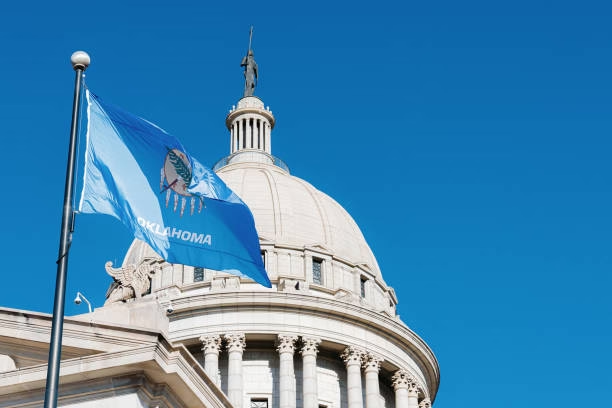
As debate continues, all eyes will be on Oklahoma’s capitol to see whether bitcoin moves from an emerging asset into a tool of public compensation policy.



Copyright © 2025 - The Bit Gazette.