







- Trending
- Comments
- Latest

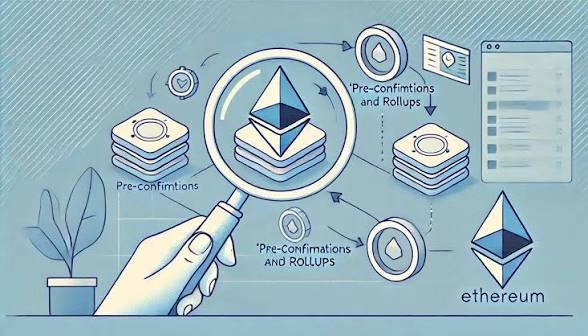
Crypto users rarely think about transaction latency until markets move fast. Then every second matters. A trader exiting a leveraged position and a stablecoin user completing a payment face the same constraint: blockchains are still too slow for real-time financial activity.
Pre-confirmations, once a niche infrastructure concept are the proposed fix, and they’re moving from theory to deployment faster than most users realize.
A pre-confirmation is an early guarantee that your transaction will be included in a future block before that block is officially finalized on-chain.
Normally, Ethereum users wait roughly 12 seconds for a block to be produced. On some Layer-2 networks, users may wait even longer depending on settlement architecture.
Pre-confirmations change that.
Instead of waiting for final settlement, validators, sequencers, or specialized infrastructure providers can issue a cryptographic promise that your transaction has already been accepted and will likely be executed.
Think of it like receiving a boarding pass before your plane actually takes off. Your transaction isn’t fully settled yet but you now have credible assurance that it’s already in line.
This topic is trending because Ethereum’s scaling roadmap is increasingly focused on user experience not just throughput.
Puffer Finance publicly promoted its Puffer Preconf model, which claims to reduce transaction latency from roughly 12 seconds to under 100 milliseconds by allowing Ethereum validators to issue economically backed execution guarantees.
This matters because Ethereum is facing growing competition from faster chains like Solana and Toncoin, both of which have recently pushed faster finality narratives.
Ethereum’s problem has never been security. Its problem has been speed. Pre-confirmations aim to fix that without relying on centralized operators.
The process typically looks like this; User submits transaction, Validator/sequencer receives it, Validator issues a signed pre-confirmation, User gets immediate assurance, and Final settlement happens later on Ethereum.
If the validator fails to honor that commitment, penalties such as slashing can be triggered in some models.
This creates stronger trust guarantees than traditional “soft confirmations” used by many rollups today.
Infrastructure shifts often become investment narratives later. Rollups that integrate pre-confirmations could attract more trading volume.
DeFi platforms may become more efficient. Wallets could offer near-instant UX, and Ethereum-aligned infrastructure tokens building this layer may gain strategic relevance if adoption accelerates.
The bigger takeaway? Crypto is moving toward a future where users expect blockchain transactions to feel as fast as Visa but without giving up decentralization.
Pre-confirmations may quietly become one of the most important infrastructure upgrades powering that shift.



Copyright © 2025 - The Bit Gazette.

