- Trending
- Comments
- Latest

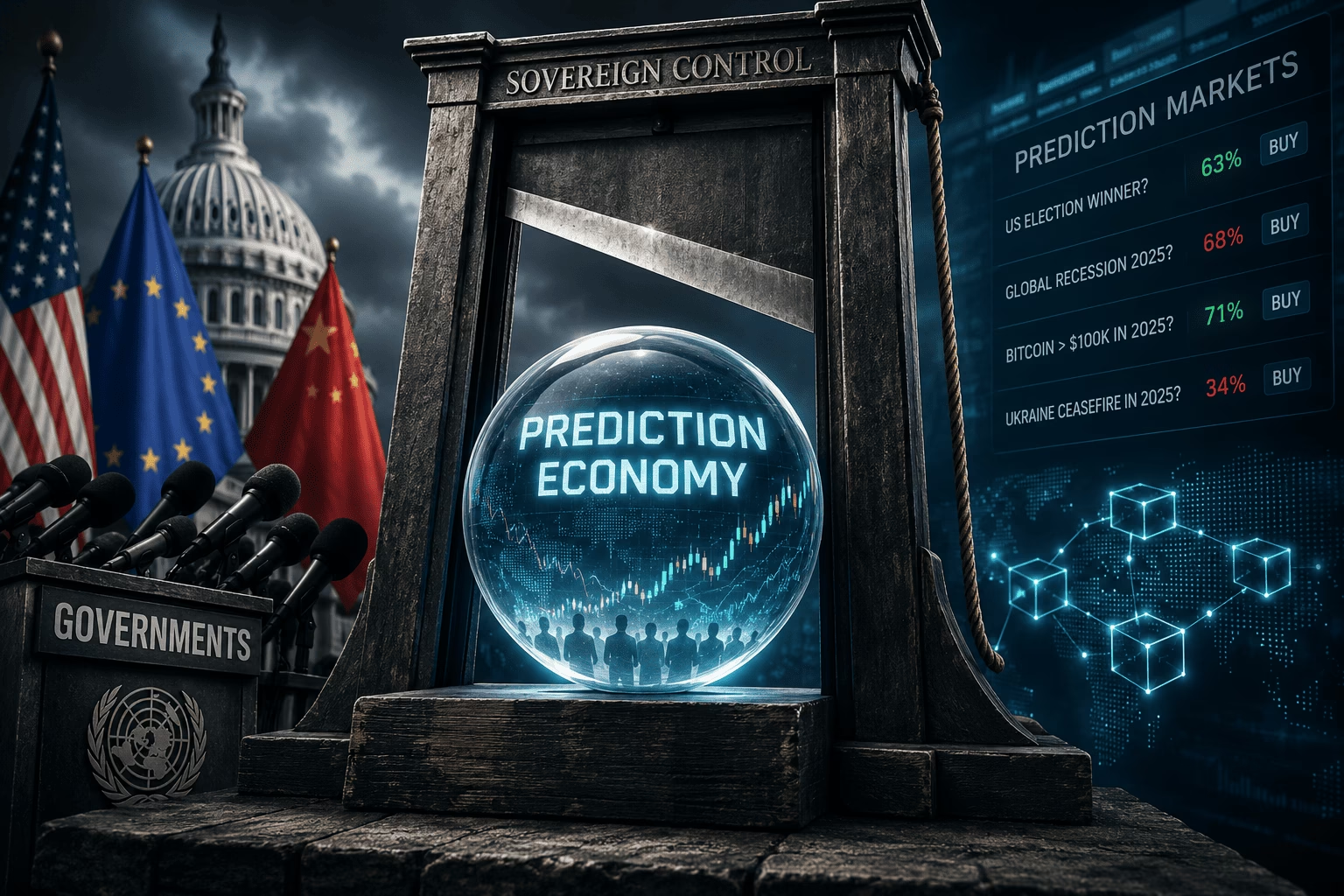
Governments worldwide are tightening their grip on prediction markets, not primarily because of gambling concerns or consumer protection, but because decentralised forecasting platforms are increasingly challenging state control over public information. That is the argument regulators won’t make in public but that the pattern of enforcement strongly suggests.
Across major economies and emerging markets alike, regulators are intensifying scrutiny of prediction markets. What started as a niche experiment in collective intelligence has evolved into a rapidly growing ecosystem capable of producing real-time forecasts that often challenge official narratives.
The dispute is no longer merely about gambling classifications or financial oversight. Increasingly, it is becoming a contest over informational authority and political power.
At the heart of the Prediction Economy is a straightforward concept: people trade contracts tied to future events, and the resulting market prices reflect the probability of those outcomes occurring.
Unlike traditional polls, which capture opinions at a specific moment, prediction markets require participants to risk capital on their beliefs. Supporters argue that this financial incentive encourages more accurate forecasting and discourages wishful thinking.
For governments, that creates a unique challenge.
Historically, states have exercised considerable influence over public information through institutions such as central banks, statistical agencies, intelligence services, and approved polling organizations. Prediction markets bypass many of those traditional gatekeepers, producing independent indicators that can contradict official messaging.
A government may claim inflation is easing, while market participants price in a growing likelihood of economic deterioration. Political leaders may project confidence ahead of an election, while prediction markets signal a far less favorable outcome.
In such situations, the Prediction Economy becomes an alternative mechanism for discovering truth—one that operates outside direct government control.
“Markets are often remarkably effective at aggregating dispersed information,” wrote Nobel Prize-winning economist Friedrich Hayek, whose work on knowledge distribution laid much of the intellectual foundation for market-based forecasting systems.
That principle has become increasingly relevant as prediction platforms attract greater liquidity and public attention.
While governments have long regulated traditional forecasting platforms through licensing requirements and banking restrictions, blockchain technology has dramatically changed the landscape.
Decentralized prediction markets operate through smart contracts that exist across distributed networks. Users can participate pseudonymously, transactions can occur globally, and market activity continues regardless of national borders.
This creates a significant enforcement challenge.
Governments can regulate companies, banks, and individuals within their jurisdiction. Regulating autonomous code operating on decentralized infrastructure is considerably more difficult.
As a result, authorities increasingly frame prediction markets as potential risks. Concerns often include consumer protection, election integrity, market manipulation, gambling exposure, and national security implications.
Many of these concerns are legitimate and deserve scrutiny. Yet critics argue that such arguments frequently obscure a deeper issue: the rise of independent forecasting systems that compete with governments for informational influence.
According to economist Robin Hanson, one of the leading advocates of prediction markets, these systems have repeatedly demonstrated their ability to aggregate information efficiently and generate useful forecasts.
Academic studies spanning decades have found that prediction markets frequently outperform expert panels and conventional surveys when forecasting uncertain outcomes.
The paradox is striking. Governments often rely on predictive intelligence internally, but public, decentralized forecasting systems appear to generate far greater discomfort.
The expansion of the Prediction Economy also threatens another important pillar of state power: narrative management.
In today’s hyperconnected digital environment, information moves faster than ever. Market-generated probabilities can shape public expectations long before official reports or government statements are released.
If a prediction market assigns a high probability to a recession, consumers and investors may alter their behavior accordingly. Those behavioral changes can then reinforce the very expectations reflected in the market.
This feedback loop gives prediction platforms influence that extends beyond simple forecasting.
The stakes become even higher when prediction contracts focus on geopolitics. Markets tied to leadership changes, military conflicts, sanctions, diplomatic negotiations, or economic crises effectively transform sensitive political developments into tradable information assets.
From the perspective of governments, such markets may be viewed as undermining strategic interests or encouraging speculative behavior around critical national events.
Whether those concerns are fully justified may be secondary to a more fundamental reality: states rarely welcome systems that reduce their control over the flow of information.
As former U.S. Secretary of Defense Donald Rumsfeld famously observed, decision-makers must contend with both known and unknown uncertainties. Prediction markets attempt to quantify those uncertainties in public view—a development many governments find uncomfortable.
Despite mounting regulatory pressure, many industry observers believe the long-term outlook for the Prediction Economy remains strong.
History offers several examples of technologies that survived intense opposition because they provided meaningful utility. File sharing networks, cryptocurrencies, encrypted communications, and decentralized finance all faced significant regulatory challenges yet continued to evolve.
Prediction markets may follow a similar path.
The demand for better forecasting remains substantial. Businesses seek stronger economic signals. Investors want superior information. Policymakers themselves increasingly depend on predictive tools when making strategic decisions.
These incentives are unlikely to vanish.
As forecasting platforms become more sophisticated and attract additional liquidity, governments will almost certainly introduce stricter oversight mechanisms. Some jurisdictions may adopt licensing frameworks. Others may impose tighter restrictions or pursue outright bans.
Yet the forces driving the Prediction Economy—decentralization, global connectivity, and the pursuit of accurate information—continue to gain momentum.
The broader question is no longer whether prediction markets will survive. Instead, it is who will control the production and dissemination of predictive knowledge in the digital era.
Will future truths emerge from decentralized networks where participants stake capital on their convictions? Or will governments maintain their historical role as the primary arbiters of public information?
The answer remains uncertain.
What is increasingly clear, however, is that the struggle surrounding the Prediction Economy has evolved beyond regulation. It has become a global debate about information, authority, and power.
Governments may slow the advance of the Prediction Economy, but stopping it entirely could prove far more difficult. Technologies that help people uncover valuable information have a history of enduring despite resistance.
The coming decade may determine whether prediction markets become a permanent feature of the global information landscape—or the latest innovation caught in a growing battle between decentralization and state control.



Copyright © 2025 - The Bit Gazette.