

- Trending
- Comments
- Latest

Alexander Browder, a 17-year-old British national, was formally sanctioned by Russia’s Foreign Ministry on Wednesday over what Moscow described as “defamatory speculations and false information.” The teenager, along with four other British citizens, is now indefinitely banned from entering Russian territory.
The sanctions stem from a policy paper Browder authored in March for the Henry Jackson Society, a London-based think tank.
Titled “Confronting the Illicit-Finance Hydra in Crypto Markets: Protecting Retail Investors and Disrupting Hostile Government Exploitation,” the report detailed how Moscow-backed crypto laundering networks allegedly processed hundreds of billions of dollars to evade international sanctions and fund military operations.
“Subsidizing crypto mining risks distorting energy markets,” — IMF spokesperson, in a statement to Independent Urdu.
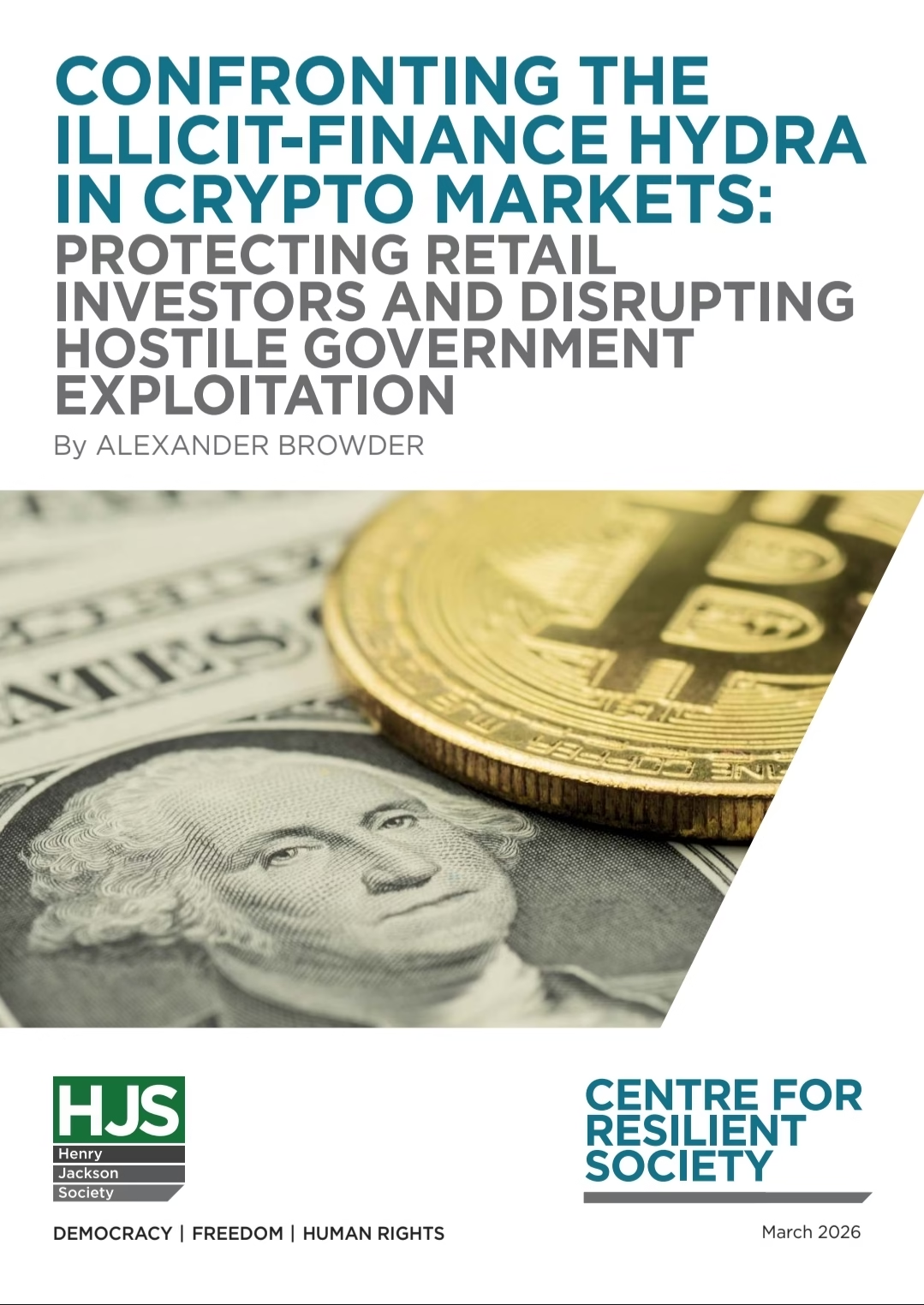
Browder’s investigation identified approximately $350 billion in laundered assets traced to multiple state actors, including Russia, Iran, and North Korea. Central to his findings was a ruble-backed stablecoin known as A7A5, which he described as “one of the most prevalent issues facing the West” in combating illicit financial flows.
According to the UK Foreign Office, Russia employs tokens such as A7A5 to circumvent Western financial restrictions imposed after the 2022 invasion of Ukraine. The stablecoin a digital currency pegged to fiat reserves allows funds to move through crypto exchanges with reduced oversight, effectively creating a parallel financial corridor.
In May, the British government announced a coordinated sanctions package targeting individuals linked to the network behind A7A5. Officials noted that the operation had allegedly moved more than $90 billion in the previous year alone.
“I have exposed their Achilles’ heel,” — Alexander Browder, via social media platform X. “Without A7A5, they would not be able to fund their war of aggression.”
The case has drawn comparisons to larger probes into Moscow-backed crypto laundering, which financial intelligence units in the US, EU, and UK have prioritized as a critical vulnerability in sanctions enforcement. Unlike traditional wire transfers, crypto transactions can be routed through multiple jurisdictions, complicating real-time tracking.
Browder is believed to be among the youngest individuals ever sanctioned by the Russian Federation. In a series of posts on X following the announcement, he characterized the punishment as “a badge of honour” and said he was “proud to be the first high school student in the world to ever be sanctioned by an authoritarian regime for uncovering corruption.”
The Kremlin’s response signals the perceived threat posed by independent investigative work, even when conducted by a minor. Russia’s Foreign Ministry warned in its official statement that “any efforts by the British political elites to escalate Russophobia, intentionally damage the international standing of our country, and ratchet up anti-Russian sanctions” would be met with “resolute response measures.”
Experts monitoring Moscow-backed crypto laundering note that stablecoins like A7A5 represent an evolution in state evasion tactics—moving from cash-based smuggling to algorithm-driven value transfer. The network’s reported $90 billion annual throughput would rival the GDP of several small nations.
Browder’s sanctions come amid a broader regulatory crackdown. The Financial Action Task Force (FATF) has updated its guidance on virtual assets three times since 2021, yet enforcement remains inconsistent across member states.
Moscow-backed crypto laundering exploits precisely these gaps, routing funds through exchanges in jurisdictions with weak know-your-customer protocols.
The Henry Jackson Society declined to comment on the sanctions but reaffirmed support for Browder’s research methodology. Meanwhile, British officials have not indicated whether additional protective measures will be extended to the teenager, who remains in the UK.
Industry analysts point out that targeting a minor with diplomatic sanctions is highly unusual, suggesting that Moscow-backed crypto laundering networks view investigative exposure as an existential threat.
The Kremlin has not provided specific evidence refuting Browder’s claims, instead framing his work as part of a broader “Russophobic” campaign.



Copyright © 2025 - The Bit Gazette.