

- Trending
- Comments
- Latest

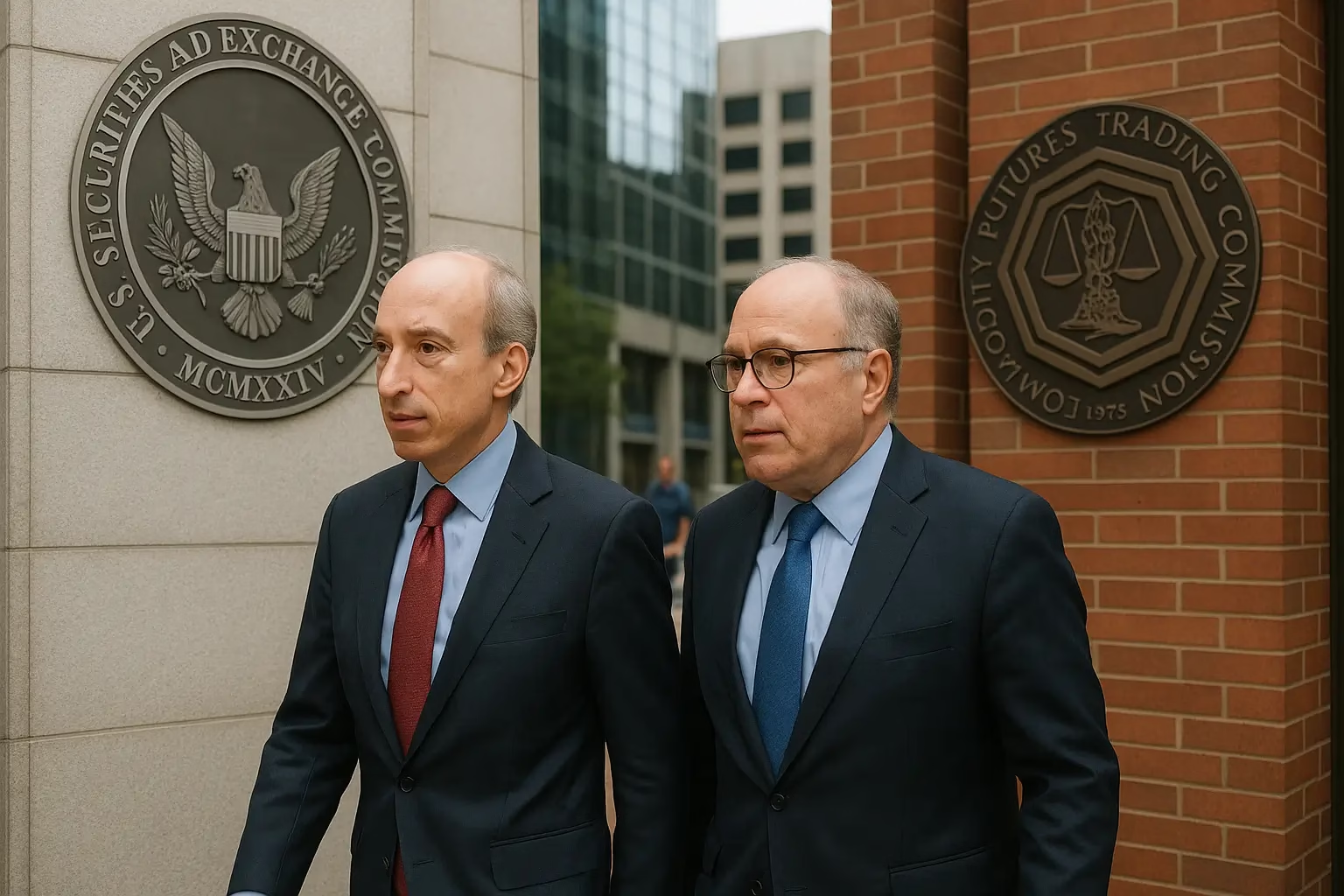
The SEC and CFTC jointly issued an interpretation on March 17, 2026, clarifying how federal securities law applies to crypto assets, the clearest sign yet that Washington’s enforcement-first approach to digital assets is over.
The shift marks a significant departure from the enforcement-heavy approach that dominated the previous administration and is likely to shape the cryptocurrency industry throughout the second half of 2026.
For several years, the SEC became synonymous with lawsuits against major crypto companies, arguing that many digital assets qualified as securities under existing federal law. Exchanges, token issuers, and decentralized finance (DeFi) projects frequently found themselves facing investigations and litigation.
That strategy has now been largely abandoned.
In March 2026, the SEC and the U.S. Commodity Futures Trading Commission (CFTC) jointly released a landmark interpretation clarifying how federal securities laws apply to digital assets. Rather than relying primarily on court battles, the agencies adopted a principles-based framework intended to provide clearer guidance to market participants.
Legal experts describe the move as one of the biggest regulatory changes the U.S. crypto industry has experienced since Bitcoin entered mainstream finance.
Several factors appear to have driven the policy shift.
First, years of litigation produced mixed court outcomes, creating legal uncertainty instead of definitive rules.
Second, institutional adoption of digital assets accelerated through spot Bitcoin ETFs, tokenized securities, and growing interest from traditional financial institutions.
Third, the new SEC leadership under Chairman Paul Atkins has emphasized that innovation should not be stifled by regulatory uncertainty while maintaining protections against fraud. The agency’s draft strategic plan for 2026–2030 also identifies digital assets as a major regulatory priority, signaling that crypto regulation is becoming more structured rather than less important.
The policy reversal should not be mistaken for deregulation.
Instead of pursuing broad registration-based enforcement actions, the SEC is increasingly focusing on fraud, market manipulation, investor protection, disclosure requirements, and developing formal regulatory frameworks.
Recent actions illustrate this balance. While opening the door to innovation, the agency has also sought public feedback on increasingly complex financial products including crypto-linked and leveraged exchange-traded funds (ETFs) before approving them, demonstrating that oversight remains active.
The second half of 2026 could become one of the most significant periods for digital assets in the United States.
Several developments are likely:
However, important questions remain unresolved, including the classification of certain digital assets, the regulation of decentralized finance, and congressional efforts to establish comprehensive crypto legislation.
The SEC’s policy shift represents more than a change in enforcement strategy it reflects a broader transformation in how U.S. regulators view digital assets.
Rather than treating the crypto industry primarily as a source of legal violations, regulators are increasingly attempting to integrate it into existing financial markets through clearer rules and coordinated oversight.
Whether this new approach succeeds will become clearer during H2 2026, as regulators balance innovation with investor protection. If successful, the SEC’s “forced retreat” from aggressive enforcement may ultimately be remembered not as a surrender, but as the beginning of a more mature phase of crypto regulation in the United States.



Copyright © 2025 - The Bit Gazette.