Tag: binance

  • Breaking: CZ’s new X bio sparks frenzy over possible Binance comeback

    Breaking: CZ’s new X bio sparks frenzy over possible Binance comeback

    Changpeng Zhao (CZ), Binance’s founder and former CEO, fueled intense speculation across the cryptocurrency sector after updating his X (formerly Twitter) profile from “ex-@binance” to “@binance”. This move comes nearly two years since he stepped down as CEO following a U.S. regulatory crackdown and a historic $4.3 billion settlement in November 2023.

    Breaking: CZ’s new X bio sparks frenzy over possible Binance comeback
    Breaking: CZ’s new X bio sparks frenzy over possible Binance comeback

    The timing of the profile tweak has turned heads: it appears just as reports suggest Binance is nearing a deal with the U.S. Department of Justice (DOJ) that could lift its three-year compliance monitoring requirement, imposed as part of its major 2023 settlement. With the native Binance Coin (BNB) surging to new all-time highs above $960, market watchers have interpreted this as a possible signal of renewed leadership ambitions at the exchange.

    Despite the market’s excitement, the legal context makes any official Binance comeback for Zhao extremely unlikely in the short term. Under his 2023 plea agreement, Zhao is explicitly barred from any management or operational role at Binance for at least three years, a restriction that has been consistently reported in company statements and legal filings. Richard Teng, who replaced Zhao as CEO, continues to lead the company as it works to restore regulatory trust in key markets.

    Zhao retains majority ownership of Binance but cannot exercise daily operational control under the terms of the DOJ agreement. Any changes to that arrangement would require new legal proceedings or, as some have speculated, executive action such as a presidential pardon—an outcome that, while technically possible, remains remote.

    Binance coin surges on speculation

    News of Zhao’s updated X profile sent BNB to a fresh record, climbing over 5% in 24 hours and trading just under $963 as of Tuesday night. The token’s futures open interest is up more than 10%, with over $1.8 billion in contracts, as traders react to expectations of a post-settlement Binance and new or renewed leadership energy.

    Trading volume for BNB jumped by more than a third, with aggregate spot volume surpassing $3 billion. Analysts attribute the excitement to both leadership speculation and optimism about a potential end to DOJ oversight.

    Future outlook

    No official statements have been released by Binance or by Zhao to clarify the reasons or implications behind the X profile change as of press time. For now, the prospect of a true “Binance comeback” by Zhao is speculative, constrained by the very real legal and regulatory barriers put in place by U.S. authorities.

    Regulators, investors, and the broader crypto community are watching Binance’s next moves closely. The outcome of ongoing DOJ talks, and any further public steps by Zhao, will continue to shape the future of both the company and the wider cryptocurrency ecosystem.

     

  • U.S. considers ending Binance DOJ monitorship after major compliance reforms

    U.S. considers ending Binance DOJ monitorship after major compliance reforms

    Binance, the world’s largest cryptocurrency exchange by trading volume, is close to brokering a pivotal agreement with the U.S. Department of Justice that could see the removal of a court-appointed compliance monitor—a major development for the embattled firm and its investors.

    The monitor was imposed in 2024 following high-profile charges of anti-money laundering (AML) and sanctions violations, which resulted in a plea deal and sweeping changes across the company’s management and operations. While no final decision has been made, sources indicate the DOJ is weighing whether recent improvements in Binance’s internal controls meet the stringent requirements set by U.S. authorities.

    The monitorship, which was set to last three years, had forced Binance to open its books to independent scrutiny. Forensic Risk Alliance (FRA), a global consulting firm specializing in forensic accounting, was selected by the DOJ to oversee Binance’s compliance practices, beating out the powerhouse law firm Sullivan & Cromwell for the role.

    Binance’s compliance transformation under scrutiny

    Under the terms of the original plea agreement reached in 2023, Binance committed to overhauling its KYC and AML frameworks, paying more than $4 billion in fines, and seeing its founder, Changpeng Zhao, step down as CEO—later serving time for compliance failures.

    According to the Bloomberg report, negotiations to end the monitorship are contingent on Binance ramping up transparency and demonstrating lasting improvements in its compliance reporting.

    “The DOJ’s primary concern remains the sustainable implementation of robust compliance practices,” said an anonymous DOJ official familiar with the negotiations, in comments reported by Bloomberg.

    This sentiment was echoed by a statement from FRA: “Our mandate is to ensure that corrective actions are substantive, not just procedural,” said Mark Thurston, Senior Partner at Forensic Risk Alliance.

    Industry watches for signals of regulatory thaw

    The prospect of the DOJ allowing Binance to operate without external oversight is being watched closely across the digital asset industry. Many stakeholders believe that lifting the compliance monitor could signal a new phase for crypto exchanges seeking to repair relationships with regulators in major jurisdictions.

    “One major exchange emerging from DOJ supervision could pave the way for broader reforms in industry self-regulation,” said Dr. Linda Lee, a legal expert in financial technology at Stanford University.

    Yet, according to market analysts, the move would not immediately erase the reputational and operational risks facing Binance as global watchdogs continue to scrutinize the sector.

    “Subsidizing crypto mining risks distorting energy markets,” warned an IMF spokesperson earlier this year in a separate report, underscoring ongoing institutional wariness toward crypto’s regulatory uncertainties.

    Changpeng Zhao seeks pardon amid Binance’s reset

    Amid the compliance overhaul, Binance’s former CEO Changpeng Zhao has confirmed efforts to secure a pardon following his conviction on charges tied to the exchange’s misconduct. Zhao’s public campaign has drawn mixed reactions in the crypto community and among investors, some of whom view it as essential for Binance’s reputation management, while others worry it could undermine longer-term reforms.

    “Restoring executive leadership and public trust is as vital as resolving regulatory overhang,” said Lee, reflecting the complex interplay between policy, practice, and market sentiment that will shape Binance’s future.

    Looking ahead as DOJ decision looms

    As of September 16, 2025, Binance’s fate remains in the balance, with the DOJ still deliberating on whether the exchange’s compliance revamp is sufficient for ending its oversight. Stakeholders, including crypto investors and industry watchdogs, are watching for a verdict that could set a precedent for future regulatory action in the fast-evolving world of digital finance.

  • Bitcoin ETFs surge, closes $2B gap on Binance’s spot trading lead

    Bitcoin ETFs surge, closes $2B gap on Binance’s spot trading lead

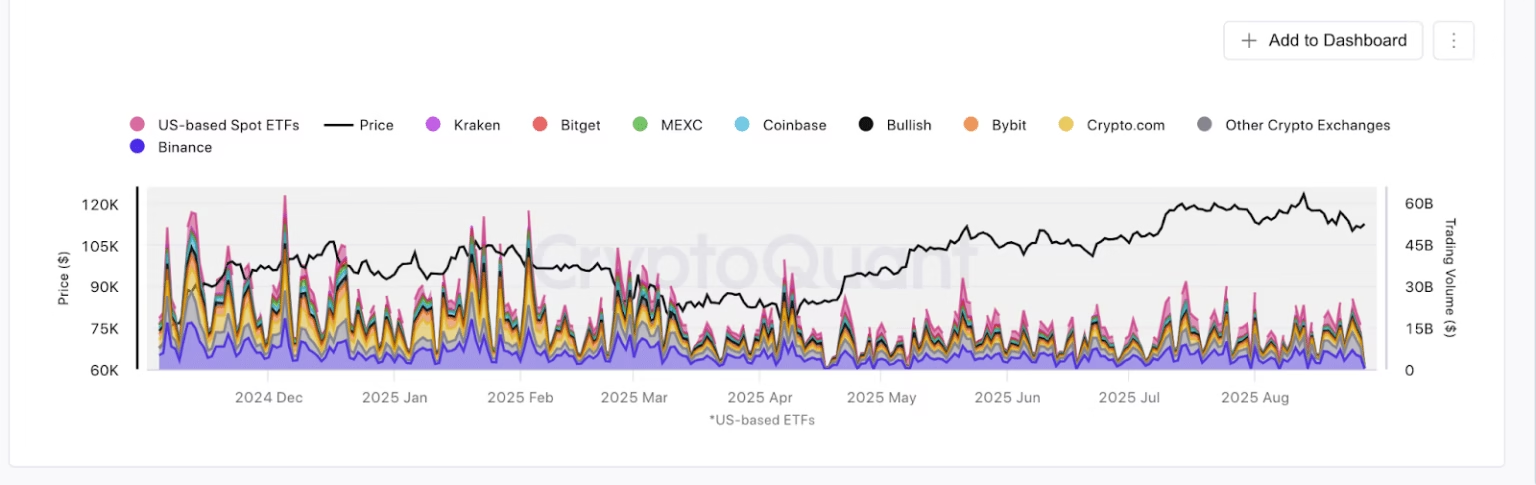
    The Bitcoin ETF revival is reshaping global crypto markets, with US-listed spot Bitcoin exchange-traded funds (ETFs) emerging as a dominant channel for investor exposure. According to Julio Moreno, head of research at CryptoQuant, these ETFs are generating daily volumes of $5–10 billion on active trading days, rivaling major exchanges.

    “The Bitcoin ETF revival has firmly established ETFs as a parallel venue to traditional exchanges,” — Julio Moreno, Head of Research, CryptoQuant. “For investors, this marks a fundamental shift in how Bitcoin liquidity is accessed.”

    CoinGecko data shows that 11 US-based Bitcoin ETFs collectively recorded $2.77 billion in daily trading volume, or about 67% of Binance’s $4.1 billion Bitcoin spot activity. On peak days, overall Bitcoin spot trading including both ETFs and exchanges has surged to $18 billion, underscoring the growing role of regulated products in crypto liquidity.

    Binance still leads but faces ETF competition

    Despite the momentum of the Bitcoin ETF revival, Binance remains the largest spot trading venue globally. Its total daily trading volume across assets stands at roughly $22 billion, with Bitcoin and Ethereum contributing the lion’s share. Ethereum alone has reached peak spot volumes of $11 billion on the exchange.

    Source:Crypto.com

    US-based Bitcoin ETFs, however, are increasingly favored by institutional investors. BlackRock’s iShares Bitcoin Trust (IBIT) leads the pack, capturing nearly 40% of recent inflows. Since Monday, IBIT has attracted $223.3 million in new capital.

    Over the last four trading days, Bitcoin ETFs collectively recorded $571.6 million in inflows. While these numbers are lower than earlier peaks, they highlight persistent institutional demand.

    “The Bitcoin ETF revival has made regulated exposure more accessible, and institutions are responding,” — Matteo Greco, Research Analyst at Fineqia International, in a recent market note.

    Ether ETFs steal the spotlight with stronger inflows

    Although the Bitcoin ETF revival is commanding headlines, Ether ETFs have quietly emerged as the stronger performer in terms of recent inflows, signaling that institutional investors are broadening their focus beyond Bitcoin. In just four trading sessions, US-listed Ether ETFs attracted $1.24 billion in new capital more than double the inflows seen in comparable Bitcoin products.

    The consistency of these flows underscores the growing appeal of Ethereum’s ecosystem to institutional investors. Since August 20, Ether ETFs have not recorded a single day of outflows, a streak that stands in contrast to the more volatile patterns observed in Bitcoin funds. Over the past month, Ether ETFs have absorbed more than $4 billion, accounting for roughly 30% of all inflows since their launch earlier this year.

    Market analysts point out that this momentum reflects Ethereum’s evolving role in the digital economy. Unlike Bitcoin, which is primarily valued as a store of wealth, Ethereum underpins a wide range of decentralized applications, including DeFi protocols, NFT platforms, and tokenized real-world assets.

    “Ethereum offers exposure not just to a digital currency, but to the infrastructure powering Web3,” said Maria Lopez, Senior Strategist at Arcane Research. “This is increasingly attractive to institutions looking for diversified blockchain investments.”

    Despite the strong showing from Ether ETFs, Ethereum’s spot trading volume remains heavily concentrated on centralized exchanges. Moreno noted that Binance and Crypto.com continue to account for the majority of ETH spot activity, with ETFs ranking only sixth in global trading share. This suggests that while ETFs are gaining traction among regulated capital allocators, their adoption still lags behind Bitcoin’s more established footprint.

    Analysts argue that this gap may close as Ethereum’s regulatory outlook improves. The US Securities and Exchange Commission (SEC) approved Ether ETFs months after Bitcoin products, and several funds are still ramping up their market presence. As these ETFs scale and institutions gain confidence in Ethereum’s long-term utility, inflows could accelerate further.

    “The contrast between the Bitcoin ETF revival and the surge in Ether ETF inflows shows that institutional interest is diversifying,” — Sarah Chen, Analyst, Solana Foundation. “Ethereum is becoming a serious contender for regulated capital, particularly for investors who see value in its smart contract capabilities.”

    For investors, the takeaway is that Ether ETFs are not simply a secondary option but a parallel growth story. If current inflow trends continue, Ether could challenge Bitcoin’s dominance in the regulated ETF landscape, reinforcing its role as the backbone of decentralized finance and digital innovation.

    ETFs reshape liquidity and investor access

    The Bitcoin ETF revival is more than a trading trend as it is reshaping the very structure of crypto market liquidity. By channeling billions of dollars in daily volume through regulated structures, ETFs are establishing themselves as a fundamental gateway for traditional finance.

    Industry researchers argue that this transformation is altering price formation and broadening participation in digital assets. For many institutional investors, ETFs offer a safer, regulated entry point into Bitcoin and Ethereum, reducing counterparty risks tied to offshore exchanges.

    “As the Bitcoin ETF revival continues, we’re likely to see ETFs play an even greater role in setting market benchmarks,” — David Lawant, Head of Research, FalconX. “They’re not just tracking the market — they’re starting to shape it.”

    For crypto investors, the message is clear: the Bitcoin ETF revival has cemented ETFs as a core driver of liquidity, inflows, and adoption. While Binance retains global dominance, ETFs are no longer a sideshow as they are a centerpiece of institutional participation in the digital asset economy.

  • WLFI token debuts, triggers $40B trading surge as investors eye sky-high rally

    WLFI token debuts, triggers $40B trading surge as investors eye sky-high rally

    The WLFI token debut is generating major buzz today as the highly anticipated launch sees 5 billion tokens unlocked and over $5 billion in derivatives trading volume ahead of the official trading start. With the token debut, traders and investors are watching closely to see if this new asset can surge to the $0.50 mark.

    The token debut marks the official launch of World Liberty Financial’s native token with Binance leading the way as the first exchange to list it. Trading for the new spot pairs WLFI/USDT and WLFI/USDC kicks off today, Sept. 1, at 13:00 UTC. Deposits are already open and withdrawals will be available starting tomorrow.

    The token debut is also being supported by other major exchanges, including KuCoin, Gate.io, Bithumb, Upbit, Kraken, OKX, HTX, MEXC, LBank and Bitrue, ensuring the WLFI token debut is accessible across all leading trading platforms.

    This WLFI token debut follows a pivotal community decision to allow trading of WLFI tokens which were previously non transferable due to regulatory compliance.

    On August 22, the World Liberty Financial community voted to unlock 20% of the total supply about 5 billion WLFI tokens held by early supporters with the WLFI token debut scheduled for Sept. 1 at 12pm UTC. This unlock provides the first real opportunity for holders to move or trade their tokens on centralized exchanges making the WLFI token debut a significant milestone.

    WLFI Token Debut: Price Predictions and Market Outlook

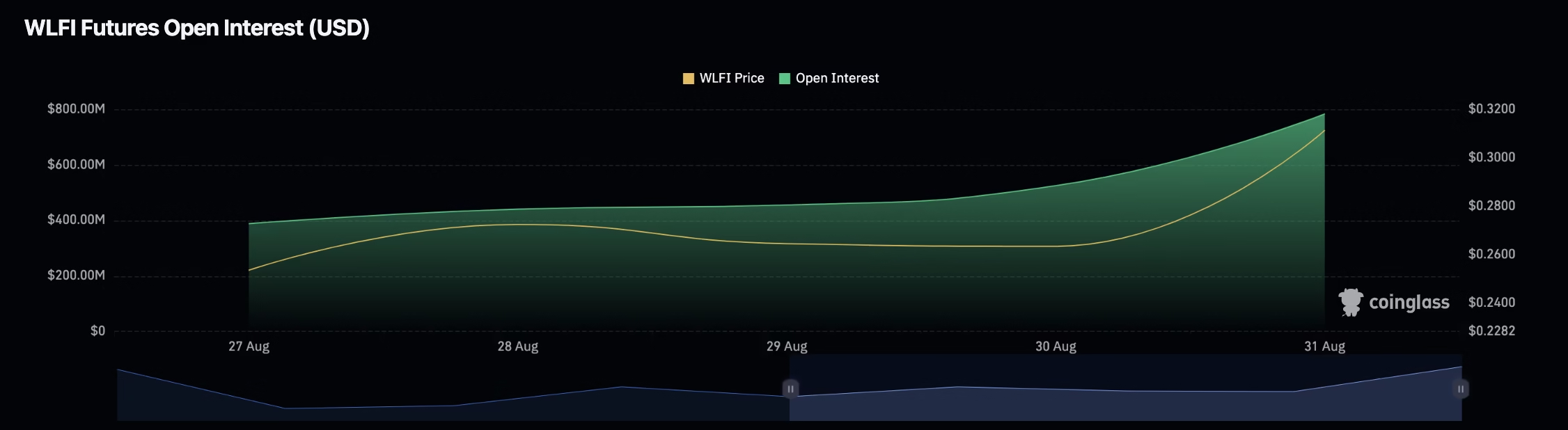
    The WLFI token debut is already attracting intense speculative interest. As reported by Coinglass, the WLFI derivatives trading volume has soared to $5.0 billion in the past 24 hours a growth surpassing 400% while open interest has climbed 25% to $850 million. This surge in leveraged trading around the WLFI token debut signals that volatility is likely to remain high.

    Market sentiment during the WLFI token debut appears bullish. The long/short ratio on Binance is over 5.4, and OKX reports a similar ratio above 6.3. Even among top traders on Binance the long/short ratio is above 5.2 indicating that many are betting on upward price movement during the WLFI token debut.

    Futures prices for WLFI have already reached the $0.30–$0.32 range, supported by rising open interest. If the momentum from the WLFI token debut continues and speculative capital keeps flowing in, the token could realistically test the $0.40–$0.50 zone in the short term.

    The WLFI token debut is also crucial for price discovery. At current prices of around $0.32–$0.34, the circulating market cap would be approximately $1.6–$1.7 billion. Should the WLFI token debut see prices hit $0.50, the circulating market cap would rise to $2.5 billion thereby placing WLFI firmly in the mid cap tier of cryptocurrencies. Its fully diluted valuation could even rival some of the top 10 crypto assets.

    Source: Coignlass The upcoming

    However, the WLFI token debut also brings potential challenges. The unlock could create a supply overhang as early investors may look to take profits after significant gains from private sale rounds at $0.015 and $0.05.

    Still, the strong derivatives interest seen during the token debut suggests that speculative demand could absorb much of this selling pressure. The balance between these forces will likely determine whether the token debut leads to consolidation in the $0.30s or a breakout toward the $0.40–$0.50 range.

    As the token unfolds, all eyes are on whether this new entrant can live up to the hype and reach the coveted $0.50 milestone.

  • Binance faces Australian regulator probe over money laundering controls

    Binance faces Australian regulator probe over money laundering controls

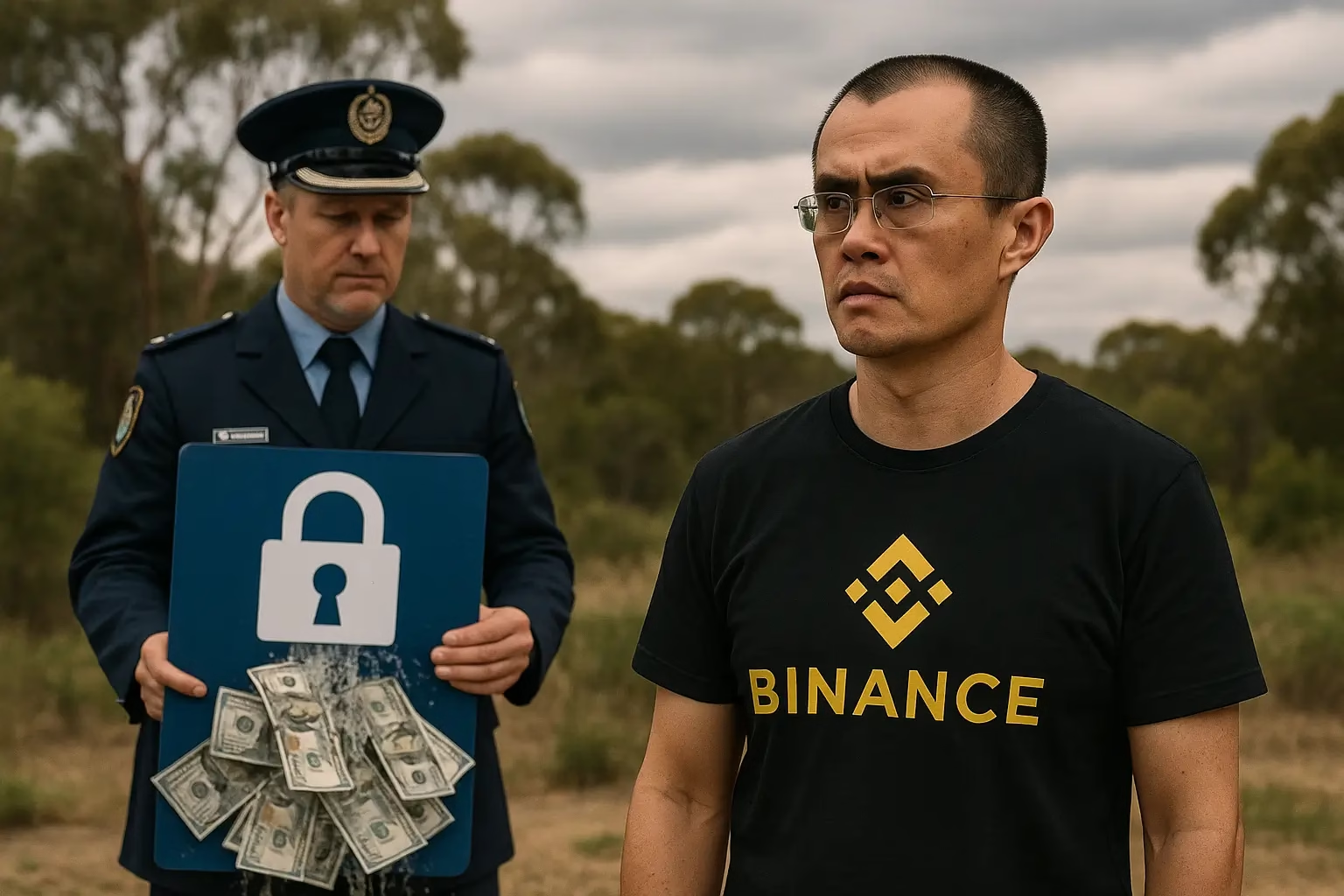
    Australia’s financial intelligence regulator has ordered Binance’s local unit to appoint an external auditor following concerns about Binance money laundering control and counter-terrorist financing (CTF) systems. The directive, announced Friday by the Australian Transaction Reports and Analysis Centre (AUSTRAC), comes after the regulator identified “serious concerns” with the exchange’s compliance framework.

    Matt Poblocki, general manager for Binance Australia and New Zealand, acknowledged the decision, stressing that it should not be seen as punitive.

    “Binance Australia acknowledges AUSTRAC’s decision,” Poblocki told Cointelegraph. “This is one of their supervisory review measures and not an enforcement action.”

    The request reflects AUSTRAC’s growing focus on the crypto sector, which the regulator has previously identified as highly vulnerable to misuse. Last year, AUSTRAC chief executive Brendan Thomas warned that digital currencies remain at risk of exploitation by criminals.

    “This is a global company operating across borders in a high-risk environment. We expect robust customer identification, due diligence and effective transaction monitoring,” Thomas said in a statement.

    Governance and oversight concerns

    AUSTRAC’s order goes beyond technical compliance. The regulator flagged Binance’s high staff turnover and lack of local senior management oversight as red flags for governance. These concerns raise questions about whether Binance money laundering control systems are being effectively implemented in Australia.

    According to AUSTRAC, ensuring strong leadership and resourcing is critical when dealing with an exchange that processes significant transaction volumes across multiple jurisdictions. Weak oversight, the regulator argued, undermines the effectiveness of anti-money laundering and counter-terrorist financing safeguards.

    Industry analysts say the move highlights the challenges global crypto firms face in tailoring compliance systems for local markets.

    “Binance’s compliance struggles in Australia are part of a broader trend of regulators demanding stronger local accountability from global exchanges,” — Karen Wu, Senior Policy Analyst at Blockchain Intelligence Group.

    Binance’s regulatory battles in Australia

    This is not the first time Binance has faced scrutiny in Australia. In late 2024, the Australian Securities and Investments Commission (ASIC) launched legal proceedings against Binance Australia Derivatives over alleged consumer protection failures. Months earlier, ASIC conducted searches of Binance’s offices as part of an investigation into its derivatives business.

    The probe ultimately led to the cancellation of Binance Australia Derivatives’ license, following concerns about the misclassification of retail clients as “wholesale” customers. The issue triggered widespread account closures and further questions about Binance’s risk management practices.

    Together with AUSTRAC’s latest directive, these episodes reinforce a pattern of regulatory friction surrounding Binance money laundering control and broader compliance systems.

    Banking access and operational challenges

    Binance has also struggled with access to Australia’s banking system. In 2023, the exchange was cut off from local payment services after its provider, Zepto, was directed to suspend support. Binance said it received less than a day’s notice before losing banking access, forcing it to suspend Australian dollar deposits and withdrawals.

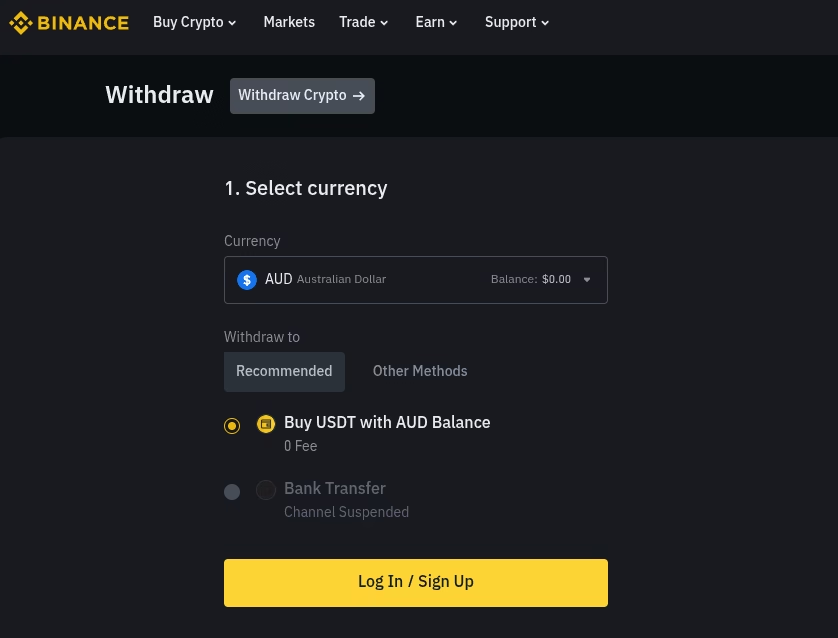
    Today, users attempting to withdraw AUD are advised to convert funds into USDt stablecoin or use Binance’s peer-to-peer marketplace. The “Bank Transfer” function remains inactive, marked with a “Channel Suspended” message.

    Binance money laundering control under regulator’s scrutiny in Australia
    Binance’s Australian dollar withdrawal menu. Source: Binance

    For many customers, these restrictions have underscored how regulatory and compliance challenges particularly around Binance money laundering control translate directly into limited service availability.

    What this means for investors

    For crypto investors, AUSTRAC’s intervention raises new questions about the exchange’s ability to maintain operations in Australia while meeting regulatory expectations. The external audit could reveal gaps in how Binance manages customer identification, due diligence, and suspicious transaction monitoring.

    While Binance insists that the review is part of routine supervisory engagement, regulators are signaling that Binance money laundering control must be strengthened if the firm wishes to operate in a market that increasingly prioritizes compliance.

    Some industry observers see the move as a turning point.

    “The requirement for an independent audit shows regulators are no longer willing to take exchanges at their word on compliance,” — James Hartley, Associate Professor of Finance, University of Sydney.

    For now, investors and users alike will be watching closely as Binance works to demonstrate improvements in Binance money laundering control. The outcome could shape not only its standing in Australia but also its broader relationship with regulators worldwide.

  • Binance, Coinbase, and partners launch TRM Beacon Network to crack down on crypto crime

    Binance, Coinbase, and partners launch TRM Beacon Network to crack down on crypto crime

    TRM Labs has unveiled the Beacon Network, a global platform designed to help crypto exchanges, law enforcement, and security researchers collaborate in real time against illicit financial activity. Launched on August 21, 2025, the initiative represents a landmark step in the industry’s ongoing battle against fraud, hacks, and money laundering.

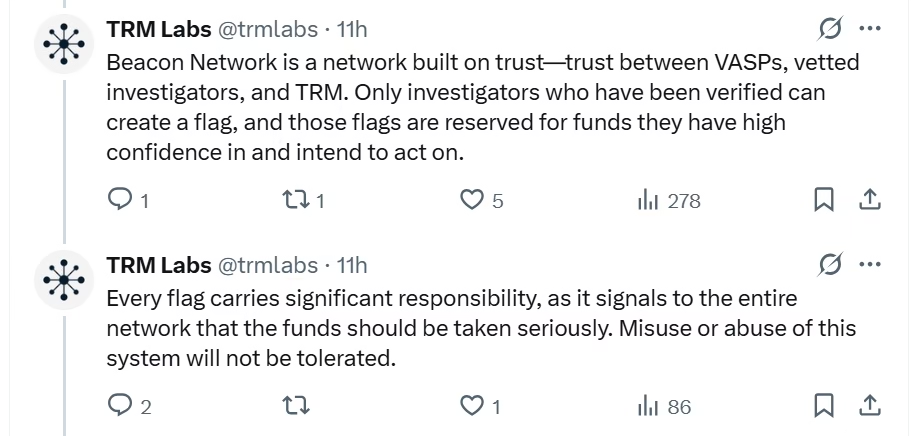
    For years, stolen or illicit digital assets could slip through the blockchain ecosystem within minutes, leaving platforms and regulators scrambling to trace their movements. The Beacon Network seeks to change that by enabling verified participants to flag suspicious wallet addresses instantly, preventing criminals from cashing out stolen funds.

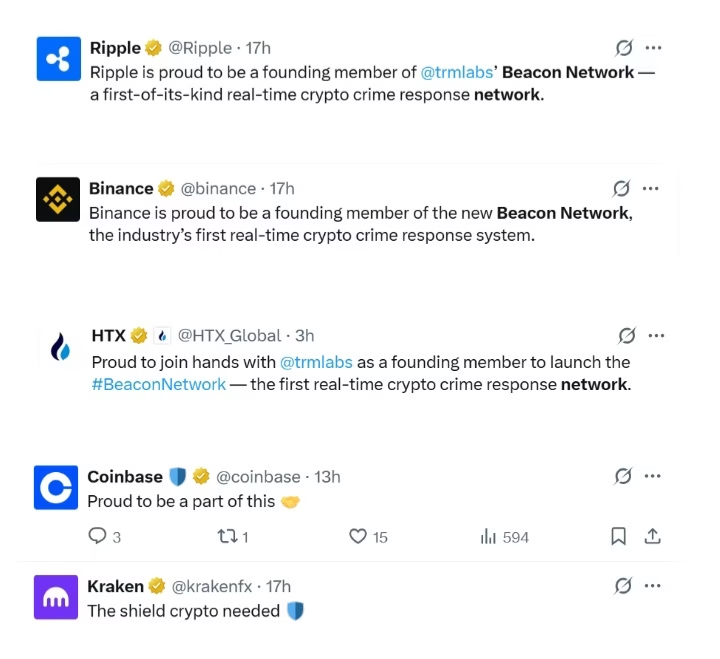
    Source; X

    “Crypto crime is borderless and fast-moving. The Beacon Network gives us a way to respond with the same speed and scale,” — Esteban Castaño, CEO of TRM Labs.

    Industry heavyweights back the initiative

    The Beacon Network is supported by some of the world’s most prominent exchanges and payment platforms, including Coinbase, Binance, Ripple, Kraken, PayPal, Robinhood, Stripe, and Crypto.com. Other major firms such as Blockchain.com, Anchorage Digital, Bitfinex, and OKX have also joined.

    This broad coalition signals growing recognition that crypto businesses cannot fight illicit activity alone. Federal law enforcement agencies are partnering with the network to identify and flag addresses linked to cybercrime. Security experts and independent watchdogs — including ZachXBT, Security Alliance (SEAL), Hypernative, and CryptoForensics Investigators — will also contribute to monitoring and analysis.

    “The Beacon Network represents one of the strongest examples yet of public-private partnership in the digital asset space,” — Angela Bryant, policy advisor at the U.S. Department of Justice’s Cybercrime Unit.

    Billions at stake in escalating crypto crime

    The urgency of the Beacon Network is underscored by staggering losses. Since 2023, at least $47 billion in digital assets has been funneled to fraud-related addresses, according to TRM Labs data. In 2025 alone, cyberattacks have drained more than $2.3 billion from investors and exchanges, making it one of the most damaging years on record.

    The true scale may be higher, as many victims remain silent due to embarrassment or lack of legal recourse. High-profile breaches, such as the $1.5 billion Bybit hack earlier this year, demonstrated how quickly stolen funds can be split across thousands of transactions to evade tracking.

    The Beacon Network aims to shift the industry’s posture from reaction to prevention. Its system provides:

    • Real-time alerts for suspicious fund movements.
    • Address flagging by vetted participants.
    • Rapid response protocols for flagged transactions.
    • Global coordination to prevent cash-outs through exchanges and fiat gateways.
    • Toward legitimacy and investor confidence

    The launch of the Beacon Network is also part of a broader push to mainstream and regulate the cryptocurrency industry, which continues to face scrutiny from policymakers. By bringing together exchanges, payment firms, and regulators, the network offers a proactive model for addressing the sector’s most persistent criticism: its vulnerability to crime.

    Industry observers argue that greater transparency and accountability could help restore investor confidence after a turbulent two years of hacks, bankruptcies, and fraud scandals.

    “This is not just about stopping criminals. It’s about proving that the digital asset ecosystem can police itself and protect investors,” — Maya Thompson, senior analyst at Chainalysis.

    For investors, the presence of a coordinated defense mechanism could signal a safer environment for participation in digital markets. For policymakers, the Beacon Network provides evidence that self-regulation and collaboration can complement formal oversight, potentially reducing pressure for heavy-handed restrictions.

    A test for global adoption

    The success of the Beacon Network will depend on adoption beyond its initial members. Smaller exchanges, regional regulators, and emerging blockchain platforms will need to integrate for the system to be truly comprehensive. Questions also remain about how disputes over flagged addresses will be resolved, and whether criminals will quickly adapt with new laundering tactics.

    Still, the initiative is widely regarded as a milestone in crypto security. If successful, it could become a blueprint for how decentralized and centralized stakeholders work together to mitigate systemic risks.

    For now, the Beacon Network marks a shift in how the industry approaches crime: not as isolated incidents to chase after, but as threats that can be intercepted before they spread.

  • Binance backs Fusionist Hard Fork with altcoin upgrade rollout

    Binance backs Fusionist Hard Fork with altcoin upgrade rollout

    The Binance altcoin upgrade is set to make waves as the exchange confirmed support for Fusionist’s (ACE) network upgrade and hard fork on August 20, 2025.

    Positioned to boost network performance and compatibility, the move underscores Binance’s commitment to delivering a seamless trading experience while reinforcing confidence in altcoin infrastructure.

    According to Binance, the Fusionist (ACE) network upgrade will occur at block height 3,828,237, expected around 9:00 AM (UTC). To facilitate the process, deposits and withdrawals of ACE tokens will be suspended from 8:00 AM. However, spot and futures trading for the token will continue without interruption.

    “This Binance altcoin upgrade is part of our commitment to ensuring that major network transitions are handled smoothly, with minimal disruption to users,” — Binance spokesperson, in a company statement.

    Trading continues despite technical pause

    While the Binance altcoin upgrade requires a temporary suspension of deposits and withdrawals, the exchange has reassured users that trading will remain unaffected. This means market participants can continue buying and selling ACE tokens on both spot and futures markets during the upgrade.

    Binance emphasized that it will take responsibility for all technical aspects of the upgrade and hard fork, requiring no action from users. Once the network stabilizes, deposits and withdrawals will be re-enabled. The exchange noted that no additional announcements will be made until the Fusionist (ACE) network is fully stable.

    “The Binance altcoin upgrade demonstrates our ongoing priority to maintain trading stability while ensuring security throughout network transitions,” — Dr. Michael Li, blockchain analyst at DeFi Insights.

    Broader strategy to support network upgrades

    Industry observers see the Binance altcoin upgrade as part of a broader strategy by the exchange to support blockchain ecosystems undergoing significant technical shifts. Binance has frequently acted as a facilitator during network upgrades, managing the backend processes so that retail and institutional users face minimal disruption.

    The company has consistently prioritized security and transparency when dealing with network changes. By handling the technical side of the Fusionist (ACE) upgrade, Binance positions itself as a trusted intermediary during events that could otherwise cause uncertainty in the markets.

    “The Binance altcoin upgrade for Fusionist reinforces the exchange’s role as a stabilizing force in the industry, ensuring that user assets and trading activities are protected,” — Carla Mendes, Head of Research, Crypto Policy Forum.

    What users should expect next

    For users holding ACE tokens, no immediate action is required during the Binance altcoin upgrade. Trading will continue as usual, while deposits and withdrawals will be restored once the Fusionist network reaches stability. Binance has urged users to remain patient and assured them of a secure, transparent process.

    The Binance altcoin upgrade highlights how exchanges are adapting to the growing complexity of blockchain ecosystems, ensuring users remain shielded from the technical challenges of upgrades and hard forks.

    With Ethereum, Bitcoin, and other blockchains frequently undergoing major network improvements, the Binance altcoin upgrade represents a model for how exchanges can streamline transitions, reinforcing both trust and resilience in the broader crypto market.

  • Binance lists BFUSD, axes 3 tokens in new shake-Up

    Binance lists BFUSD, axes 3 tokens in new shake-Up

    Binance has rolled out a significant trading update, adding BFUSD to its listings while delisting three other tokens in a strategic shake-up that could reshape altcoin market dynamics.

    On August 13, 2025, the exchange announced the listing of BFUSD while simultaneously confirming the removal of three other trading pairs.

    The move, which Binance says is part of its “routine market quality review,” will see BFUSD/USDT trading open at 14:00 UTC with a limited-time zero-fee promotion for both spot and margin trades. However, on August 15, 2025, the exchange will delist ANIME/FDUSD, HYPER/FDUSD, and STO/BNB at 03:00 UTC due to low liquidity and trading volume.

    “Maintaining a healthy market requires tough decisions,” — Binance spokesperson, in a statement. “When a trading pair fails to meet our liquidity and quality standards, delisting is the responsible course of action.”

    For investors tracking Trump-backed altcoin investment opportunities, the update underscores the volatility of niche assets in the face of exchange reviews.

    Listing of BFUSD: zero fees to attract traders

    The highlight of Binance’s announcement is the addition of BFUSD, paired with USDT. For traders engaged in Trump-backed altcoin investment strategies, the zero-fee incentive could create short-term liquidity spikes as market participants seek to capitalize on reduced trading costs.

    Industry analysts note that such promotional listings often generate an initial surge in trading activity, though sustainability depends on market fundamentals.

    “Fee waivers can drive speculative volume, but the real test comes after the promotion ends,” — Clara Wu, Senior Market Analyst, CryptoMetrics.

    The pairing of BFUSD/USDT also aligns with Binance’s broader push to attract high-volume stablecoin traders, a segment that has recently intersected with political-themed cryptocurrency investments, including Trump-backed altcoin investment plays.

    Delisting of niche trading pairs raises caution

    The removal of ANIME/FDUSD, HYPER/FDUSD, and STO/BNB highlights Binance’s ongoing approach to pruning underperforming markets. For those exploring Trump-backed altcoin investment options, the development serves as a reminder that even politically branded or community-driven tokens can face exchange withdrawal if they fail to maintain sufficient liquidity.

    Binance reiterated that its periodic asset reviews assess “multiple factors including liquidity, trading volume, network stability, and compliance requirements.” The decision-making process, while framed as investor protection, also shapes which assets remain accessible to retail traders and institutional players alike.

    Implications for Trump-backed altcoin investment strategies

    While none of the delisted pairs are directly tied to Trump-backed altcoin investment vehicles, the exchange’s actions underline the fragility of low-volume tokens in the current regulatory and competitive landscape.

    Political-themed cryptocurrencies, particularly those connected to high-profile figures, can experience rapid valuation shifts based on both news cycles and exchange policies. Investors in Trump-backed altcoin investment projects must therefore monitor not only price action but also the listing health of their chosen platforms.

    Given the promotional push for BFUSD and the concurrent removal of less active pairs, market watchers suggest a potential pivot toward consolidating liquidity in fewer, more resilient assets.

    “In a concentrated market environment, the winners are those tokens with strong community support, clear use cases, and consistent exchange backing,” — Rafael Ortega, Independent Crypto Policy Researcher.

    For investors, the message is clear: while Trump-backed altcoin investment narratives can fuel enthusiasm, long-term positioning demands awareness of exchange policy shifts like Binance’s latest move.

    Summary of Binance changes:

    • New Listing: BFUSD/USDT (from Aug. 13, 2025, 14:00 UTC)
    • Promotion: Zero fees on BFUSD/USDT spot and margin trading
    • Delistings: ANIME/FDUSD, HYPER/FDUSD, STO/BNB (effective Aug. 15, 2025, 03:00 UTC)
  • Meme coin minting takes a hit as Pump.fun’s PUMP token crashes 22% post-ICO

    Meme coin minting takes a hit as Pump.fun’s PUMP token crashes 22% post-ICO

    Meme coin minting is under fire as Pump.fun’s native token, PUMP, nosedives just days after its record-shattering debut.

    Despite raising a jaw-dropping $600 million in just 12 minutes, the token has plunged more than 22%, slipping from a post-ICO peak above $0.006 to around $0.004, according to CoinMarketCap.

    This sharp fall effectively returns the PUMP token to its launch price, indicating potential turbulence ahead for the meme coin that once revitalized Solana’s meme ecosystem.

    From major rise to market reality

    Meme coin minting, once seen as the engine behind Pump.fun’s meteoric rise, is facing stiff headwinds.

    The project, which allocated 15% of its total 1 trillion PUMP supply to the public, stunned the market with its $600 million ICO.

    An additional 18% was sold privately, valuing the fully diluted market cap at a staggering $4 billion.

    But the post-launch performance tells a different story.

    “Retail investors jumped in fast, but without sustained demand or fresh incentives, early sell-offs are inevitable,” said David Gokhshtein, founder of Gokhshtein Media and a vocal crypto commentator.

    Competition heats up in meme coin minting wars

    Even as Pump.fun aimed to dominate the meme coin minting space, the landscape shifted quickly.

    On-chain data shows that LetsBONK, a new entrant focused on the BONK ecosystem, has overtaken Pump.fun in terms of token creation volumes.

    This transition occurred just two weeks ago and reflects broader saturation in Solana’s meme token market.

    Meme Coin Minting Meltdown: Pump.fun’s PUMP Token Plunges Despite $600M Hype
    Meme Coin Minting Meltdown: Pump.fun’s PUMP Token Plunges Despite $600M Hype

    “LetsBONK is the first real competitor to challenge Pump.fun’s monopoly on meme coin minting,” noted Anatoly Yakovenko, co-founder of Solana Labs, during a recent podcast.

    “Their growth has been explosive, and BONK’s 64% price jump reinforces that momentum.”

    Buybacks, utility & community takeovers

    In response to dwindling price action and increased competition, Pump.fun’s team has doubled down on token utility and community features.

    On Tuesday, the platform repurchased nearly 188,000 SOL—roughly $31.3 million—in PUMP tokens at an average price of $0.0064.

    The move temporarily boosted the token by 17%, topping $0.0067 before retracing.

    Pump.fun also pledged to funnel 25% of protocol revenues into ongoing buybacks. However, fee revenues on Friday came in at just $968,000, below the platform’s daily average.

    To rekindle interest, co-founder Alon Cohen introduced a bold new feature: Community Takeover.

    This function lets users claim abandoned meme coin projects and redirect creator fees toward active community contributors involved in raids, content, and development.

    “We’re flipping the script,” Cohen said in a Telegram AMA. “Meme coin minting should reward the builders and the raiders, not just the whales.”

    Strategic acquisition: Kolsca joins the meme war

    In a bid to differentiate itself, Pump.fun recently completed its first acquisition—Kolscan, a wallet-tracking platform that monitors top Solana traders.

    The integration will allow users to track whale activity, mirror trades, and access analytics—all for free.

    “Trading is a social sport,” Cohen emphasized. “Adding Kolscan to our arsenal turns meme coin minting into a data-driven experience, opening the door to smarter strategies and better community engagement.”

    The move aligns with Pump.fun’s broader ambition to evolve beyond meme coin minting into a full-fledged crypto social network, combining financial speculation with social clout.

    The road ahead for meme coin minting

    As meme coin minting cools across Solana, questions loom over Pump.fun’s ability to sustain momentum.

    Though the project still boasts tens of thousands of users and is rolling out aggressive upgrades, it now faces a crowd of imitators—and an increasingly fatigued retail audience.

    Still, some remain bullish. “Pump.fun laid the foundation for modern meme tokenization,” said Mira Christanto, former Messari analyst.

    “But sustaining that hype requires more than fast minting—it requires staying power.”

    The volatile saga of Pump.fun describes a hard truth in crypto: Meme coin minting success isn’t guaranteed by hype alone.

  • XRP skyrockets to new ATH as Ripple CEO celebrates historic whitehouse milestone

    XRP skyrockets to new ATH as Ripple CEO celebrates historic whitehouse milestone

    XRP skyrockets to new ATH in a jaw-dropping rally that sent shockwaves across the crypto industry, marking a historic day as Ripple’s top brass took center stage during a major U.S. regulatory event at the White House.

    The surge coincided with the signing of the much-anticipated Genius Act into law—ushering in a new era of regulatory clarity for crypto, and fueling bullish momentum for XRP.

    XRP skyrockets to new ATH just as photos emerged of Ripple executives attending the landmark event in Washington, D.C., where U.S.

    President Donald Trump signed the Genius Act—designed to regulate the $250 billion stablecoin market with clarity and pro-innovation guidelines.

    Ripple CEO applauds crypto clarity from the White House as XRP skyrockets to new ATH 

    Brad Garlinghouse, CEO of Ripple Labs, took to X (formerly Twitter) to share his thoughts on the monumental development.

    Though he couldn’t attend the event in person, he reshared a post from Ripple’s Chief Legal Officer, Stuart Alderoty, who was photographed at the White House as the legislation was signed.

    “This is a defining moment—not just for Ripple, but for the entire crypto ecosystem. Regulatory clarity in the U.S. has been long overdue, and today, we finally see that tide turning,” Garlinghouse wrote in his post.

    He emphasized that the Genius Act marks a seismic shift away from America’s historically cautious stance on digital assets, calling it a “day to remember for XRP holders and crypto believers alike.”

    Genius act spurs XRP rally: XRP skyrockets to new ATH

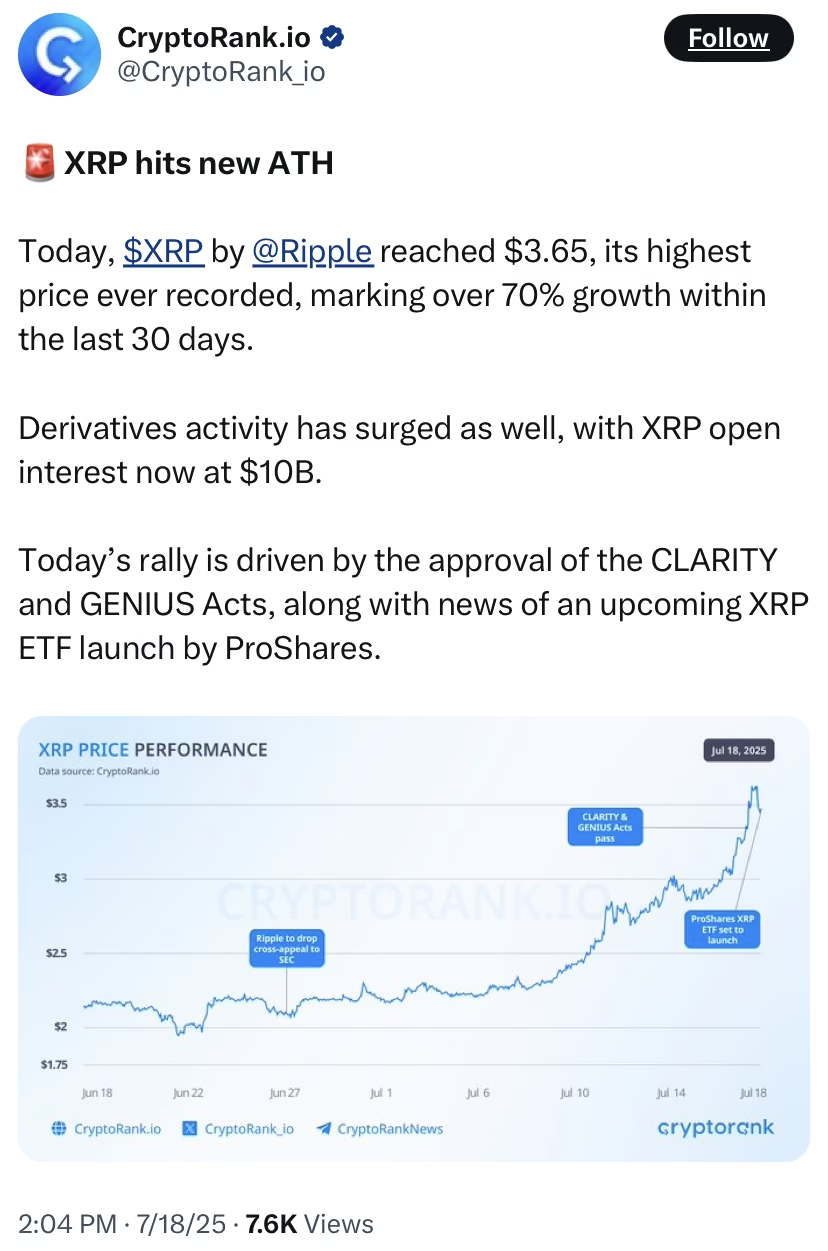
    The market reacted with force. XRP skyrockets to new ATH, breaching $3.65—an explosive 16% jump in just 24 hours.

    Analysts noted two significant green hourly candles in the price chart, each driving a 5% rally upward. The move finally eclipsed XRP’s previous all-time high from early January 2018, ending a long-awaited breakout.

    “This rally reflects a massive psychological barrier being lifted,” said crypto analyst Michaël van de Poppe. “The Genius Act eliminates the regulatory fog, which had kept XRP sidelined for years.”

    Within a month, XRP had already gained 70%, and although it has now seen a modest 6% correction, the token is still holding strong at $3.44—evidence of the market’s confidence in Ripple’s regulatory trajectory.

    Observers were quick to point out the deeper implications of Ripple’s presence at the White House.

    Source: x/CryptoRank_io
    Source: x/CryptoRank_io

    The Genius Act not only recognizes the role of blockchain innovation but positions Ripple as a serious stakeholder in shaping crypto legislation.

    “This moment marks a true convergence of policy and innovation,” said Sheila Warren, CEO of the Crypto Council for Innovation. “The U.S. is finally waking up to the strategic importance of digital assets like XRP.”

    Of particular interest is the recent financial disclosure suggesting that members of the Trump family have gained an estimated $2 billion from crypto-related ventures—highlighting the rising political and economic stakes of blockchain adoption in America.

    XRP skyrockets to new ATH—What’s next?

    With XRP skyrocketing to new ATH, traders and investors are eyeing what’s next. Short-term resistance is expected around $3.70, with analysts predicting increased volatility as XRP navigates post-breakout territory.

    Despite the short-term pullback, the long-term outlook remains bullish. Many are betting that further institutional adoption and regulatory wins will cement XRP’s place in the top tier of digital assets.

    “The Genius Act may be just the beginning,” said Katie Haun, a former federal prosecutor turned crypto VC. “The clarity it brings could be replicated in other areas of crypto, further empowering the next wave of innovation.”

    In what can only be described as a perfect storm of regulation, politics, and market momentum, XRP skyrockets to new ATH—proving that clarity fuels confidence.

    With Ripple now in lockstep with policymakers and XRP’s chart breaking through historic resistance, the digital asset’s future appears brighter than ever.

Are you sure want to unlock this post?
Unlock left : 0
Are you sure want to cancel subscription?