Tag: long-term holding

  • Missouri advances Bitcoin reserve bill requiring state treasury to hold BTC for minimum 5 years

    Missouri advances Bitcoin reserve bill requiring state treasury to hold BTC for minimum 5 years

    Missouri lawmakers have advanced a bill that would authorize the state treasury to buy and hold bitcoin for a minimum of five years, making it one of the more structurally distinct proposals in a wave of state-level bitcoin reserve legislation sweeping the United States.

    The initiative, introduced in early 2026, would allow the state treasury to hold Bitcoin alongside traditional assets.

    A development closely watched by crypto investors assessing long-term institutional demand.

    The bill, known as House Bill 2080, was introduced by Republican Representative Ben Keathley and recently advanced to the Missouri House Commerce Committee.

    If passed, Missouri would join a growing list of states considering Bitcoin reserves as a hedge against inflation and currency risk.

    The proposal arrives amid increasing political and institutional interest in Bitcoin across the United States, raising questions about whether state-level adoption could become a major catalyst for future BTC price cycles.

    Missouri’s bitcoin reserve proposal gains traction

    Missouri’s legislation seeks to create a Bitcoin Strategic Reserve Fund managed by the state treasurer.

    Under the proposal, the treasury would be authorized to receive, invest in, and hold Bitcoin using state funds as well as donations, grants, or gifts from residents and government entities.

    The bill also includes a long-term holding requirement: Bitcoin acquired under the program must be held for at least five years before it can be sold or converted.

    Supporters argue that integrating Bitcoin into state reserves could diversify public investments while protecting purchasing power against inflation.

    “Creating a Bitcoin reserve allows states to explore alternative assets that may preserve value over time.” Ben Keathley, Missouri State Representative, said in legislative remarks summarized in bill documentation.

    The proposal follows a similar Missouri bill introduced in 2025 that stalled in committee.

    The structure of the bill is particularly notable because it enables both direct acquisition and passive accumulation through contributions.

    A nationwide push toward state-level bitcoin treasuries

    Missouri’s move is not happening in isolation. Nearly two dozen U.S. states have proposed or explored Bitcoin reserve legislation.

    Texas, for example, passed legislation in 2025 establishing a strategic Bitcoin reserve fund, allowing the state to purchase cryptocurrency as a long-term financial asset.

    Other states including Florida, Massachusetts, Michigan, and Kentucky have introduced similar proposals.

    While some efforts have faced resistance or legislative rejection due to concerns about volatility and regulatory uncertainty.

    Industry analysts believe widespread adoption could materially affect Bitcoin markets.

    Strategic Bitcoin reserves across U.S. states could generate more than $23 billion in potential demand if widely implemented, according to estimates cited by asset manager VanEck.

    That scale of potential accumulation is one reason institutional investors are closely monitoring policy developments rather than focusing solely on private-sector adoption.

    Why states are turning to bitcoin now

    Several macroeconomic and political factors are driving the push toward state Bitcoin reserves.

    First, inflation concerns and long-term currency depreciation have encouraged policymakers to explore alternative stores of value.

    Bitcoin’s fixed supply and growing institutional acceptance have positioned it as a potential hedge similar to gold in earlier eras.

    Second, federal policy momentum has reinforced legitimacy. In March 2025, a U.S. executive order established a national Strategic Bitcoin Reserve using government-owned BTC holdings.

    Finally, competition between states to attract crypto businesses and innovation hubs has intensified.

    This policy competition may represent a structural demand driver distinct from traditional market cycles driven by retail speculation.

    Risks, skepticism, and market implications

    Despite growing support, Bitcoin reserve proposals remain controversial.

    Critics argue that cryptocurrency volatility could expose public funds to unpredictable risk.

    Similar concerns led lawmakers in South Dakota to reject a Bitcoin reserve bill after officials questioned Bitcoin’s lack of income generation and price stability.

    Opponents also warn that government adoption could politicize crypto markets or introduce regulatory complexity.

    Still, proponents counter that limited allocations and long holding periods reduce risk while positioning states for potential upside if Bitcoin continues to mature as a global reserve asset.

    If more states follow through, analysts say state-level accumulation could create steady, long-term buying pressure.


  • Over 400,000 Bitcoin withdrawn from exchanges since December as holders move to storage

    Over 400,000 Bitcoin withdrawn from exchanges since December as holders move to storage

    More than 400,000 Bitcoin have been withdrawn from exchanges since December 2024, representing nearly 2% of the cryptocurrency’s total supply, according to data from Santiment.

    The outflows have pushed exchange-held Bitcoin to 2.11 million BTC, down 15% year-over-year, as ETFs and institutions absorb supply.

    Rising Bitcoin Outflow Suggests Long-Term Accumulation

    The latest Bitcoin outflow report from Santiment shows that the number of BTC held on exchanges has fallen sharply over the past year.

    According to the firm’s Sanbase dashboard, more than 403,000 Bitcoin have been transferred out of exchange wallets since Dec. 7, 2024.

    In general, this is a positive long-term sign, Santiment analysts noted in a recent X post. “The fewer coins that exist on exchanges, the less likely we’ve historically seen a major sell-off that causes downside pressure for an asset’s price.”

    At a current market value near $90,000 per Bitcoin, this massive Bitcoin outflow translates into tens of billions of dollars in digital assets moving away from liquid markets and into cold storage or institutional custody, reflecting both security concerns and long-term holding strategies.

    Institutions and ETFs Absorbing Bitcoin Outflow

    While individual holders are securing their BTC in private wallets, the Bitcoin outflow trend also reveals a growing appetite among exchange-traded funds (ETFs) and institutional investors.

    According to Giannis Andreou, founder and CEO of Bitmern Mining, ETFs have quietly become major absorbers of these outflows. Institutional ownership has quietly crossed into a new phase: less liquid supply, more long-term holders, stronger price reflexivity, and a market driven by regulated vehicles, not trading platforms said Andreou

    He emphasized that the ongoing Bitcoin outflow marks a paradigm shift in market structure: This shift is bigger than people think.

    Bitcoin isn’t moving to exchanges anymore. It’s moving off them straight into institutions that don’t sell easily. The supply squeeze is building in real time.

    Data Shows ETFs and Corporations Now Hold More Bitcoin Than Exchanges

    Supporting this view, BitcoinTreasuries.net data shows that ETFs and public companies now hold more Bitcoin than all centralized exchanges combined — a first in the digital asset’s history.

    The Bitcoin outflow aligns with rising ETF inflows, as funds like BlackRock’s iShares Bitcoin Trust (IBIT) and Fidelity’s FBTC continue to accumulate BTC to back their growing investor demand.

    Crypto data firm CoinGlass further reinforces this trend, showing that Bitcoin held on exchanges has dropped to 2.11 million BTC as of late November 2025, down from 2.5 million the year before. That’s a striking 15% annual decline, even as prices fluctuate between $84,000 and $90,000.

    Why Bitcoin Outflow Is a Bullish Signal

    Historically, a sustained Bitcoin outflow has been viewed as a bullish indicator, signaling that holders are not looking to sell in the near term.

    Lower supply on exchanges reduces selling pressure and increases scarcity — often leading to price appreciation during market recoveries.

    Market strategist Lyn Alden previously explained that “exchange balances are one of the best on-chain indicators of investor behavior. When those balances fall, it usually precedes major upward moves.”

    As the total exchange-held BTC continues to shrink, analysts believe the Bitcoin outflow could set the stage for a powerful supply squeeze.

    With ETFs and institutions hoarding supply, and retail investors shifting to cold storage, liquidity is tightening, potentially amplifying future price movements.

    Bitcoin Outflow May Define 2025 Market Dynamics

    The scale of this Bitcoin outflow underscores a fundamental transformation in the market’s structure.

    The balance of power is moving away from trading platforms and toward regulated investment vehicles and private holders.

    With 403,000 BTC leaving exchanges in just 12 months, and institutional demand showing no signs of slowing, the Bitcoin outflow narrative could be the defining market force heading into 2025.

    As Santiment concluded: Bitcoin’s continuous migration away from exchanges shows confidence, not fear. Historically, this kind of movement has always preceded major bullish cycles.

    If history repeats, the ongoing Bitcoin outflow might just be the calm before another storm — this time, a bullish one.

  • Fidelity forecasts 42% of Bitcoin supply to go illiquid by 2032

    Fidelity forecasts 42% of Bitcoin supply to go illiquid by 2032

    Nearly half of Bitcoin’s circulating supply may become unavailable for trading within the next decade, according to a new report by Fidelity Digital Assets. The asset management firm estimates that by 2032, around 8.3 million BTC or 42% of circulation will qualify as Bitcoin illiquid supply, significantly reducing coins available on the open market.

    The analysis identifies two key groups driving this trend: long-term holders who have not moved their Bitcoin in at least seven years, and publicly traded companies holding more than 1,000 BTC. Fidelity applied a strict criterion, counting wallets whose balances increased each quarter or at least 90% of the time over the past four years.

    “By the end of 2025, we project these two cohorts will hold more than six million Bitcoin, equal to over 28% of the total 21 million that will ever exist,” Fidelity researchers wrote.

    Who is locking up Bitcoin?

    The first cohort is long-term holders, often referred to as “diamond hands,” who historically resist selling even during volatile downturns. According to Fidelity, their supply has not decreased since 2016, underscoring a persistent accumulation pattern.

    The second group consists of publicly traded companies that have integrated Bitcoin into their balance sheets. Data compiled by Bitbo shows there are currently 105 listed firms holding Bitcoin, with combined reserves exceeding 969,000 BTC, or roughly 4.6% of total supply. Notably, these firms have only recorded a single quarter of net selling in Q2 2022 suggesting strong conviction.

    “Corporate adoption of Bitcoin is no longer an experiment,” said Alex Thorn, Head of Research at Galaxy Digital. “Treasury allocations are becoming strategic, and that makes a substantial portion of Bitcoin illiquid supply effectively locked away.”

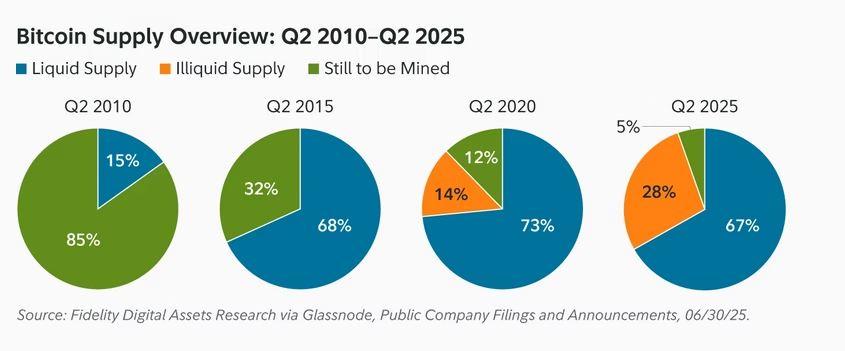
    Bitcoin’s supply has changed drastically in the past 15 years.
    Source: Fidelity

    Why illiquidity matters for price

    For investors, the rise of Bitcoin illiquid supply represents a double-edged sword. On one hand, fewer coins available on exchanges could create scarcity-driven price support over the long run. On the other, concentrated holdings in the hands of a few cohorts particularly corporations and whales raise the risk of sharp volatility if large amounts are sold.

    At the end of Q2 2025, the combined holdings of long-term investors and corporate treasuries were valued at $628 billion, at an average acquisition price of $107,700 per BTC, according to Fidelity. That figure is double last year’s valuation, highlighting both rising conviction and rising exposure.

    “Bitcoin’s supply schedule is fixed, but liquidity is not,” noted Noelle Acheson, author of the Crypto Is Macro Now newsletter. “The more coins that migrate into illiquid supply, the more sensitive the market becomes to marginal flows.”

    The risk of whale sell-offs

    The Fidelity report also raised concerns about large-scale selling. In the past 30 days alone, Bitcoin whales typically defined as addresses holding at least 1,000 BTC have sold nearly $12.7 billion worth of Bitcoin, the largest outflow since mid-2022. During the same period, Bitcoin’s price fell by about 2%, according to CoinGecko.

    While these sell-offs suggest that not all major holders are immovable, the long-term structural trend still points to rising illiquidity. If corporate treasuries continue to expand and long-term holders maintain discipline, Bitcoin illiquid supply could exceed 8.3 million BTC by Q2 2032.

    Outlook for crypto investors

    For crypto investors, the report underscores the importance of monitoring liquidity metrics, not just total supply. Unlike traditional assets, where central banks can adjust issuance, Bitcoin’s 21 million cap makes shifts in illiquid supply a defining feature of market dynamics.

    Fidelity did not account for potential future entrants, such as additional corporations or sovereign entities, which could further tighten circulating supply. If adoption accelerates, the proportion of Bitcoin illiquid supply could rise well above current projections.

    In the meantime, investors face a market where scarcity may steadily increase but where sudden whale moves can still rattle sentiment. As one Fidelity researcher concluded: “Illiquidity is Bitcoin’s hidden supply curve, and it may shape price action for years to come.”

Are you sure want to unlock this post?
Unlock left : 0
Are you sure want to cancel subscription?