





- Trending
- Comments
- Latest

Tempo launched a privacy feature this week that lets designated operators monitor all transactions, restrict transfers, and freeze accounts inside its stablecoin network. It’s called Tempo Zones. And depending on who you ask, it’s either the future of enterprise blockchain, or a private bank wearing a crypto costume.
Unveiled on Thursday, Tempo Zones are designed to enable private, permissioned stablecoin transactions within a public blockchain framework. The feature targets institutional users seeking confidentiality without abandoning the liquidity and interoperability of open networks. But while the pitch is clear, the reaction has been anything but unanimous.
At the center of the discussion is a fundamental question: can crypto preserve its trust-minimized ethos while accommodating the compliance demands of large organizations?
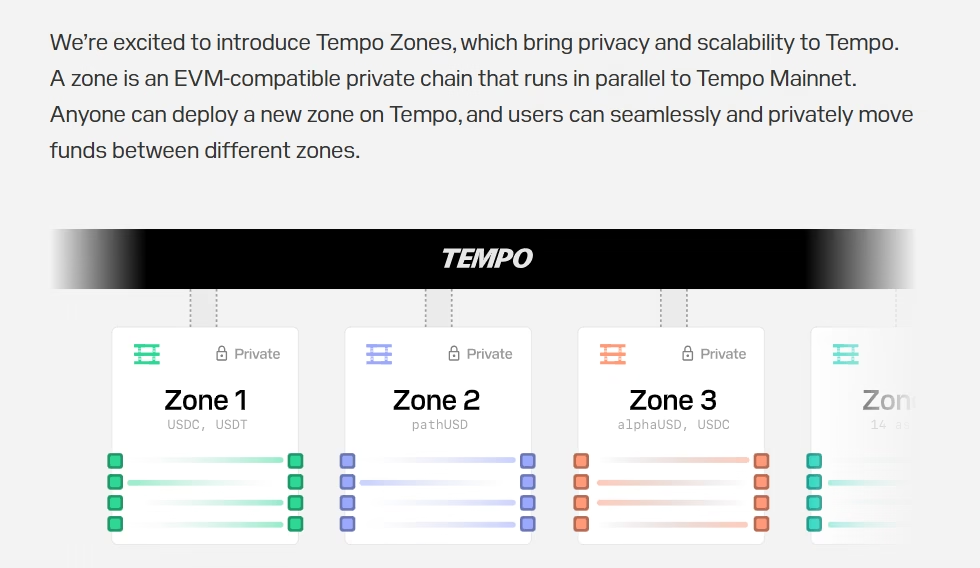
The core idea behind Tempo Zones is straightforward. Enterprises can operate within controlled environments—referred to as Zones—where sensitive financial data remains shielded from public view, even as transactions ultimately settle on a broader blockchain network.
These Zones function as parallel, permissioned environments connected to Tempo’s base layer. Within them, companies can handle use cases like payroll, treasury management, and B2B payments without exposing transaction details such as employee salaries or merchant volumes.
Tempo argues that this hybrid model delivers the best of both worlds. Firms retain access to shared liquidity pools and interoperability with public infrastructure, while gaining a level of confidentiality typically associated with traditional banking systems.

A spokesperson familiar with the project described the approach as “a practical solution for institutions that need both transparency and discretion,” noting that fully public blockchains often fall short when handling sensitive corporate data.
Still, the architecture of Tempo Zones introduces a key distinction: each Zone is governed by an operator.
That operator-controlled design has become the focal point of criticism. Within each of the Tempo Zones, the operator has visibility into all transactions and can enforce compliance rules, including restricting transfers or freezing accounts.
For some developers, that’s a step backward.
“It starts to resemble a traditional financial intermediary,” said one privacy-focused builder, pointing out that users must trust the Zone operator rather than rely solely on cryptographic guarantees.
This concern cuts to the heart of crypto’s value proposition. Blockchains were designed to eliminate the need for trusted third parties, replacing them with transparent, verifiable systems. By giving operators control over access and data, critics argue that Tempo Zones dilute that principle.
The comparison to centralized exchanges has come up repeatedly in discussions, with skeptics warning that such models could recreate the same vulnerabilities crypto was meant to solve.
The debate around Tempo Zones reflects a wider split in how projects are approaching privacy.
On one side are platforms like Tempo, prioritizing simplicity, usability, and regulatory alignment. On the other are projects investing heavily in advanced cryptography to achieve end-to-end confidentiality without sacrificing decentralization.
Technologies such as zero-knowledge proofs, fully homomorphic encryption, and distributed encryption models are gaining traction as alternatives. These systems allow transactions to be verified without revealing underlying data, removing the need for a trusted operator.
Ghazi Ben Amor, senior vice president of business development at Zama, emphasized that complexity should not be a barrier.
“While the underlying cryptographic algorithms are indeed extremely complex, we abstract that complexity away,” he said. “Developers can build using familiar tools like Solidity without needing deep expertise in cryptography.”
According to Ben Amor, this approach ensures that enterprises benefit from privacy without even noticing the technical machinery behind it.
He also argued that models like Tempo Zones risk replicating existing financial systems.
“At their core, these are private blockchains,” he said. “We’ve already seen the limitations of centralized systems when it comes to scalability and resilience.”
Despite the criticism, Tempo appears to be making a calculated bet: that enterprises value operational clarity over ideological purity.
Advanced cryptographic systems, while powerful, often come with trade-offs in performance, developer experience, and implementation complexity. Tempo’s argument is that many businesses are not ready to navigate those challenges.
Instead, Tempo Zones offer a more familiar structure—one that aligns with existing compliance frameworks and audit requirements. By allowing operators to enforce rules and monitor activity, the system may be more palatable to regulators and corporate stakeholders.
This positioning could give Tempo an edge in onboarding traditional financial institutions, particularly those hesitant to fully embrace decentralized models.
The controversy surrounding Tempo Zones is not just about one feature. It’s a snapshot of a larger transition happening across the industry.

As crypto matures, the push for institutional adoption is forcing difficult compromises. Privacy, decentralization, usability, and compliance are often at odds, and different projects are prioritizing them in different ways.
For some, Tempo Zones represent a necessary evolution—an acknowledgment that real-world finance requires certain controls. For others, they signal a drift away from the foundational principles that made blockchain technology disruptive in the first place.
Tempo has yet to publicly respond to all of the criticisms, but the conversation is unlikely to fade anytime soon.
What’s clear is that Tempo Zones have struck a nerve, bringing long-standing tensions into sharper focus. Whether they become a blueprint for enterprise blockchain adoption or a cautionary tale will depend on how the market—and regulators—respond in the months ahead.



Copyright © 2025 - The Bit Gazette.