

- Trending
- Comments
- Latest

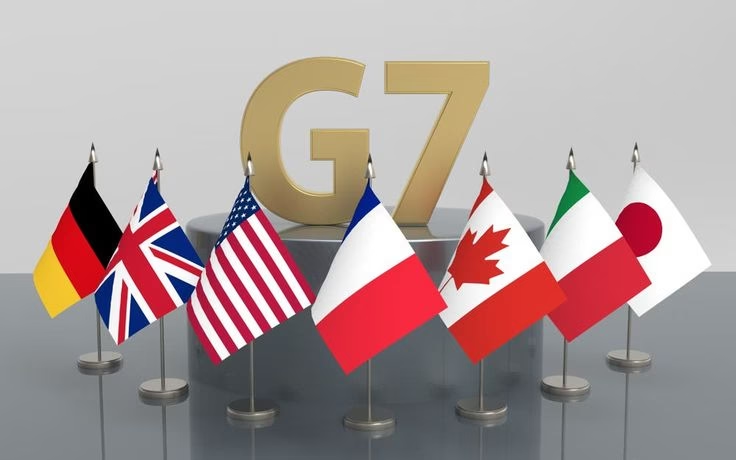
On June 17, 2026, the G7 formally called for a coordinated international response to North Korea’s escalating cryptocurrency theft, explicitly linking digital asset heists to the regime’s nuclear and ballistic missile programs. The statement is not diplomatic rhetoric. It is the opening move in an enforcement realignment that is quietly rewriting the rules for every decentralized protocol operating today.
The mechanism of this shift is simple but devastating: regulators now classify protocols as regulated financial products if any party—a founding team, multisig signer, or governance token majority—retains “unilateral control” over the code. Under this framework, the absence of unilateral control is the primary litmus test for “sufficient decentralization” and regulatory forbearance.
But this creates a trap. Fully decentralized protocols cannot comply with sanctions because no one can freeze assets or block addresses. Protocols with unilateral control can comply and are therefore legally obligated to do so. The result is a borderless trap: DeFi protocols must either surrender their decentralization to avoid sanctions liability or remain decentralized and risk being designated as illicit financial infrastructure.
The G7 is not outlawing DeFi. It is forcing protocols to become the new financial police or face the consequences.
The G7’s June 2026 statement was triggered by a staggering reality: North Korean-linked hackers stole $2.02 billion in cryptocurrency in 2025, and just two attacks in early 2026 totaling $577 million accounted for 76% of all crypto hack losses through April. The G7 explicitly tied these thefts to the regime’s nuclear and ballistic missile programs, which remain in violation of multiple UN Security Council resolutions.
The leaders reiterated their “unwavering commitment to the complete, verifiable, and irreversible denuclearization of the Korean Peninsula” and expressed deep concern over the “frequency and sophistication of North Korea’s cyber operations.” The formal statement calls for stricter sanctions, enhanced information sharing, and potentially coordinated action with private sector entities to trace and freeze stolen crypto assets.
The enforcement push extends beyond Pyongyang. In December 2024, the U.S. Treasury’s OFAC sanctioned the TGR Group, an international network that used U.S. dollar-backed stablecoins such as USDT to evade sanctions on behalf of Russian elites. The network operated across Russia, the UK, the UAE, and the U.S., providing cryptocurrency exchange, cash-to-crypto conversion, and fund obfuscation services for high-net-worth Russian nationals purchasing property in the UK.
In May 2026, U.S. Treasury Secretary Scott Bessent pressed G7 finance ministers to tighten Iran sanctions enforcement, explicitly naming digital assets as a channel for evasion. The focus is on “decentralized networks, stablecoins, and peer-to-peer trading” that allow sanctioned entities to bypass traditional banking systems.
The G7 has set a November 2026 deadline for a wider institutional action plan. This creates a window in which markets can begin pricing enforcement risk before the details are fully public. Enforcement is expected to focus on service points—exchanges, bridges, and conversion chains—rather than blockchains themselves. The goal is not to stop every exploit but to create “friction when stolen funds are most exposed during conversion and routing.”
Regulators have converged on a single decisive test to determine whether a DeFi protocol qualifies as truly decentralized or should be treated as a regulated financial product: the presence or absence of unilateral control.
“Unilateral control” refers to the ability of any single party, founding team, core developer group, multisig wallet, or governance token majority, to unilaterally:
The UK’s Financial Conduct Authority (FCA), the U.S. SEC, the EU’s MiCA framework, and Singapore’s MAS all apply this test. The UK FCA has been particularly clear: protocols are regulated if any person or group can unilaterally exercise control over assets, rules, or operations—even if that control is not currently exercised.
The 2024 Fifth Circuit Court of Appeals ruling in the Tornado Cash case provides the legal foundation for this shift.
The Treasury’s OFAC had sanctioned Tornado Cash in 2022, alleging that North Korean hackers used its mixing service to launder over $7 billion. But the Fifth Circuit reversed the decision, finding that immutable smart contracts could not be owned or controlled by anyone and therefore did not fall within the scope of the International Emergency Economic Powers Act (IEEPA).
The court ruled that:
The Treasury withdrew the sanctions on March 31, 2025, citing a review of “the novel legal and policy issues raised by the use of sanctions against evolving technology.” But it warned that it “remains open to exploring other enforcement tools in its utility belt to address national security risk.”
The Tornado Cash ruling created a paradox. Fully immutable decentralized protocols cannot be sanctioned under IEEPA because no one controls them. But protocols with any residual unilateral control can be sanctioned and are therefore subject to AML, KYC, and sanctions compliance obligations.
This is the borderless trap:
If you are truly decentralized, you cannot comply. If you can comply, you are not truly decentralized.
The absence of unilateral control is the only path to regulatory forbearance. But it also means no one can freeze assets, block addresses, or prevent sanctions evasion. The protocol becomes a tool for illicit finance by design and, under the G7’s framework, a target.
The G7’s enforcement strategy targets monetization, not attack frequency. North Korea has demonstrated it can generate enormous proceeds with relatively few attacks. The core danger remains concentrated high value theft followed by monetization.
The current pressure point is the exit path. THORChain processed the vast majority of proceeds from both the Bybit breach and the KelpDAO hack, converting large amounts of stolen ETH into Bitcoin without operators freezing or rejecting transfers. That does not prove every stolen fund follows that route, but it shows why the debate is shifting from blockchain traceability to practical monetization.
If governments can make the Bitcoin exit harder, they are targeting the point where stolen ETH becomes liquid capital. Enforcement does not need to stop every exploit to have an effect. It needs to create “friction when stolen funds are most exposed during conversion and routing.”
This is where decentralized protocols become the new financial police. If protocols with unilateral control are legally obligated to freeze and block, they become the first line of defense against monetization.
Under the G7’s new framework, DeFi protocols face a binary choice:
| Choice | Path | Outcome |
|---|---|---|
| Surrender control | Maintain admin keys, upgrade capability, emergency pause functions | Can comply with sanctions but becomes a regulated entity subject to AML and KYC |
| Eliminate control | Renounce keys, make contracts immutable, fully decentralize governance | Cannot comply with sanctions but may be designated as illicit infrastructure |
Protocols that choose the first path become compliance engines, the “new financial police.” Protocols that choose the second become targets.
Cross-border regulatory divergence is intensifying. Jurisdictions with strict unilateral control tests, such as the UK and U.S., contrast with more permissive regimes, forcing projects to choose between global accessibility and compliance. The G7 push for coordination aims to close these gaps, but fragmentation remains significant.
The EU’s MiCA and AML frameworks continue to struggle with defining “obliged entities” in decentralized systems, creating legal uncertainty over enforcement responsibilities.
The G7’s June 2026 sanctions framework is not a ban on DeFi. It is a structural redefinition of how decentralized protocols interact with global financial enforcement systems. Protocols with unilateral control become regulated financial entities. Protocols without control become enforcement problems.
The borderless trap is this:
“Unilateral control” has emerged as the decisive indicator in DeFi regulation. Protocols are increasingly classified as regulated financial products whenever any party can unilaterally alter rules, pause functions, or extract value.
The G7 has made clear it will not tolerate unrestricted illicit financial flows through decentralized rails. The era of regulatory ambiguity is closing. A new era is emerging in which decentralized protocols are either compliance instruments or compliance challenges.
The four words that define this shift are simple:
Control creates liability.



Copyright © 2025 - The Bit Gazette.