




- Trending
- Comments
- Latest

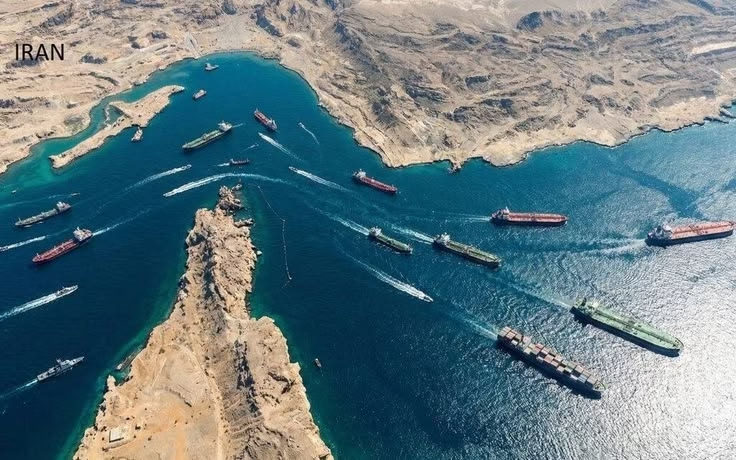
Since mid-March 2026, Iran’s Islamic Revolutionary Guard Corps has been charging oil tankers and LNG carriers up to $2 million per vessel to cross the Strait of Hormuz demanding settlement in Bitcoin, USDT, or Chinese yuan in what analysts at Chainalysis have called a “significant milestone” for state-level blockchain adoption, and what the rest of the world should recognise as the most consequential deployment of crypto geopolitics in history.
Iran’s IRGC, operating under a formal legislative framework started a $1-per-barrel crypto transit toll on one of the world’s most vital energy corridors.
Beginning mid-March 2026, codified into law on March 30–31, the Strait of Hormuz, a 21-mile-wide passage through which roughly 20% of global petroleum flows to construct a sovereign revenue stream that no Western sanctions regime can intercept in real time.
Who would ever think cryptocurrency adoption would look like this? Here is a story about how permissionless blockchain infrastructure has become the most dangerous geopolitical tool of 2026.
Iran’s “Strait of Hormuz Management Plan” formally approved by its parliament on March 30–31, 2026 is not an improvised shakedown. It is a codified revenue system, administered by an IRGC-linked intermediary whose identity remains publicly unknown, and designed with a sophistication that reflects years of sanctions-evasion experience.
Under the mechanism, ship operators must email cargo details vessel ownership, flag, cargo volume, destination, crew information to Iranian authorities, who then levy a fee of approximately $1 per barrel of crude cargo and instruct crews on how to settle the payment in digital assets.
A fully loaded Very Large Crude Carrier hauling 2 million barrels pays $2 million before it clears the waterway. At the Strait’s throughput of approximately 21 million barrels per day, analysts estimate the Hormuz crypto toll generates up to $21 million daily from oil tankers alone and $600–800 million per month once LNG vessels are included.
The payment menu is deliberate. Bitcoin is decentralised and issuer-free cannot be frozen by Tether or Circle the way USDT or USDC can. USDT offers price stability and processing speed for routine commercial volume. Chinese yuan, routed through Kunlun Bank via CIPS, handles the non-crypto portion entirely outside SWIFT.
Iran has not made a philosophical statement about decentralisation. It has engineered a multi-rail payment system specifically designed to survive every tool in the Western financial enforcement toolkit.
Iran could prioritize stablecoins over BTC for these tariffs, consistent with the heavy historical reliance on stablecoins by the regime and its regional proxies to engage in illicit trade and sanctions evasion at scale. Chainalysis, April 2026
This is not a departure from established IRGC behaviour. Chainalysis and TRM Labs have documented the IRGC routing approximately $1 billion through offshore stablecoin infrastructure in preceding periods, exploiting the same properties low transaction costs, high throughput, and independence from US correspondent banking that attract legitimate users to the same protocols. The Hormuz crypto toll is simply that playbook scaled to a sovereign chokepoint and backed by naval enforcement.
For two decades, the United States Treasury’s Office of Foreign Assets Control has constructed a dollar-centric enforcement system premised on one assumption: that meaningful financial flows require access to the US correspondent banking network. The Iran blockchain toll at Hormuz demolishes that assumption in a single operational deployment.
Every tanker that pays the toll in Bitcoin or USDT completes a transaction that bypasses SWIFT, bypasses correspondent banking, and bypasses the sanctions infrastructure that OFAC has spent two decades building. As of this writing, OFAC has not issued specific guidance on the Hormuz crypto toll. The unnamed intermediary administering toll collection which is the single most important enforcement target remains publicly unidentified. That intermediary’s anonymity is not an oversight. It is the system’s primary defence.
Sanctions Exposure Alert: Shipping companies that make payments to Iran for Hormuz passage face significant sanctions liability under existing US and international frameworks. Such transactions typically require a specific OFAC licence. No such licence pathway currently exists for IRGC-administered crypto toll payments.
TRM Labs notes that crypto transactions can be settled quickly and independently of US correspondent banking, making real-time interdiction technically difficult. OFAC can designate wallet addresses and has done so aggressively with Houthi-linked crypto wallets but designation is a reactive tool. It identifies value after it has moved, not before. In a system where a $2 million transaction settles in seconds and the receiving wallet is rotated regularly, the enforcement lag is the vulnerability that Iran is exploiting.
Regulators, law enforcement, and stablecoin issuers all have a role to play in identifying IRGC-controlled wallets and their counterparties. But the Iran IRGC stablecoin infrastructure, which Chainalysis estimates accounted for approximately 50% of Iran’s total crypto ecosystem in Q4 2025, was built precisely to be resilient to that kind of pressure. The question is not whether OFAC can designate wallets. It is whether designation at pace with a $20-million-per-day revenue operation is operationally possible. Evidence suggests it is not.
If the geopolitical stakes were limited to the Strait of Hormuz, the calculus would be serious but contained. They are not. The Iran-backed Houthi regime which already uses crypto to trade oil across Red Sea networks has raised the prospect of imposing a second blockchain toll on the Red Sea shipping lane.
If that materialises, two of the world’s five most critical maritime chokepoints will be operating state-sponsored crypto payment rails simultaneously, covering an estimated 35–40% of global seaborne oil trade between them.
The broader precedent is the more troubling variable. Iran has demonstrated that a sovereign actor under comprehensive international sanctions can use crypto geopolitics to transform geographic leverage into a durable, liquid, and sanction-resistant revenue stream without a central bank, without SWIFT access, and without a willing Western financial intermediary.
If that model holds, the incentive for other sanctioned or semi-sanctioned states to replicate it is substantial. The Panama Canal. The Suez Canal. The Turkish Straits. Each is a physical chokepoint. Each is now a potential candidate for an on-chain payment layer.
Duke University’s Lee Reiners has offered the most provocative dimension of this risk. Speaking to CoinDesk, Reiners noted that if Iran was thinking strategically, it might demand payment in USD1 the stablecoin launched by the Trump family-affiliated World Liberty Financial which would create a direct financial incentive for the sitting U.S. president to soften sanctions pressure. That scenario has not materialised. The fact that it is analytically credible is itself a measure of how far crypto-geopolitics has travelled in a single quarter.
The Hormuz toll is a stress test for every narrative the crypto industry has built over the past decade. Bitcoin’s bulls will note that BTC is functioning precisely as designed as permissionless money that no government can unilaterally block. That argument is correct. It is also, in this context, indistinguishable from an argument for why Bitcoin is a liability to the international rules-based order.
For stablecoins, the pressure is more immediate. Tether and Circle are now being asked to function as a digital enforcement arm of Western sanctions policy freezing wallets, blacklisting addresses, and absorbing the political and reputational cost of policing a decentralised system they did not design to be policed.
The IRGC’s deliberate inclusion of USDT in the toll payment menu is not incidental. It is a bet that stablecoin issuers will either refuse to act preserving the payment rail or act too slowly to prevent settlement.
For regulators in Washington and Brussels, the Iran blockchain toll represents the end of a comfortable fiction: that crypto’s transparency made it unsuitable for state-level sanctions evasion at scale.
The Hormuz toll is transparent every transaction is on-chain, in principle traceable and still operationally unstoppable in real time. Transparency without the capacity for interdiction is not an enforcement mechanism. It is a ledger of completed crimes.
The blockchain has become the world’s most consequential geopolitical payment rail. The Strait of Hormuz is its first toll booth. Whether it becomes its last depends entirely on whether the international community can construct an enforcement architecture as fast-moving, flexible, and borderless as the technology it is trying to govern. Based on the evidence of the past six weeks, that gap remains very wide.



Copyright © 2025 - The Bit Gazette.