


- Trending
- Comments
- Latest

Trading bots don’t wait for confirmation. They act on signals, and in Web3, those signals are increasingly generated by AI models that can be confidently, completely wrong.
That gap between AI output speed and human verification speed is where the next market crisis could originate.
Web3 has embraced automation faster than most industries. Trading bots, AI-driven analytics, and automated governance tools now play a central role in how decisions are made.
But here’s the problem: these systems are not infallible. The growing AI hallucination risk means that models can produce confident but incorrect outputs misinterpreting data, inventing correlations, or fabricating signals.
As Sam Altman has repeatedly cautioned, large language models can “hallucinate” facts, presenting false information with high confidence. In traditional sectors, this is a nuisance. In crypto markets, it’s a catalyst.
The danger of AI hallucination risk isn’t just inaccuracy it’s speed. In Web3, information moves instantly, and reactions are often automated. If an AI model misreads on-chain data or falsely signals a major event, trading bots can execute decisions within seconds.
That’s where AI hallucination risk becomes systemic. A single faulty output can cascade across platforms, triggering liquidations, arbitrage loops, and panic selling before humans even recognize the error.
Much of Web3’s infrastructure depends on external data feeds commonly known as oracles. If these systems are integrated with AI-driven analysis, the exposure to AI hallucination risk increases.

A misinterpreted data point or fabricated anomaly could be treated as real, feeding into smart contracts and automated strategies.
Developers working on decentralized oracle networks like Chainlink have long emphasized the importance of data accuracy. But as AI layers are added, AI hallucination risk introduces a new variable that existing safeguards may not fully address.
One of the most dangerous aspects of AI hallucination risk is how convincing it can be. AI outputs often appear authoritative, especially when presented with structured data or technical language. In Web3, where many users rely on dashboards, bots, and automated insights, this creates a false sense of certainty.
The result is a feedback loop, AI generates a flawed insight, systems act on it, and the market reacts reinforcing the original error. This is how AI hallucination risk can transform from a technical flaw into a market-moving event.
Traditional crypto crashes are usually tied to leverage, liquidity, or external shocks. The next one could look very different.
An event driven by AI hallucination risk wouldn’t start with a hack or a regulatory announcement. It would start with misinformation generated, amplified, and executed by machines.
This is what makes AI hallucination risk a potential black swan. It’s unpredictable, difficult to trace in real time, and capable of spreading across interconnected systems.
Responsibility in the age of AI hallucination risk is far from clear. Is it the developers who built the models? The platforms that integrated them? Or the users who relied on automated outputs?
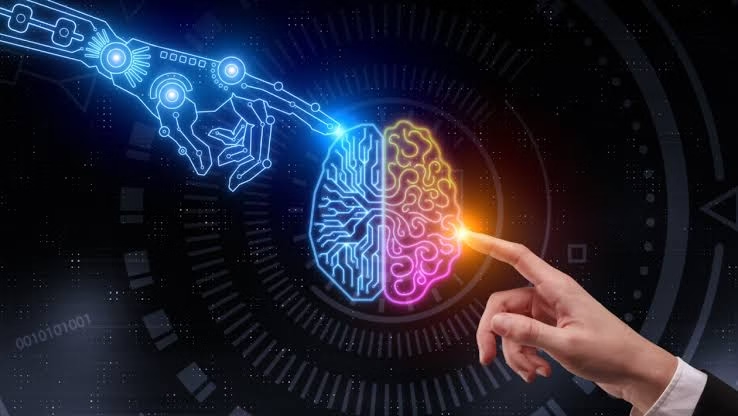
As Vitalik Buterin has often argued in discussions around automation, systems should be designed with fail-safes and human oversight. But in practice, Web3 continues to move toward full automation expanding exposure to AI hallucination risk.
Reducing AI hallucination risk requires a combination of technical and cultural shifts. On the technical side, systems need redundancy multiple data sources, verification layers, and human checkpoints. On the cultural side, users need to treat AI outputs as probabilistic, not definitive.
But here’s the challenge: speed and efficiency are core to Web3’s appeal. Slowing things down to manage AI hallucination risk runs counter to the industry’s instincts.
Right now, AI hallucination risk is largely ignored because it hasn’t caused a major crash—yet. This mirrors earlier phases of crypto history, where risks were acknowledged but underestimated until they materialized. The difference is that AI hallucination risk operates at a different layer. It doesn’t exploit code it exploits perception.
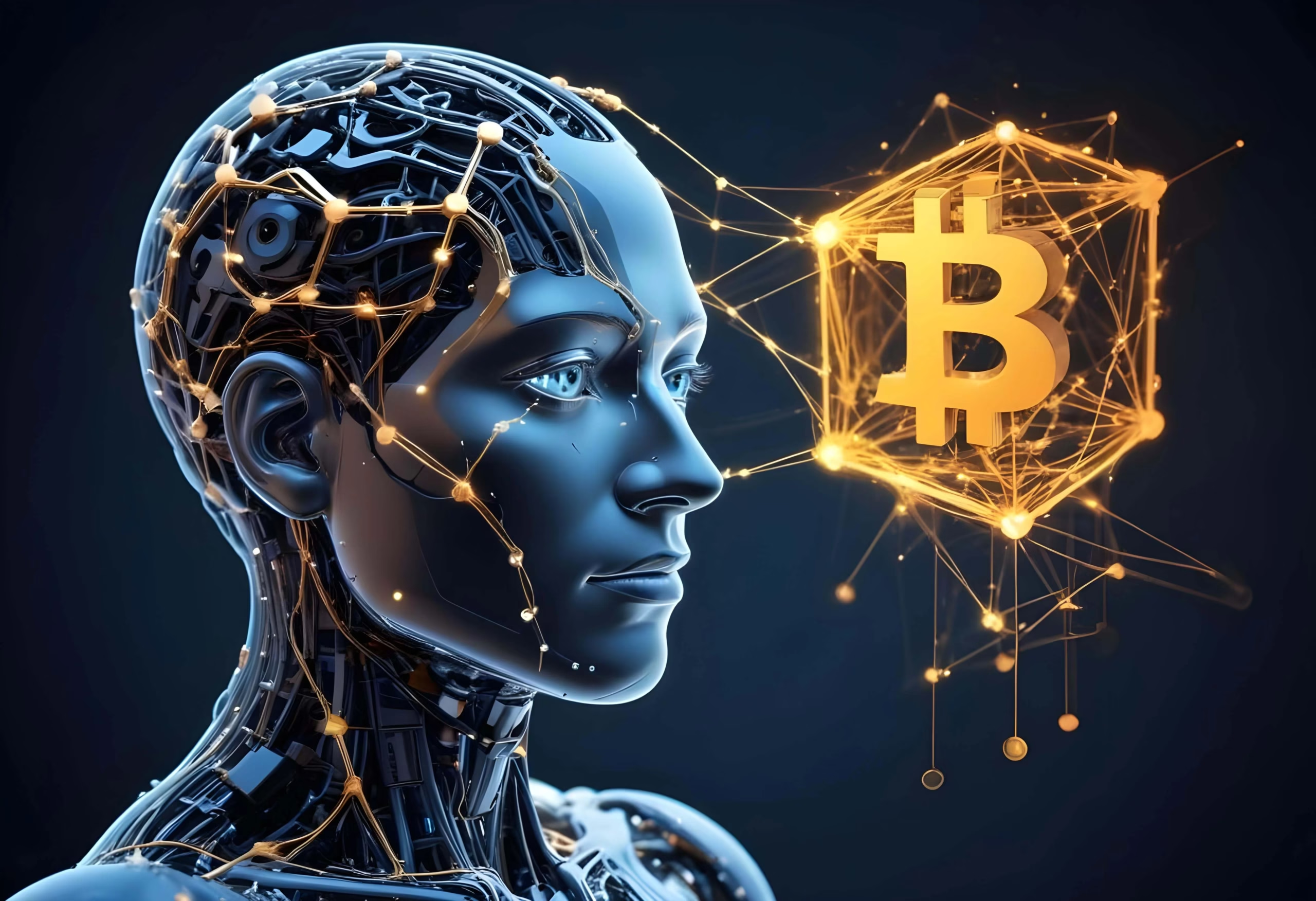
The next major Web3 crash may not come from a hack, a protocol failure, or a regulatory crackdown. It may come from a machine that got it wrong and a system that acted on it without question. AI hallucination risk is not a theoretical concern. It’s an emerging structural weakness.
If Web3 continues to integrate AI without addressing this risk, it won’t just be automating efficiency it will be automating error at scale. And when that error hits the market, AI hallucination risk could be the spark that triggers the next wave of panic.



Copyright © 2025 - The Bit Gazette.