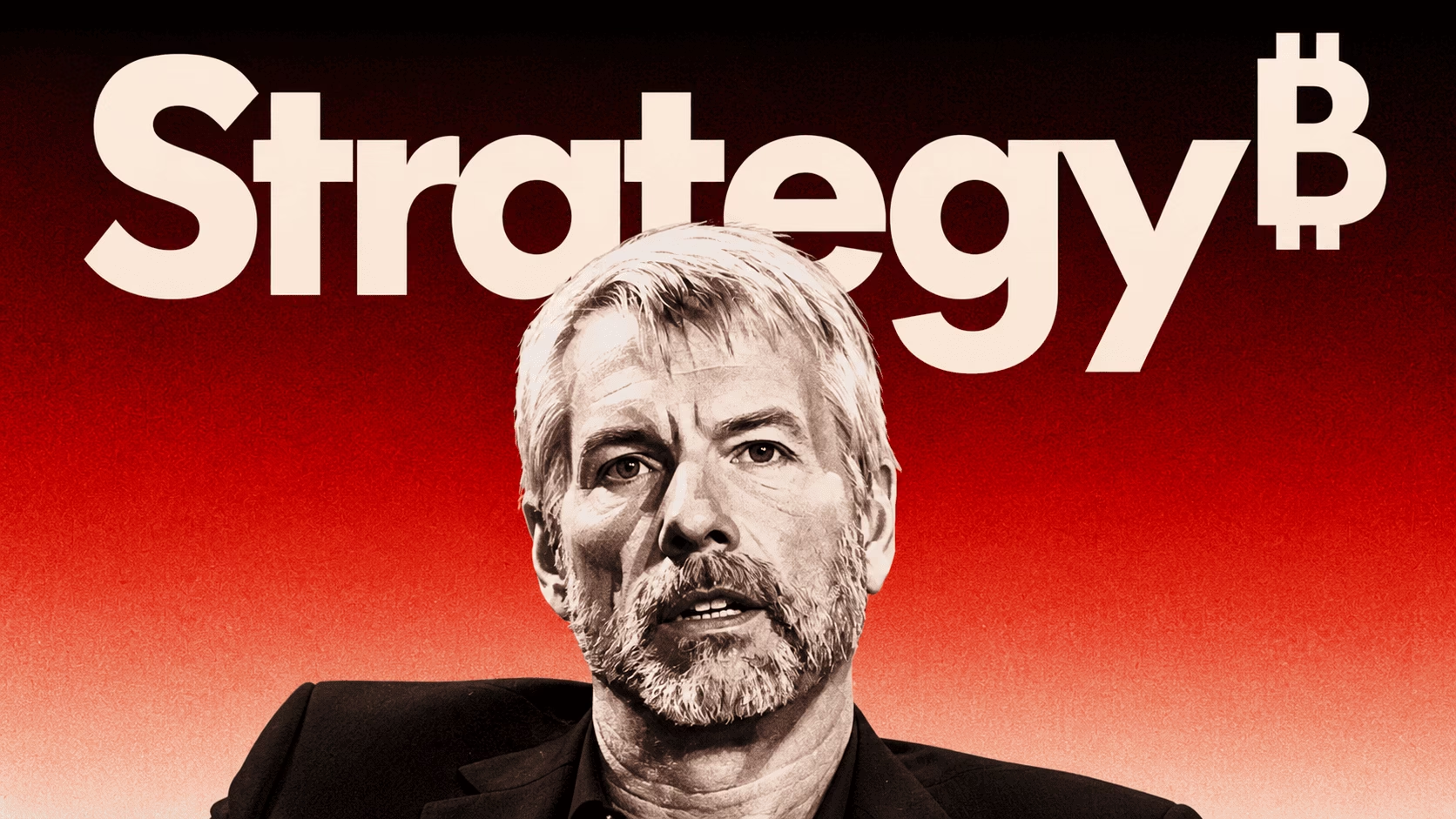
Michael Saylor’s Bitcoin treasury playbook is quietly replacing the central bank as crypto’s crisis backstop
As volatility deepens across digital asset markets, corporate treasuries are quietly emerging as stabilising forces that could reshape global liquidity dynamics.
Michael Saylor didn’t just put Bitcoin on a corporate balance sheet, he may have accidentally built a new kind of financial shock absorber. As more companies follow Strategy’s lead, a growing body of analysts argues that conviction-driven Bitcoin treasuries are beginning to do what central banks once did alone: hold firm and absorb pressure when markets break.
At the centre of this transformation is what the industry now refers to as The Saylor Shield, a concept rooted in Michael Saylor’s aggressive Bitcoin treasury strategy at Strategy (formerly MicroStrategy). His long-standing conviction that Bitcoin belongs on corporate balance sheets has evolved into something broader than a single-company bet; it has become a narrative about systemic market resilience.
Under The Saylor Shield, corporations holding large, liquid, globally traded assets like Bitcoin are no longer passive entities. Instead, they function as quasi-stabilizers, capable of absorbing volatility rather than amplifying it.
One market commentator described the shift as “a move from fragile cash reserves to conviction-backed digital balance sheets that don’t flinch under stress,” a sentiment often echoed by crypto analysts observing Saylor’s strategy.
From cash reserves to Bitcoin fortresses: redefining corporate treasuries
Corporate treasuries were once designed with caution as their guiding principle. Cash, treasury bills, and short-term instruments formed the backbone of risk management, ensuring companies could survive downturns without disruption.
But Bitcoin’s emergence as a corporate reserve asset has fundamentally rewritten that playbook.
Unlike fiat currencies, Bitcoin is scarce, borderless, and operates on a 24/7 global trading cycle. For firms like Strategy, it is not merely a speculative position but a long-term hedge against monetary dilution and inflationary pressures.
This evolution is central to The Saylor Shield, which reframes corporate balance sheets as dynamic liquidity reservoirs rather than static storage accounts. Instead of reacting to market fear with liquidation, these companies often maintain or expand positions during downturns, reducing forced selling pressure across the market.
Industry analysts have described this behaviour as “structural patience embedded into capital allocation,” noting that conviction-driven treasuries tend to resist panic cycles that typically destabilise markets.
As adoption spreads, it creates a new layer of market behaviour where corporate holders act as stabilising anchors during periods of stress. Their long-term horizon effectively slows the velocity of capital flight in downturns.
The balance sheet as shock absorber: how liquidity is being rewritten
The deeper implication of The Saylor Shield is not just asset allocation—it is liquidity transformation.
When corporations hold significant Bitcoin reserves, they introduce a new behavioural class into the market: long-duration, low-leverage participants who are structurally less reactive to short-term volatility. This creates a stabilising asymmetry.
In traditional downturns, leveraged traders and retail investors exit positions first, accelerating price declines. However, corporations aligned with The Saylor Shield framework are more likely to hold or even accumulate during drawdowns, reducing cascading liquidation risks.
This dynamic has led some analysts to describe Bitcoin-heavy corporate treasuries as “non-sovereign liquidity absorbers,” a phrase used to highlight their indirect stabilising effect on broader markets.
Strategy’s capital structure illustrates this mechanism clearly. By combining equity issuance and debt financing to acquire Bitcoin, the company has built a feedback loop where asset appreciation strengthens the balance sheet, which in turn improves access to capital for further accumulation.
However, not all commentary is optimistic. Some risk analysts warn that excessive leverage tied to volatile assets could amplify stress if market cycles turn sharply downward.
Systemic strength or hidden fragility? The limits of the Saylor shield
Despite its growing influence, The Saylor Shield is not a guaranteed safeguard against financial instability. It carries structural limitations that become more visible under extreme market conditions.
First, corporate balance sheets are finite and governed by contractual obligations, including debt covenants and shareholder expectations. In prolonged downturns, even strong treasuries may be forced to rebalance positions.
Second, Bitcoin itself remains highly volatile despite increasing liquidity depth. While its global accessibility is a strength, its historical drawdowns highlight the risks of concentrated exposure.
Third, if adoption of Bitcoin treasury strategies becomes too widespread, correlation risk may increase. In such a scenario, could shift from a stabilising force to a synchronized risk amplifier during systemic shocks.
As one risk strategist put it, “when every balance sheet holds the same volatility engine, diversification becomes an illusion.”
Even Michael Saylor’s own public stance—frequently framed by observers as unwavering conviction in Bitcoin as a treasury asset—acknowledges, at least indirectly, that volatility is an inherent feature of the system rather than a flaw.
Still, proponents argue that The Saylor Shield represents a meaningful step toward decentralised financial resilience. Instead of relying solely on central banks during crises, markets increasingly distribute liquidity buffering across corporate actors with long-term incentives.
A new financial order built on conviction capital
As more companies adopt Bitcoin-centric treasury strategies, the line between operating business and systemic market actor continues to blur.
In this emerging structure, The Saylor Shield functions less as a formal institution and more as a distributed behavioural pattern—one where conviction capital replaces reactive liquidity, and long-term holding power becomes a stabilising force in its own right.
Whether this shift will reduce systemic risk or simply repackage it into new forms remains unresolved. But one conclusion is increasingly clear: in a 24/7 digital asset economy, the strongest defence against financial instability may no longer sit with central banks alone, but within corporate treasuries willing to hold firm when markets shake.