


• Trending
  • Comments
  • Latest
AI People joins Dubai’s innovation one — Declares war on the forgetting of humanity

AI People joins Dubai’s Innovation One program: Declares war on the forgetting of humanity

07/22/2025 - Updated On 07/23/2025
FBI nabs Nigerian ‘tech queen’ Sapphire Egemasi in multi-million dollar fraud scheme

FBI arrests Nigerian ‘tech queen’ Sapphire Egemasi in $1.3M heist targeting U.S. government

06/05/2025 - Updated On 06/17/2025
Crypto investor and wife found dead in Dubai as police investigate possible link to digital assets

Crypto investor and wife found dead in Dubai as police investigate possible link to digital assets

11/08/2025
Polygon Discord Channel Hacked, Throws Crypto Community in Turmoil

Polygon Discord Channel Hacked, Throws Crypto Community in Turmoil

2
Bitcoin reclaims $107,000 as Iran-Israel ceasefire cools market tensions

Bitcoin reclaims $107,000 as Iran-Israel ceasefire cools market tensions

2

Hello world!

1
Trump to host exclusive gala dinner for Trump memecoin holders amid impeachment saga

Trump says he’ll review pardon for Samourai Wallet founder days before prison term

12/16/2025
Singapore Retail Crypto Market Enters New Phase of Stability and Confidence

StraitsX to bring Singapore dollar and US dollar stablecoins to Solana in 2026

12/16/2025
Wyoming Crypto Bank petition headlines a rapidly intensifying legal confrontation that could reshape how crypto banks access the U.S. financial system. Wyoming-chartered Custodia Bank has formally petitioned the full Tenth Circuit Court of Appeals to review the Federal Reserve’s denial of its master account, escalating a five-year fight with sweeping implications for federal power, state banking authority, and digital asset innovation. Wyoming Crypto Bank petition filings submitted on December 15 request an en banc review, asking all active judges on the Tenth Circuit to reconsider an October panel ruling that upheld the Fed’s decision. Custodia argues the panel misread federal law and endorsed a system that grants regional Federal Reserve Banks unchecked discretion over legally eligible state-chartered institutions. Wyoming Crypto Bank Petition Challenges Fed’s Master Account Authority At the heart of the Wyoming Crypto Bank petition is the Federal Reserve’s refusal to grant Custodia access to a master account—an essential gateway to core payment rails such as wire transfers and automated clearinghouse (ACH) services. Without it, Custodia says its Wyoming-issued charter is effectively rendered meaningless. Custodia contends the ruling conflicts directly with the Monetary Control Act (MCA), which states that Federal Reserve services shall be available to nonmember depository institutions. The bank argues the Fed has transformed that mandate into what it calls an unconstitutional veto over state banking decisions. When the Fed denies a master account to a state-chartered financial institution, it effectively vetoes a bank charter that State regulators have approved, Custodia wrote in its petition. State Banking Authority Under Threat The Wyoming Crypto Bank petition also raises serious federalism concerns. Wyoming chartered Custodia in 2020 as a Special Purpose Depository Institution (SPDI), a regulatory framework specifically designed to attract digital asset firms while minimizing systemic risk through 100% reserve backing and a prohibition on lending. Custodia argues the Fed’s rejection undermines Wyoming’s carefully constructed regulatory regime and erodes states’ constitutional authority to charter banks. The petition warns that allowing the Fed such power could discourage innovation-driven state banking models nationwide. Constitutional Red Flags in the Wyoming Crypto Bank Petition Beyond federalism, the Wyoming Crypto Bank petition pushes into constitutional territory. Custodia’s legal team argues that if regional Federal Reserve Bank presidents possess unreviewable discretion over master accounts, they effectively function as “Officers of the United States” without proper constitutional appointment. Federal Reserve Bank presidents are selected by private bank directors and approved by the Board of Governors. Custodia says that structure violates the Appointments Clause if those officials wield significant executive authority. Judicial Split Deepens Over Wyoming Crypto Bank Petition The petition highlights a growing divide within the Tenth Circuit itself. Judge Timothy Tymkovich’s dissent in Custodia’s case aligns with Judge Robert Bacharach’s earlier opinion in Fourth Corner Credit Union v. Federal Reserve Bank of Kansas City, creating a 2-2 split among circuit judges. Tymkovich warned that the Fed’s interpretation grants “unreviewable discretion” that contradicts the plain language of the MCA and raises “thorny questions” under Article II of the Constitution. Fed’s Own Records Undermine Denial Rationale The Wyoming Crypto Bank petition also points to contradictions within the Federal Reserve’s own process. The Kansas City Fed denied Custodia’s application in January 2023 after a 27-month review, citing risks tied to “crypto-asset activities.” Yet internal documents show Fed staff initially found Custodia’s capital levels “adequate” and praised its leadership as “impressive.” Custodia says the decision only shifted after intervention by the Board of Governors. Federal Reserve Governor Christopher Waller later acknowledged publicly that the Fed has sufficient supervisory tools to manage risk without blanket denials. In an October interview, Waller said the Fed can “tailor” master account structures to fit a bank’s specific risk profile. Wyoming Crypto Bank Petition Lands Amid Crypto Debanking Reckoning The Wyoming Crypto Bank petition arrives as regulators face mounting scrutiny over crypto debanking. In December, the Office of the Comptroller of the Currency revealed that all nine of the largest U.S. banks imposed “inappropriate” restrictions on lawful businesses, including digital asset firms, between 2020 and 2023. Institutions such as JPMorgan Chase, Bank of America, Citibank, and Wells Fargo maintained internal policies that escalated or restricted entire sectors, reinforcing claims of systemic exclusion. If the full Tenth Circuit agrees to hear the Wyoming Crypto Bank petition, the outcome could redefine the balance of power between state banking regulators and the Federal Reserve—setting a precedent that reaches far beyond Custodia and Wyoming. For the crypto industry, the case may determine whether compliance-focused digital asset banks can ever gain equal footing within the U.S. financial system.Wyoming Crypto Bank Petition Sparks High-Stakes Legal Showdown as Fed Power Faces Fierce Constitutional Test

Wyoming-chartered Custodia Bank challenges Federal Reserve’s master account veto power

12/16/2025
  • Trending
  • Comments
  • Latest
AI People joins Dubai’s innovation one — Declares war on the forgetting of humanity

AI People joins Dubai’s Innovation One program: Declares war on the forgetting of humanity

07/22/2025 - Updated On 07/23/2025
FBI nabs Nigerian ‘tech queen’ Sapphire Egemasi in multi-million dollar fraud scheme

FBI arrests Nigerian ‘tech queen’ Sapphire Egemasi in $1.3M heist targeting U.S. government

06/05/2025 - Updated On 06/17/2025
Crypto investor and wife found dead in Dubai as police investigate possible link to digital assets

Crypto investor and wife found dead in Dubai as police investigate possible link to digital assets

11/08/2025
Polygon Discord Channel Hacked, Throws Crypto Community in Turmoil

Polygon Discord Channel Hacked, Throws Crypto Community in Turmoil

2
Bitcoin reclaims $107,000 as Iran-Israel ceasefire cools market tensions

Bitcoin reclaims $107,000 as Iran-Israel ceasefire cools market tensions

2

Hello world!

1
Trump to host exclusive gala dinner for Trump memecoin holders amid impeachment saga

Trump says he’ll review pardon for Samourai Wallet founder days before prison term

12/16/2025
Singapore Retail Crypto Market Enters New Phase of Stability and Confidence

StraitsX to bring Singapore dollar and US dollar stablecoins to Solana in 2026

12/16/2025
Wyoming Crypto Bank petition headlines a rapidly intensifying legal confrontation that could reshape how crypto banks access the U.S. financial system. Wyoming-chartered Custodia Bank has formally petitioned the full Tenth Circuit Court of Appeals to review the Federal Reserve’s denial of its master account, escalating a five-year fight with sweeping implications for federal power, state banking authority, and digital asset innovation. Wyoming Crypto Bank petition filings submitted on December 15 request an en banc review, asking all active judges on the Tenth Circuit to reconsider an October panel ruling that upheld the Fed’s decision. Custodia argues the panel misread federal law and endorsed a system that grants regional Federal Reserve Banks unchecked discretion over legally eligible state-chartered institutions. Wyoming Crypto Bank Petition Challenges Fed’s Master Account Authority At the heart of the Wyoming Crypto Bank petition is the Federal Reserve’s refusal to grant Custodia access to a master account—an essential gateway to core payment rails such as wire transfers and automated clearinghouse (ACH) services. Without it, Custodia says its Wyoming-issued charter is effectively rendered meaningless. Custodia contends the ruling conflicts directly with the Monetary Control Act (MCA), which states that Federal Reserve services shall be available to nonmember depository institutions. The bank argues the Fed has transformed that mandate into what it calls an unconstitutional veto over state banking decisions. When the Fed denies a master account to a state-chartered financial institution, it effectively vetoes a bank charter that State regulators have approved, Custodia wrote in its petition. State Banking Authority Under Threat The Wyoming Crypto Bank petition also raises serious federalism concerns. Wyoming chartered Custodia in 2020 as a Special Purpose Depository Institution (SPDI), a regulatory framework specifically designed to attract digital asset firms while minimizing systemic risk through 100% reserve backing and a prohibition on lending. Custodia argues the Fed’s rejection undermines Wyoming’s carefully constructed regulatory regime and erodes states’ constitutional authority to charter banks. The petition warns that allowing the Fed such power could discourage innovation-driven state banking models nationwide. Constitutional Red Flags in the Wyoming Crypto Bank Petition Beyond federalism, the Wyoming Crypto Bank petition pushes into constitutional territory. Custodia’s legal team argues that if regional Federal Reserve Bank presidents possess unreviewable discretion over master accounts, they effectively function as “Officers of the United States” without proper constitutional appointment. Federal Reserve Bank presidents are selected by private bank directors and approved by the Board of Governors. Custodia says that structure violates the Appointments Clause if those officials wield significant executive authority. Judicial Split Deepens Over Wyoming Crypto Bank Petition The petition highlights a growing divide within the Tenth Circuit itself. Judge Timothy Tymkovich’s dissent in Custodia’s case aligns with Judge Robert Bacharach’s earlier opinion in Fourth Corner Credit Union v. Federal Reserve Bank of Kansas City, creating a 2-2 split among circuit judges. Tymkovich warned that the Fed’s interpretation grants “unreviewable discretion” that contradicts the plain language of the MCA and raises “thorny questions” under Article II of the Constitution. Fed’s Own Records Undermine Denial Rationale The Wyoming Crypto Bank petition also points to contradictions within the Federal Reserve’s own process. The Kansas City Fed denied Custodia’s application in January 2023 after a 27-month review, citing risks tied to “crypto-asset activities.” Yet internal documents show Fed staff initially found Custodia’s capital levels “adequate” and praised its leadership as “impressive.” Custodia says the decision only shifted after intervention by the Board of Governors. Federal Reserve Governor Christopher Waller later acknowledged publicly that the Fed has sufficient supervisory tools to manage risk without blanket denials. In an October interview, Waller said the Fed can “tailor” master account structures to fit a bank’s specific risk profile. Wyoming Crypto Bank Petition Lands Amid Crypto Debanking Reckoning The Wyoming Crypto Bank petition arrives as regulators face mounting scrutiny over crypto debanking. In December, the Office of the Comptroller of the Currency revealed that all nine of the largest U.S. banks imposed “inappropriate” restrictions on lawful businesses, including digital asset firms, between 2020 and 2023. Institutions such as JPMorgan Chase, Bank of America, Citibank, and Wells Fargo maintained internal policies that escalated or restricted entire sectors, reinforcing claims of systemic exclusion. If the full Tenth Circuit agrees to hear the Wyoming Crypto Bank petition, the outcome could redefine the balance of power between state banking regulators and the Federal Reserve—setting a precedent that reaches far beyond Custodia and Wyoming. For the crypto industry, the case may determine whether compliance-focused digital asset banks can ever gain equal footing within the U.S. financial system.Wyoming Crypto Bank Petition Sparks High-Stakes Legal Showdown as Fed Power Faces Fierce Constitutional Test

Wyoming-chartered Custodia Bank challenges Federal Reserve’s master account veto power

12/16/2025
Tuesday, December 16, 2025
  • Login
The Bit Gazette
  • Home
  • Crypto News
  • Expert Analysis
  • Finance
  • Tech
  • Sponsored
  • Press Release
  • Opinion
No Result
View All Result
The Bit Gazette
No Result
View All Result
Home Crypto

Usual Protocol Revenue Switch Activation Announced Amid USD0++ Depegging From $1

by Chinyere Onuoha
11 months ago
in Crypto, Crypto News, Trending Stories
Reading Time: 3 mins read
0
Usual Protocol Revenue Switch Activation

Usual Protocol Revenue Switch Activation

Share on FacebookShare on Twitter

The Usual Protocol Revenue Switch Activation has begun, introducing a $5 million monthly revenue-sharing model to stabilize the ecosystem after USD0++ sharply depegged from its $1 peg. This early activation addresses community concerns and reinforces confidence in the decentralized finance (DeFi) project.

On January 9, USD0++ saw a steep decline to $0.89, later stabilizing at $0.92. The drop followed the introduction of a new floor price mechanism and dual exit options that blindsided investors. To address the turbulence, Usual Protocol fast-tracked its revenue switch, beginning January 13, to distribute real-world asset earnings and protocol revenues to the community.

What Is the Usual Protocol Revenue Switch Activation?

The Usual Protocol Revenue Switch Activation allows for weekly distributions of approximately $5 million in monthly revenues, derived from real-world assets such as US Treasury bills and protocol operations. Under current conditions, the projected annual return exceeds 50%.

This initiative highlights the tangible value of USUAL, the balance of its economic model, and the income generated by the protocol, the Usual Protocol team announced on X (formerly Twitter).

The team also plans to roll out a 1:1 Early Unstaking feature next week. This feature lets users redeem USD0++ at the $1 peg but requires them to forfeit a portion of accrued rewards as a penalty.

USD0++, a bond-like financial instrument backed by real-world revenue streams, depegged due to governance updates that reduced its redemption value to a new minimum floor price of $0.87.

These adjustments caused multimillion-dollar liquidations on platforms like Curve Finance and Pendle, further shaking investor confidence.

Stani Kulechov, founder of Aave, criticized the update on X: This is a textbook example of how hardcoded and immutable price feeds can lead to problems.
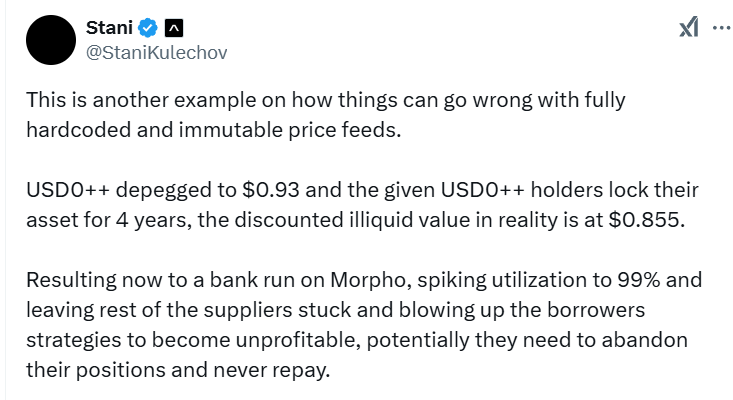
Source: Stani Kulechov

Curve Finance founder Michael Egorov offered insights into USD0++ mechanics, explaining its discount: USD0++ should likely have a discount. However, the change caught many off guard, and some protocols hardcoded price oracle for USD0++ to 1.0.

DeFi researcher Ignas raised concerns about governance, stating: Where was the DAO vote? The whitepaper specifies that the DAO reserves the authority to set this price floor. USUALx holders needed to vote on this.

The Usual Protocol Revenue Switch Activation signals a shift in how DeFi projects can stabilize their ecosystems. By sharing protocol earnings, Usual Protocol aims to restore trust and highlight the value of its ecosystem.

USD0, a stablecoin with a $1.57 billion market cap, is pegged to the US dollar and backed by real-world assets. Users can stake USD0 to convert it into USD0++, locking funds for four years and earning yields in the protocol’s native token, USUAL.

The team emphasized that the revenue switch is more than a temporary fix: Our revenue-sharing model demonstrates the income-generating potential of real-world asset backing. This is the future of stablecoins, Usual Protocol said in a statement.

New Mechanisms and Community Backlash

While the revenue switch offers a path to stability, the rapid introduction of dual exit mechanisms and floor price adjustments blindsided the community. Liquidations surged, and liquidity on platforms like Curve Finance took a hit.

In response to criticisms, Usual Protocol acknowledged the need for improved governance transparency.

Although these changes align with our vision, we regret any confusion caused and are committed to ensuring future updates are better communicated, the team shared in a follow-up post.

As the Usual Protocol Revenue Switch Activation takes effect, its success depends on community acceptance and market performance. The weekly distributions could help regain investor trust, but governance transparency and communication remain areas for improvement.

Michael Egorov emphasized the long-term nature of the changes: The introduction of 4-year Treasury backing is innovative but requires user education. The immediate impact is challenging, but the long-term outlook aligns with DeFi’s promise of sustainable income streams.

DeFi expert Ignas echoed the sentiment, urging users to focus on the protocol’s potential: While the rollout faced hurdles, the revenue-sharing model has merit. Usual Protocol could set a new standard for real-world asset integration in DeFi.

The Usual Protocol Revenue Switch Activation is a bold step toward stabilizing the ecosystem and restoring community trust. With weekly $5 million distributions and innovative exit mechanisms, the protocol aims to redefine stablecoin functionality. However, governance transparency and effective communication will be critical for long-term success.

As the revenue switch takes shape, all eyes are on Usual Protocol Revenue Switch Activation, to deliver on its promises while navigating the challenges of a dynamic DeFi landscape. Get more from The Bit Gazette

Share196Tweet123
Chinyere Onuoha

Chinyere Onuoha

Chinyere Onuoha is a seasoned crypto journalist and content writer with a robust background in Accounting. She has effectively combined her financial expertise with her passion for digital marketing and content creation. Her unique skill set allows her to craft insightful and accurate articles that resonate within the crypto community. As a digital marketer and content writer, she excels at breaking down complex concepts into engaging and informative content, making her a trusted voice in the rapidly evolving world of cryptocurrency journalism

  • Trending
  • Comments
  • Latest
AI People joins Dubai’s innovation one — Declares war on the forgetting of humanity

AI People joins Dubai’s Innovation One program: Declares war on the forgetting of humanity

07/22/2025 - Updated On 07/23/2025
FBI nabs Nigerian ‘tech queen’ Sapphire Egemasi in multi-million dollar fraud scheme

FBI arrests Nigerian ‘tech queen’ Sapphire Egemasi in $1.3M heist targeting U.S. government

06/05/2025 - Updated On 06/17/2025
Crypto investor and wife found dead in Dubai as police investigate possible link to digital assets

Crypto investor and wife found dead in Dubai as police investigate possible link to digital assets

11/08/2025
Polygon Discord Channel Hacked, Throws Crypto Community in Turmoil

Polygon Discord Channel Hacked, Throws Crypto Community in Turmoil

2
Bitcoin reclaims $107,000 as Iran-Israel ceasefire cools market tensions

Bitcoin reclaims $107,000 as Iran-Israel ceasefire cools market tensions

2

Hello world!

1
Trump to host exclusive gala dinner for Trump memecoin holders amid impeachment saga

Trump says he’ll review pardon for Samourai Wallet founder days before prison term

12/16/2025
Singapore Retail Crypto Market Enters New Phase of Stability and Confidence

StraitsX to bring Singapore dollar and US dollar stablecoins to Solana in 2026

12/16/2025
Wyoming Crypto Bank petition headlines a rapidly intensifying legal confrontation that could reshape how crypto banks access the U.S. financial system. Wyoming-chartered Custodia Bank has formally petitioned the full Tenth Circuit Court of Appeals to review the Federal Reserve’s denial of its master account, escalating a five-year fight with sweeping implications for federal power, state banking authority, and digital asset innovation. Wyoming Crypto Bank petition filings submitted on December 15 request an en banc review, asking all active judges on the Tenth Circuit to reconsider an October panel ruling that upheld the Fed’s decision. Custodia argues the panel misread federal law and endorsed a system that grants regional Federal Reserve Banks unchecked discretion over legally eligible state-chartered institutions. Wyoming Crypto Bank Petition Challenges Fed’s Master Account Authority At the heart of the Wyoming Crypto Bank petition is the Federal Reserve’s refusal to grant Custodia access to a master account—an essential gateway to core payment rails such as wire transfers and automated clearinghouse (ACH) services. Without it, Custodia says its Wyoming-issued charter is effectively rendered meaningless. Custodia contends the ruling conflicts directly with the Monetary Control Act (MCA), which states that Federal Reserve services shall be available to nonmember depository institutions. The bank argues the Fed has transformed that mandate into what it calls an unconstitutional veto over state banking decisions. When the Fed denies a master account to a state-chartered financial institution, it effectively vetoes a bank charter that State regulators have approved, Custodia wrote in its petition. State Banking Authority Under Threat The Wyoming Crypto Bank petition also raises serious federalism concerns. Wyoming chartered Custodia in 2020 as a Special Purpose Depository Institution (SPDI), a regulatory framework specifically designed to attract digital asset firms while minimizing systemic risk through 100% reserve backing and a prohibition on lending. Custodia argues the Fed’s rejection undermines Wyoming’s carefully constructed regulatory regime and erodes states’ constitutional authority to charter banks. The petition warns that allowing the Fed such power could discourage innovation-driven state banking models nationwide. Constitutional Red Flags in the Wyoming Crypto Bank Petition Beyond federalism, the Wyoming Crypto Bank petition pushes into constitutional territory. Custodia’s legal team argues that if regional Federal Reserve Bank presidents possess unreviewable discretion over master accounts, they effectively function as “Officers of the United States” without proper constitutional appointment. Federal Reserve Bank presidents are selected by private bank directors and approved by the Board of Governors. Custodia says that structure violates the Appointments Clause if those officials wield significant executive authority. Judicial Split Deepens Over Wyoming Crypto Bank Petition The petition highlights a growing divide within the Tenth Circuit itself. Judge Timothy Tymkovich’s dissent in Custodia’s case aligns with Judge Robert Bacharach’s earlier opinion in Fourth Corner Credit Union v. Federal Reserve Bank of Kansas City, creating a 2-2 split among circuit judges. Tymkovich warned that the Fed’s interpretation grants “unreviewable discretion” that contradicts the plain language of the MCA and raises “thorny questions” under Article II of the Constitution. Fed’s Own Records Undermine Denial Rationale The Wyoming Crypto Bank petition also points to contradictions within the Federal Reserve’s own process. The Kansas City Fed denied Custodia’s application in January 2023 after a 27-month review, citing risks tied to “crypto-asset activities.” Yet internal documents show Fed staff initially found Custodia’s capital levels “adequate” and praised its leadership as “impressive.” Custodia says the decision only shifted after intervention by the Board of Governors. Federal Reserve Governor Christopher Waller later acknowledged publicly that the Fed has sufficient supervisory tools to manage risk without blanket denials. In an October interview, Waller said the Fed can “tailor” master account structures to fit a bank’s specific risk profile. Wyoming Crypto Bank Petition Lands Amid Crypto Debanking Reckoning The Wyoming Crypto Bank petition arrives as regulators face mounting scrutiny over crypto debanking. In December, the Office of the Comptroller of the Currency revealed that all nine of the largest U.S. banks imposed “inappropriate” restrictions on lawful businesses, including digital asset firms, between 2020 and 2023. Institutions such as JPMorgan Chase, Bank of America, Citibank, and Wells Fargo maintained internal policies that escalated or restricted entire sectors, reinforcing claims of systemic exclusion. If the full Tenth Circuit agrees to hear the Wyoming Crypto Bank petition, the outcome could redefine the balance of power between state banking regulators and the Federal Reserve—setting a precedent that reaches far beyond Custodia and Wyoming. For the crypto industry, the case may determine whether compliance-focused digital asset banks can ever gain equal footing within the U.S. financial system.Wyoming Crypto Bank Petition Sparks High-Stakes Legal Showdown as Fed Power Faces Fierce Constitutional Test

Wyoming-chartered Custodia Bank challenges Federal Reserve’s master account veto power

12/16/2025
No Result
View All Result
  • Home
  • Crypto News
  • Expert Analysis
  • Finance
  • Tech
  • Sponsored
  • Press Release
  • Opinion

Copyright © 2025 - The Bit Gazette.

Are you sure want to unlock this post?
Unlock left : 0
Are you sure want to cancel subscription?