- Trending
- Comments
- Latest

A covered call is an options strategy that lets a cryptocurrency holder earn a premium by selling someone else the right to buy their asset at a fixed price, without giving up the asset unless that price is reached.
As crypto options markets on platforms like Deribit and OKX have grown, long-term holders of Bitcoin and Ethereum have increasingly used the approach to generate yield during flat or moderately bullish periods.
At its core, the covered call strategy involves holding a cryptocurrency while selling a call option tied to that same asset. This structure allows the investor to collect a premium upfront in exchange for giving another party the right to buy the asset at a predetermined price.
In crypto markets, the covered call strategy is commonly applied to assets like Bitcoin and Ethereum, where options markets are more liquid. The strategy is considered “covered” because the investor already owns the underlying asset, which reduces exposure compared to speculative options trading.
Executing a covered call strategy involves three key elements: the underlying asset, the strike price, and the expiration date. The investor selects a price level at which they are willing to sell the asset and then writes a call option at that level.
If the market price remains below the strike price, the option expires without being exercised, and the investor keeps both the premium and the asset. This outcome is typically the goal when using a covered call strategy in stable or mildly bullish conditions.
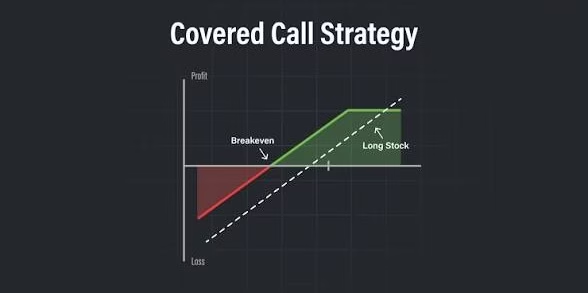
If the price rises above the strike price, the asset may be sold at that level. While this limits further upside, the investor still benefits from the price increase up to the strike price, in addition to the premium earned. This trade-off defines the risk-reward balance of the covered call strategy.
The covered call strategy is more relevant as the market matures and investors look for structured ways to generate yield. Long-term holders, in particular, are turning to the covered call strategy to earn returns during periods of low momentum.
Exchanges such as Deribit and OKX have expanded access to options trading, making it easier for retail and institutional users to deploy the covered call strategy at scale.
The growth of crypto derivatives markets has further supported adoption, with options volumes increasing as investors seek alternatives to spot trading.
The primary benefit of the covered call strategy is income generation. By collecting premiums, investors can create a steady return stream regardless of short-term price direction.
Another advantage is partial downside protection. The premium received can offset some losses if the asset declines in value, making the covered call strategy more resilient than a simple buy-and-hold approach in certain market conditions.
The covered call strategy also introduces discipline, as it requires investors to define exit levels in advance rather than reacting emotionally to market movements.
The most significant limitation of the covered call strategy is capped upside. If the asset experiences a strong rally, gains are limited to the strike price plus the premium, meaning investors may miss out on larger profits.

Liquidity and execution risks also play a role, particularly in less mature crypto options markets. Poor pricing or low demand can reduce the effectiveness of the covered call strategy.
Additionally, the strategy requires a clear understanding of market conditions. It tends to perform best in neutral or moderately bullish environments, but can underperform during strong upward trends.
Institutional interest in the covered call strategy is increasing as firms seek predictable yield in a volatile asset class.
Structured products built around the covered call strategy are becoming more common, offering investors packaged exposure with defined risk parameters.



Copyright © 2025 - The Bit Gazette.