







- Trending
- Comments
- Latest


Approximately 472 million XRP ($652 million) flowed onto Binance and other major exchanges on March 4, 2026, marking the largest monthly inflow on record and triggering warnings that the token could face sharp volatility in coming sessions.
The liquidity surge coincided with escalating U.S.-Iran tensions, prompting analysts to debate whether large holders are preparing to dump holdings or strategically repositioning capital ahead of potential geopolitical de-escalation.
The convergence of thin liquidity conditions, heightened geopolitical strain among the United States, Israel and Iran, and shifting on-chain behavior has placed the token at what some describe as a distribution-versus-repositioning crossroads.
At the center of the debate is whether the XRP Liquidity Overhang represents a quiet exit by large holders or a calculated rotation of capital ahead of renewed upside.
Market analyst Kaan Kaya argues that XRP’s current setup is being shaped less by internal fundamentals and more by global macroeconomic headwinds. He describes the environment as a classic “distribution vs. repositioning” battle.
“XRP is entering a decisive phase driven more by escalating global macro pressures than by its own fundamentals,” — Kaan Kaya, Market Analyst.
Kaya warns that rapidly shifting liquidity conditions could trigger sharp volatility, particularly as crypto assets continue to function as high-beta proxies for broader risk sentiment. In periods of geopolitical stress, digital assets often react swiftly to headlines, amplifying price swings.
The emerging XRP Liquidity Overhang comes against a backdrop of rising geopolitical tensions involving Washington, Tel Aviv and Tehran. These developments have unsettled traditional equity markets and, by extension, digital assets. On-chain data shows XRP holders increasingly shifting toward defensive positioning, reflecting caution amid uncertainty.
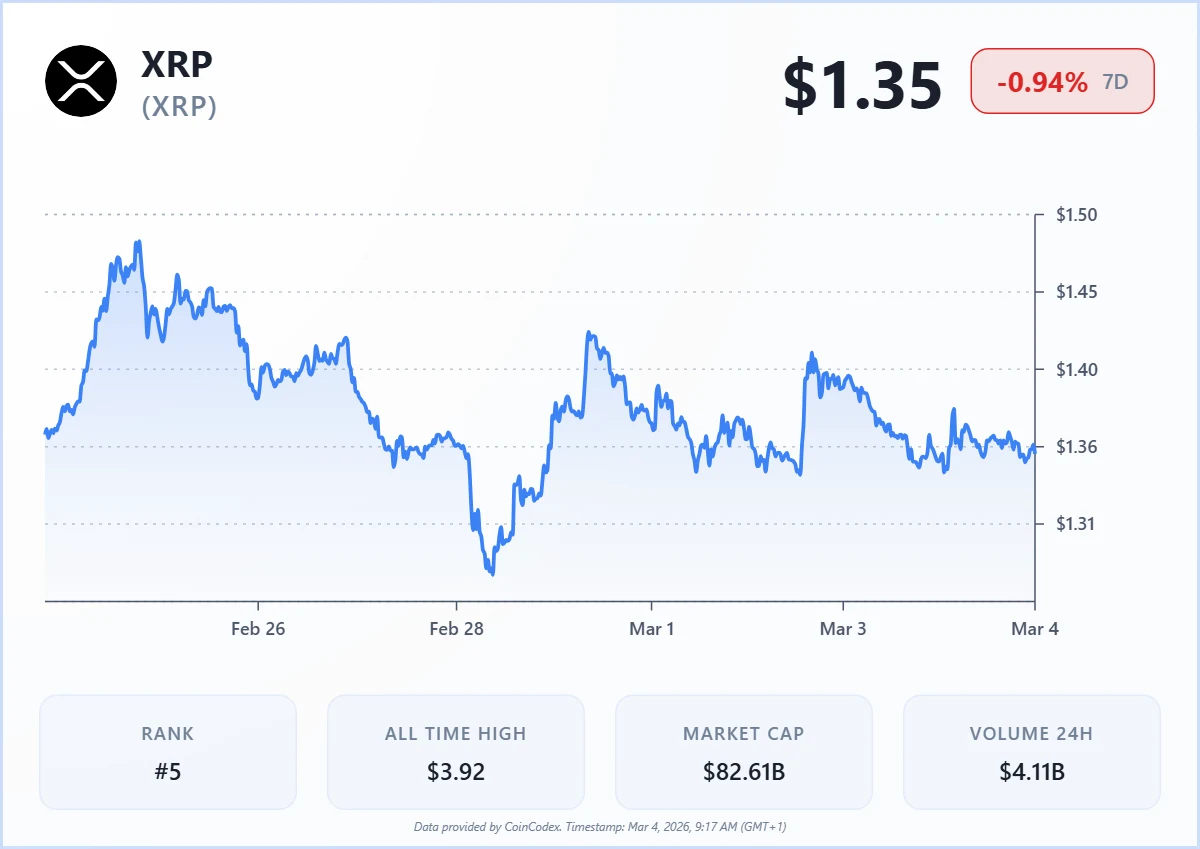
Despite these pressures, XRP has shown resilience. The asset has rebounded steadily in recent sessions, forming higher highs and higher lows — a technically constructive pattern that suggests underlying demand remains intact even as the XRP Liquidity Overhang narrative gains traction.
The most striking development underpinning the XRP Liquidity Overhang is the spike in exchange inflows. Approximately 472 million XRP moved onto Binance in February, marking the largest inflow trend for that month on record.
While exchange inflows do not automatically signal an impending sell-off, they increase the probability of discretionary selling. By placing large token volumes directly on trading platforms, holders make supply immediately accessible to the market. In fragile macro conditions, that accessible liquidity can amplify volatility.
In a risk-off environment, elevated exchange balances can weigh on sentiment, reinforcing the perception of an XRP Liquidity Overhang even if outright distribution has not yet materialized. The distinction between strategic repositioning and broad de-risking remains critical.
Currently, XRP is holding near the $1.35 level, according to CoinCodex data cited in the report. However, with substantial liquidity parked on exchanges, traders are closely monitoring whether the token can maintain support or if the overhang begins to pressure price action.
Adding context to the XRP Liquidity Overhang discussion, market analyst Darkfost pointed to the timing of the transfers. The surge in exchange inflows occurred shortly after traditional equity markets closed — a window when crypto liquidity typically thins and retail participation tends to dominate flows.
“The surge hit just after traditional equity markets closed, a window when crypto liquidity typically thins and retail traders dominate flows,” — Darkfost, Market Analyst.
In these off-hours conditions, even modest macro headlines can trigger outsized reactions. Crypto markets frequently serve as an early pressure valve for rapid risk-off positioning, meaning liquidity placement becomes especially consequential.
Under stable conditions, abundant liquidity can tighten spreads and enhance price discovery. But in stressed environments, the same liquidity can accelerate downside momentum if sentiment shifts abruptly. That dynamic sits at the heart of the XRP Liquidity Overhang concern: supply concentration on exchanges during uncertain macro cycles can act as a volatility catalyst.
Still, the situation has not been confirmed as a full-scale distribution event. If the recent inflows represent strategic repositioning, XRP could remain range-bound while traders recalibrate exposure. If, however, large holders are actively reducing risk, the overhang could exert sustained downward pressure.
Even as the XRP Liquidity Overhang narrative intensifies, XRP’s structural integrity remains part of the broader conversation. Ripple’s chief technology officer has reiterated that all XRP transactions are fully immutable and cannot be blocked by any party, reinforcing confidence in the network’s underlying mechanics.
For now, XRP appears to be behaving as a macro-sensitive asset, responding quickly to global developments rather than purely ecosystem-specific catalysts. With the token hovering around $1.35, the coming sessions may prove pivotal.
If geopolitical tensions ease and broader risk appetite returns, the liquidity currently sitting on exchanges could fuel sharp rebounds as sidelined capital re-engages. Conversely, renewed instability could magnify downside momentum, validating concerns around the XRP Liquidity Overhang.
The key takeaway is that in today’s macro-driven environment, where liquidity sits can matter as much as how much exists. XRP now stands at the center of that test, as traders determine whether the present setup signals strategic positioning for opportunity — or the early stages of broader distribution.



Copyright © 2025 - The Bit Gazette.

