


- Trending
- Comments
- Latest

Bitcoin’s mining difficulty fell 7.7% to 133.79 trillion on March 20, marking one of the steepest declines in recent months as slowing block production and increased operational pressures prompt miners to reduce network participation.
The adjustment reflects a structural shift: rising energy costs and competition from artificial intelligence infrastructure are forcing major mining firms to reallocate computing resources away from Bitcoin.
The latest drop in Bitcoin mining difficulty follows a period of slower-than-expected block production.
Over the previous 2,016 blocks, average block times reached approximately 12 minutes and 36 seconds, significantly above the protocol’s 10-minute target.
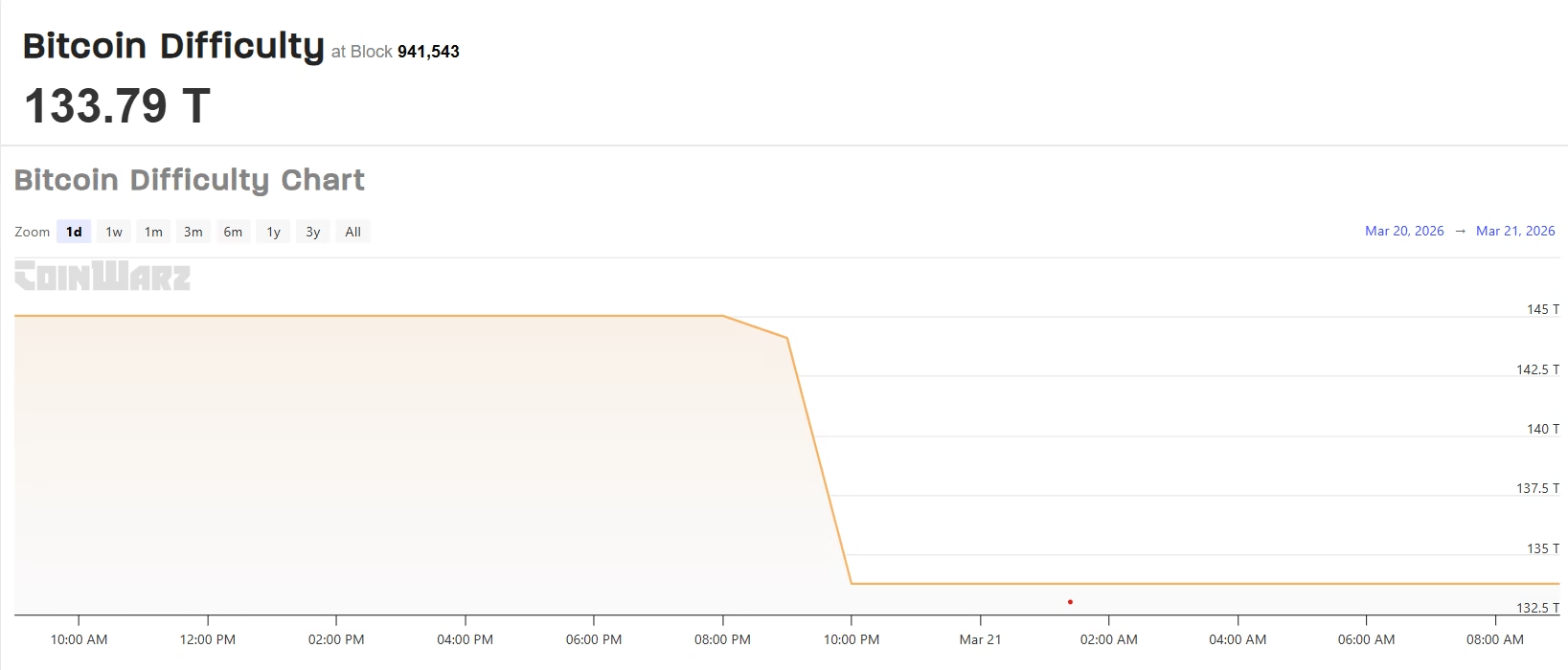
Bitcoin’s self-adjusting mechanism ensures consistent issuance by recalibrating Bitcoin mining difficulty based on total network hashrate.
When block times exceed the target, difficulty decreases, making it easier for miners to find valid hashes and restore equilibrium.
“Bitcoin’s difficulty adjusts automatically to maintain a steady block interval,” — Network protocol documentation, Bitcoin core design principles.
This dynamic ensures that despite fluctuations in participation, the network continues to produce blocks at a predictable rate.
The next Bitcoin mining difficulty adjustment is projected for early April, though estimates remain fluid as new blocks are added.
Fluctuations in Bitcoin mining difficulty often correlate with changes in network hashrate.
Earlier in February, extreme weather conditions in the United States forced several large mining facilities offline, causing a temporary drop in hashrate and a corresponding decline in difficulty.
As power conditions normalized, miners returned to the network, pushing Bitcoin mining difficulty back up by roughly 15% before the recent correction.
These cyclical movements highlight the sensitivity of mining operations to external factors such as energy availability and infrastructure stability.
“When more computing power joins the network, difficulty rises; when it falls, difficulty adjusts downward,” — Industry explanation, mining network mechanics.
The latest decline suggests a temporary reduction in active hashrate, potentially linked to profitability pressures and operational adjustments across the mining sector.
Beyond short-term fluctuations, the Bitcoin mining difficulty trend reflects a broader structural shift in the industry.
Increasing energy costs and competition for computing resources are prompting miners to explore alternative revenue streams, particularly in artificial intelligence and high-performance computing.
Major mining firms such as Core Scientific, MARA Holdings, Hut 8, and Cipher Mining have begun reallocating infrastructure to support AI workloads, which often offer more predictable returns than traditional mining.
Crypto trader Ran Neuner highlighted the growing competition, stating, “AI has become Bitcoin mining’s biggest competitor as both industries compete for electricity.”
This shift underscores a critical challenge: as AI demand for power-intensive data centers rises, Bitcoin miners face increasing pressure on margins, influencing participation rates and, consequently, Bitcoin mining difficulty levels.
The current environment has also prompted some miners to adjust financial strategies. Bitdeer, for instance, recently liquidated 943 BTC and reduced its corporate holdings to zero, signaling a more conservative approach amid uncertain profitability conditions.
Such decisions reflect broader industry caution, as miners navigate volatile Bitcoin prices, energy costs, and competition from alternative computing sectors.
While lower Bitcoin mining difficulty can temporarily improve margins, long-term sustainability increasingly depends on diversification and operational efficiency.
Looking ahead, Bitcoin mining difficulty will continue to serve as a key indicator of network health and miner participation.
Short-term declines may provide relief, but the underlying trends rising energy costs, infrastructure competition, and technological shifts suggest a more complex future for the sector.
“The system will continue to adjust based on participation, ensuring stability regardless of external pressures,” — Bitcoin network design principle.
For investors and industry participants, monitoring Bitcoin mining difficulty offers valuable insight into the balance between supply-side economics and network security.
As miners adapt to evolving conditions, the interplay between hashrate, energy markets, and emerging technologies like AI will shape the next phase of Bitcoin’s development.
In conclusion, the recent drop in Bitcoin mining difficulty highlights both immediate operational relief and deeper structural changes within the mining ecosystem.
While the adjustment restores short-term balance, it also signals a transition as miners rethink strategies in an increasingly competitive and resource-constrained environment.



Copyright © 2025 - The Bit Gazette.