


- Trending
- Comments
- Latest

On February 4, 2026, a property deed in Saudi Arabia changed hands in seconds rather than days. The transaction was not a startup experiment or a speculative crypto pilot. It was executed by droppRWA, chaired by the architect behind the kingdom’s national digital payments system.
That single transfer signaled something much larger: Saudi Arabia is moving major parts of its economy onto blockchain rails as part of a sovereign infrastructure strategy tied to Vision 2030.
The kingdom’s sovereign wealth engine, the Public Investment Fund (PIF), which manages roughly $1 trillion in assets, has reportedly positioned tokenization as a key pillar of its 2026–2030 modernization agenda. Saudi Arabia’s digital economy reached approximately SAR 495 billion ($132 billion) in 2025, accounting for roughly 15% of GDP.
Unlike retail-driven crypto hubs or Bitcoin adoption experiments, Saudi Arabia’s model is institution-first, registry-backed, and state-aligned. The strategy focuses on tokenizing real estate, energy infrastructure, manufacturing assets, and capital markets to create faster, programmable, and more resilient financial systems.
| Key metric | Value |
|---|---|
| PIF assets under management | ~$1 trillion |
| Saudi digital economy (2025) | $132 billion |
| droppRWA tokenization mandates | $12.5 billion |
| Blockchain company registrations (2025) | 4,000+ |
| Growth in blockchain registrations | 51% YoY |
| Estimated active crypto investors | ~3 million |
| Crypto transaction volume (2023–2024) | $48 billion |
| Global tokenized U.S. Treasuries (May 2026) | $15.5 billion |
| Global tokenized RWA market | ~$25 billion |
To understand Saudi Arabia’s on-chain ambitions, attention inevitably turns to Faisal Monai.
Monai designed SADAD, the Saudi Central Bank’s digital bill payment network launched in 2004. Before its rollout, most utility and bill payments in the kingdom were still handled physically with cash transactions at bank branches. SADAD digitized that process by creating a unified payment pipeline between banks and billers across the country.
By 2025, the system had reportedly processed more than 14.5 billion transactions worth roughly $250 billion.
Monai now chairs droppRWA, which says it has secured approximately $12.5 billion in mandates to tokenize real-world assets across real estate, manufacturing, and energy sectors.
His vision is direct:
“By 2030, Saudi Arabia will have demonstrated something the rest of the world is still debating: that sovereign-grade tokenization can function as core national financial infrastructure.”
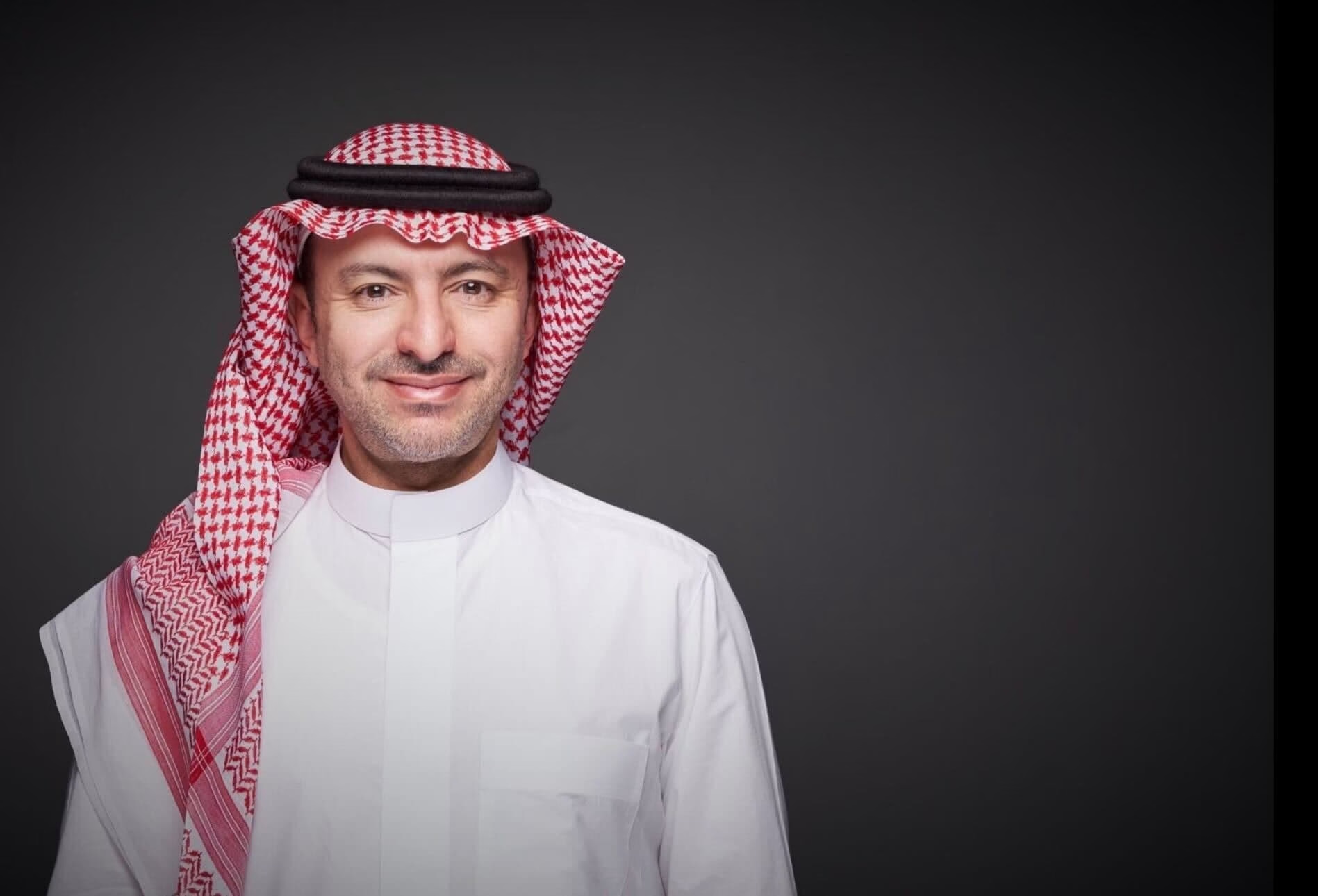
Unlike many blockchain evangelists, Monai enters the conversation with institutional credibility rooted in building national-scale financial systems rather than speculative crypto ventures.
On February 4, 2026, droppRWA completed what it described as the world’s first tokenized property deed transaction.
The transfer reduced settlement times from days to seconds, demonstrating how blockchain infrastructure can eliminate manual reconciliation processes, title verification delays, and escrow bottlenecks that traditionally slow property transfers.
Following the pilot, Monai confirmed the infrastructure would be expanded across Saudi Arabia’s multi-trillion-dollar real estate development pipeline, including designated investment zones.
The broader implication is significant: ownership records become programmable, instantly transferable, and verifiable on-chain without relying entirely on layers of intermediaries.
Stablecoin-based real estate settlement is also expected to launch in Saudi Arabia by late 2026 under coordination between the Saudi Central Bank (SAMA) and the Capital Market Authority (CMA).
If fully implemented, developers and institutional investors could move capital into Saudi real estate markets in minutes instead of waiting days for conventional settlement rails.
Real estate appears to be only the beginning.
Saudi Arabia’s broader tokenization strategy includes expansion into energy infrastructure, manufacturing assets, and carbon credit markets. In January 2026, the kingdom launched the Open World RWA Tokenization Center of Excellence in Al Khobar, described as Saudi Arabia’s first licensed tokenization center.
The initiative focuses on three sectors:
| Sector | Application |
|---|---|
| Energy infrastructure | Tokenized access to capital markets |
| Real estate development | Fractional ownership and liquidity |
| Carbon reduction credits | On-chain verification and trading |
The location is strategic. Al Khobar sits within Saudi Arabia’s Eastern Province, home to major energy infrastructure and the headquarters ecosystem surrounding Saudi Aramco.
The tokenization strategy aligns closely with Vision 2030’s broader objective of diversifying the Saudi economy beyond hydrocarbon dependency while modernizing financial infrastructure.
Reports also indicate Saudi regulators are exploring pathways for on-chain sukuk issuance, potentially enabling 24/7 trading and programmable compliance mechanisms for Islamic finance products.
Saudi Arabia’s tokenization ambitions require global institutional participation, and the kingdom has already started opening those channels.
On February 1, 2026, the Tadawul Main Market officially opened to all foreign investors, broadening access to Saudi equities, bonds, and potentially future tokenized financial products.
At the same time, regulators are reportedly considering frameworks for Bitcoin and Ether ETFs with enhanced settlement capabilities and fractional ownership structures.
The country’s blockchain ecosystem is already growing rapidly:
These figures position Saudi Arabia as one of the Middle East’s fastest-growing digital asset markets.
The strategic logic behind Saudi Arabia’s blockchain push is not primarily speculative. It is geopolitical and infrastructural.
According to Monai, tokenization provides resilience during periods of market instability by improving certainty around ownership, transfer, collateralization, and settlement.
“When markets are calm, tokenization improves efficiency. When markets are under stress, it can become a safety layer.”
The argument gained attention amid geopolitical tensions in the Middle East, where traditional markets periodically close while digital asset markets continue operating around the clock.
Saudi Arabia is not attempting to replace the U.S. dollar. Instead, officials and industry participants increasingly describe a “multi-rail” financial architecture where blockchain-based settlement systems operate alongside existing dollar-denominated infrastructure.
This creates optionality without requiring a full monetary realignment.
Saudi Arabia does not currently operate under a single unified “crypto law.” Instead, regulators apply what legal analysts describe as an activity-based framework.
Oversight is distributed across several institutions:
| Regulatory area | Regulator | Primary focus |
|---|---|---|
| Markets and investor protection | CMA | Issuance, trading, disclosure |
| Payments and settlement | SAMA | Clearing and payment systems |
| Cybersecurity and infrastructure | CST / NCA | Hosting, compliance, data governance |
Key legal frameworks include:
This structure allows Saudi Arabia to avoid retail-focused crypto speculation while creating controlled pathways for institutional-grade tokenization.
Compliance, auditability, sanctions screening, and cybersecurity are treated as foundational infrastructure requirements rather than secondary considerations.
Saudi Arabia’s banking sector is also moving deeper into blockchain experimentation.
In January 2026, Ripple signed an MoU with Jeel, the innovation arm of Riyad Bank.
The partnership focuses on:
The initiative is designed to test blockchain-based financial services within controlled regulatory environments while aligning with Saudi compliance standards.
Ripple executives described Saudi Arabia as an increasingly important hub for digital financial infrastructure in the Middle East and North Africa region.
Underpinning Saudi Arabia’s strategy is a concept often described as “sovereign compute” — the ability to run critical blockchain infrastructure within national borders under domestic regulatory controls.
Rather than relying solely on open public blockchain systems, Saudi initiatives are increasingly focused on permissioned and auditable infrastructure with:
This represents a fundamentally different philosophy from early crypto ideology.
Saudi Arabia’s model is not crypto-anarchism. It is state-aligned programmable finance designed to function inside national legal and regulatory systems.
Saudi Arabia’s push comes as global real-world asset tokenization accelerates rapidly.
By May 2026:
Major financial institutions including JPMorgan Chase and BlackRock have already expanded blockchain-based financial infrastructure efforts.
Saudi Arabia’s distinction lies in scale and integration. Rather than launching isolated products, the kingdom is attempting to build sovereign-level financial rails connected directly to official registries and national infrastructure.
Saudi Arabia’s roadmap is already taking shape.
| Milestone | Timeline | Status |
|---|---|---|
| Tokenized property deed pilot | February 2026 | Completed |
| Tadawul market opening | February 2026 | Completed |
| RWA Center of Excellence launch | January 2026 | Completed |
| Energy and real estate pilots | Mid-2026 | In progress |
| Stablecoin real estate settlement | Late 2026 | Expected |
| Sovereign tokenization infrastructure | By 2030 | In development |
By the end of the decade, Saudi Arabia aims to position itself as one of the first nations to operationalize blockchain infrastructure at sovereign scale.
Saudi Arabia’s tokenization strategy is ultimately about resilience, efficiency, and strategic control.
The kingdom is not abandoning traditional finance or replacing dollar-based systems. Instead, it is constructing parallel settlement infrastructure capable of operating continuously, reducing friction, and increasing certainty during periods of volatility.
Property deeds settling in seconds rather than days are only the visible surface of a much broader transformation.
While much of the world continues debating whether tokenization can function at sovereign scale, Saudi Arabia is already attempting to build the infrastructure to prove that it can.
The February 2026 property deed transfer was not merely a pilot. It was a signal that one of the world’s largest sovereign economies intends to move significant portions of its financial architecture on-chain.



Copyright © 2025 - The Bit Gazette.