


- Trending
- Comments
- Latest

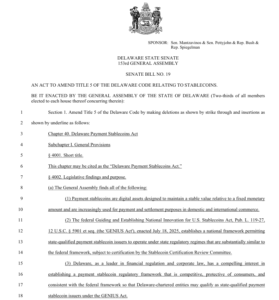
Delaware lawmakers have introduced legislation that would classify stablecoin issuers as banking entities, requiring them to obtain licenses, maintain full reserves, and comply with traditional banking oversight.
The bill, introduced in early 2026, targets rapid stablecoin growth and regulatory concerns about financial stability—and could become a model for other states navigating digital asset regulation.
The bill targets stablecoins, cryptocurrencies pegged to fiat currencies like the U.S. dollar—amid growing concerns about financial stability, transparency, and systemic risk.
If passed, Delaware would become one of the first U.S. states to explicitly regulate stablecoin issuance through banking laws rather than treating them purely as digital assets.
The legislation comes at a time when policymakers across the country are debating how best to regulate stablecoins, which have grown rapidly in both usage and market capitalization.
At the core of the bill is a requirement that stablecoin issuers operating in Delaware obtain banking licenses or partner with regulated financial institutions.
This would effectively place them under the supervision of state banking regulators, aligning their operations more closely with traditional financial institutions.
The bill also includes provisions requiring issuers to maintain full reserves backing their tokens, undergo regular audits, and comply with anti-money laundering (AML) standards.
These measures are designed to ensure that stablecoins remain redeemable and do not pose risks to consumers or the broader financial system.
According to lawmakers, the goal is not to stifle innovation but to provide clarity and trust in a rapidly evolving sector.
“Establishing clear rules for stablecoin issuers is essential to protect consumers and maintain confidence in digital financial systems.”
Delaware state legislator, bill sponsor.
Stablecoins have become a critical part of the cryptocurrency ecosystem, facilitating trading, cross-border payments, and decentralized finance (DeFi). However, their rapid growth has also raised alarms among regulators.
Institutions such as the International Monetary Fund and the Federal Reserve have warned that poorly regulated stablecoins could threaten financial stability, particularly if issuers lack sufficient reserves or transparency.
A key concern is the risk of a “run” on stablecoins, similar to bank runs, where users rush to redeem their tokens, potentially exposing liquidity gaps.
“Stablecoins must be subject to robust oversight to ensure they do not undermine financial stability.”
IMF spokesperson said in a policy briefing.
The collapse of certain algorithmic stablecoins in recent years has further intensified calls for regulation, highlighting the need for stronger safeguards.
The proposed Delaware bill has drawn mixed reactions from the crypto industry. Some stakeholders view it as a positive step toward legitimacy, while others worry about increased compliance costs and regulatory fragmentation across states.
Supporters argue that clearer rules could attract institutional investors and encourage responsible innovation.
Critics, however, caution that a state-by-state approach could create inconsistencies, complicating operations for companies that operate nationwide.
They advocate for a unified federal framework to avoid regulatory arbitrage and ensure consistency.
The bill also raises questions about how it will interact with potential federal legislation on stablecoins, which has been under discussion in Congress.
If multiple states adopt similar measures, it could accelerate federal action or create a patchwork of rules that companies must navigate.
Delaware’s initiative could serve as a model for other states exploring how to regulate digital assets within existing financial systems.
Known for its business-friendly legal environment, the state has historically played a significant role in shaping corporate law in the United States.
If successful, the bill could establish a precedent for integrating stablecoins into traditional banking frameworks, bridging the gap between crypto innovation and financial regulation.
The key challenge will be balancing innovation with risk management, ensuring that stablecoins can continue to evolve while safeguarding consumers and the financial system.



Copyright © 2025 - The Bit Gazette.