


- Trending
- Comments
- Latest

Distributed ledgers are reshaping more than just cryptocurrency, they’re being deployed in voting systems, land registries, and supply chains worldwide. At their core, they’re shared databases where every participant holds an identical copy of records, eliminating the need for a central authority to verify transactions.
Unlike traditional systems controlled by a central authority, Distributed Ledger Technology operates on a decentralized network. This means no single institution owns or controls the data, making it fundamentally different from how banks or corporations manage records today.
Distributed Ledger Technology enables participants to record, share, and synchronize transactions in real time without relying on intermediaries. That shift is exactly why it has become a foundational innovation in crypto.
To understand Distributed Ledger Technology, think of a system where multiple computers—called nodes maintain the same record simultaneously. Each node independently verifies transactions and updates the ledger once consensus is reached.
This consensus mechanism is critical. Instead of trusting a central authority, Distributed Ledger Technology relies on agreement across the network to validate transactions.
Security is another key feature. Distributed Ledger Technology uses cryptographic techniques like digital signatures and hashing to ensure data integrity and authenticity.
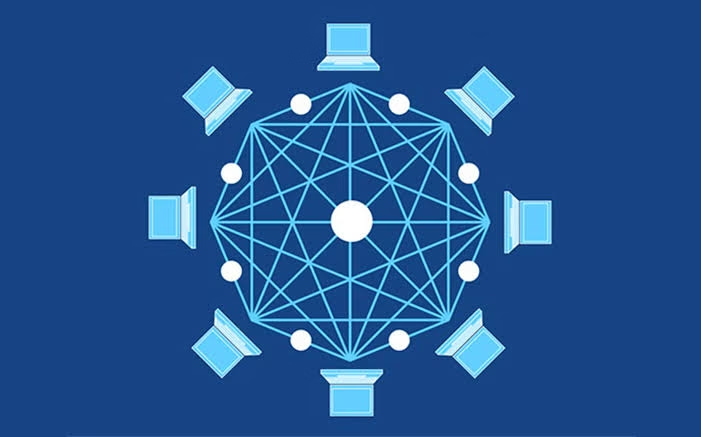
Once information is recorded, it becomes extremely difficult to alter, creating what experts call an “immutable” record. That’s one of the biggest reasons Distributed Ledger Technology is trusted in high-stakes environments.
A common misconception is that blockchain and Distributed Ledger Technology are the same thing. They’re not.
Blockchain is simply one type of Distributed Ledger Technology. It organizes data into blocks that are linked together chronologically.
However, Distributed Ledger Technology includes other structures beyond blockchain, such as directed acyclic graphs (DAGs) and other architectures.
This distinction matters because it shows that Distributed Ledger Technology is a broader category one that continues to evolve beyond traditional blockchain systems.
Distributed Ledger Technology is transforming how data is stored, verified, and shared. Traditional systems often suffer from inefficiencies, duplication, and vulnerability to tampering.
With Distributed Ledger Technology, records are synchronized across all participants in real time, reducing errors and eliminating the need for reconciliation between different databases.
It also enhances transparency. Every participant can view the same data, which builds trust without requiring intermediaries.

In financial systems, Distributed Ledger Technology enables faster transactions, lower costs, and improved security. Beyond finance, it is being explored in supply chains, healthcare, voting systems, and identity management.
Distributed Ledger Technology is already being deployed across multiple industries.
In crypto, Distributed Ledger Technology powers networks like Bitcoin and Ethereum, enabling peer-to-peer transactions without banks.
In supply chains, it helps track goods from origin to destination, ensuring authenticity and reducing fraud.
Governments are exploring Distributed Ledger Technology for land registries, digital identity systems, and even voting mechanisms.
These applications highlight how Distributed Ledger Technology is moving from theory to real-world impact.
The advantages of Distributed Ledger Technology are clear: decentralization, transparency, security, and efficiency.
But it’s not perfect.
Distributed Ledger Technology can face scalability challenges, especially in public networks where transaction volumes are high. It also requires significant computational resources in some implementations, particularly those using proof-of-work systems.
Regulation is another hurdle. As Distributed Ledger Technology reshapes industries, legal frameworks are still catching up.
Industry leaders consistently point to Distributed Ledger Technology as a transformative force.
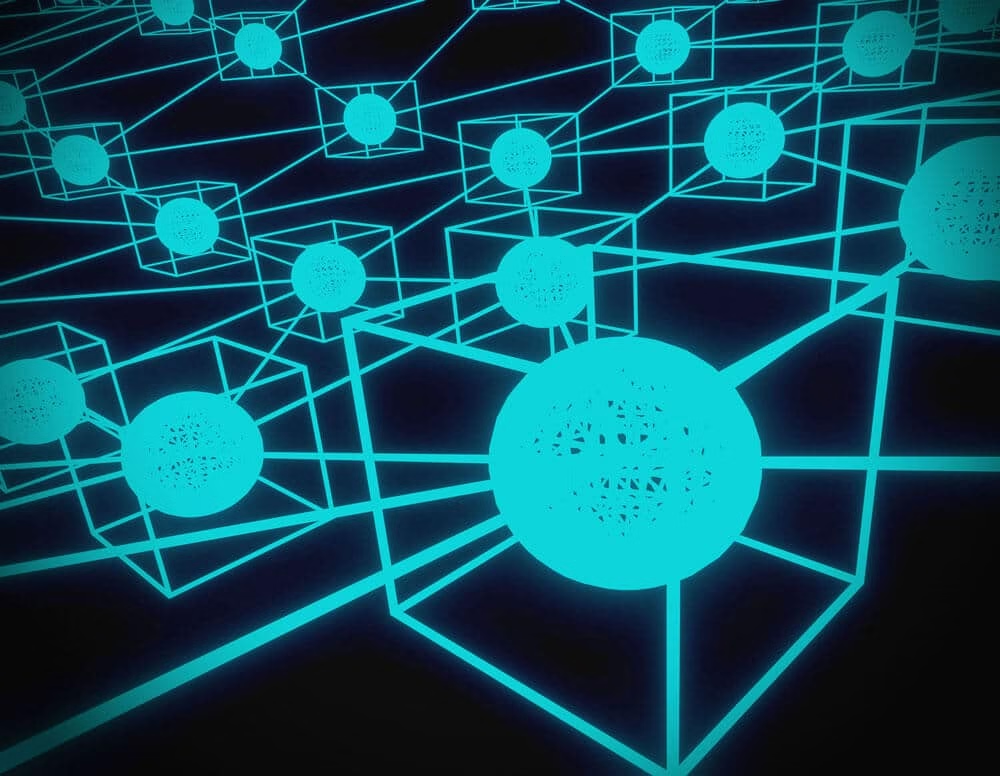
As noted by technology analysts, decentralized systems reduce reliance on intermediaries and improve trust between participants two factors that are critical in global financial systems.
However, experts also caution that adoption depends on usability, regulation, and integration with existing infrastructure.
Distributed Ledger Technology is more than just the engine behind crypto—it’s a shift in how the world thinks about trust, data, and ownership.
As adoption grows, Distributed Ledger Technology is expected to play a central role in the evolution of Web3, digital finance, and global data systems.



Copyright © 2025 - The Bit Gazette.